
Native across much of southern Africa in ponds, lakes, slow rivers, canals and temporary waters, tolerating turbid and variable conditions. Research, pet and release pathways have introduced it to the Americas, Europe and elsewhere, creating invasive populations in some regions. [1,2,4]
Snout-to-vent length is commonly about 5–12 cm; females are larger and can be substantially heavier than males. The body is flattened with a low head and powerful hind limbs; adults lack a tail while tadpoles have a long swimming tail. [1–3]
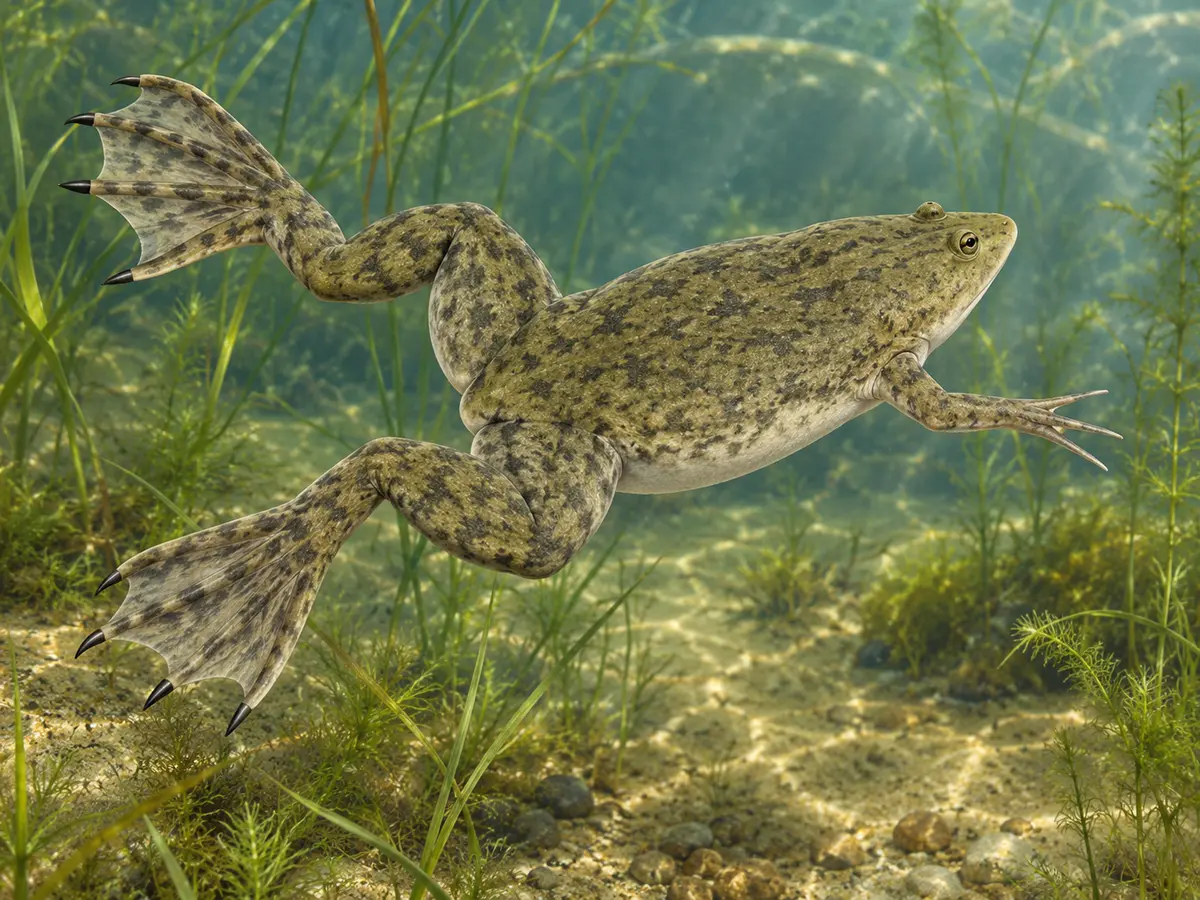
Smooth olive, grey-brown or mottled skin contrasts with a pale belly; small eyes sit dorsally and a visible lateral-line system runs along the sides. Hind feet are fully webbed with dark claws on the inner three toes; small unwebbed forefingers manipulate food. [1–3]
A flattened body and powerful webbed feet generate thrust, while upward-facing eyes and nostrils allow seeing and breathing with most of the body submerged. The lateral line compensates in turbid water; temporary drought tolerance helps establishment beyond the native range. [1–3]
Behaviour and ecology
Spends most time on the bottom or swimming, surfacing to breathe with lungs; the lateral line detects vibration and prey movement. When water dries it may bury in mud and reduce activity, and in moist conditions can move short distances overland to reach water. [1–3]
Diet
An opportunistic feeder on crustaceans, aquatic insects and larvae, worms, molluscs, small fish and amphibians, eggs and carrion. The mouth creates suction and the forelimbs push prey inward because the species lacks a tongue; smaller conspecifics may be eaten. [1–3]
Reproduction and life cycle
Fertilisation is external in water; the male clasps the female and eggs are released in repeated bouts, totalling hundreds or thousands depending on the individual. Tadpoles filter suspended particles before metamorphosing; development rate depends strongly on temperature and food. [1–3]
Ecosystem role
Acts as both benthic predator and scavenger, transferring invertebrate production to fish, birds and larger predators. Outside the native range, dense populations can compete with and prey upon native amphibians, so release is unacceptable. [1,2,4]
Threats & conservation
The species is not globally threatened, though native populations still face pollution and wetland change; where introduced, the frog itself is an ecological risk. Xenopus is documented as a possible chytrid carrier without severe signs; DinoJura needs closed containment, quarantine, vet-directed testing and a no-escape/no-release plan. [1,4]
A CITES amphibian-trade report cites the 2016 IUCN assessment as Least Concern (LC) with an increasing trend. Xenopus laevis is not listed in the CITES Appendices effective 5 March 2026; invasive-species, welfare, quarantine, transport and research-permit rules still apply locally. [1,4,5]5 sourced facts
Species in five facts
Three inner hind toes bear black claws. [1–3]
It lacks a tongue and uses the forelimbs to push food into the mouth. [2,3]
A lateral-line system detects movement in water. [1,2]
Xenopus eggs and embryos are major models in developmental biology. [1,3]
The species is not listed in the current CITES Appendices. [4,5]
Sources
[1] AmphibiaWeb — Xenopus laevis[2] Animal Diversity Web — Xenopus laevis[3] Smithsonian's National Zoo — African clawed frog[4] U.S. National Invasive Species Information Center — African clawed frog[5] CITES — International trade in amphibians reportCITES Appendices effective 5 March 2026