
Deserts and semi-deserts of North Africa, from the Sahara east to the Sinai Peninsula, especially where soils permit burrow systems.
Body length is roughly 24–41 cm, tail 18–31 cm, and mass often around 1–1.5 kg. Ears may approach 10–15 cm.
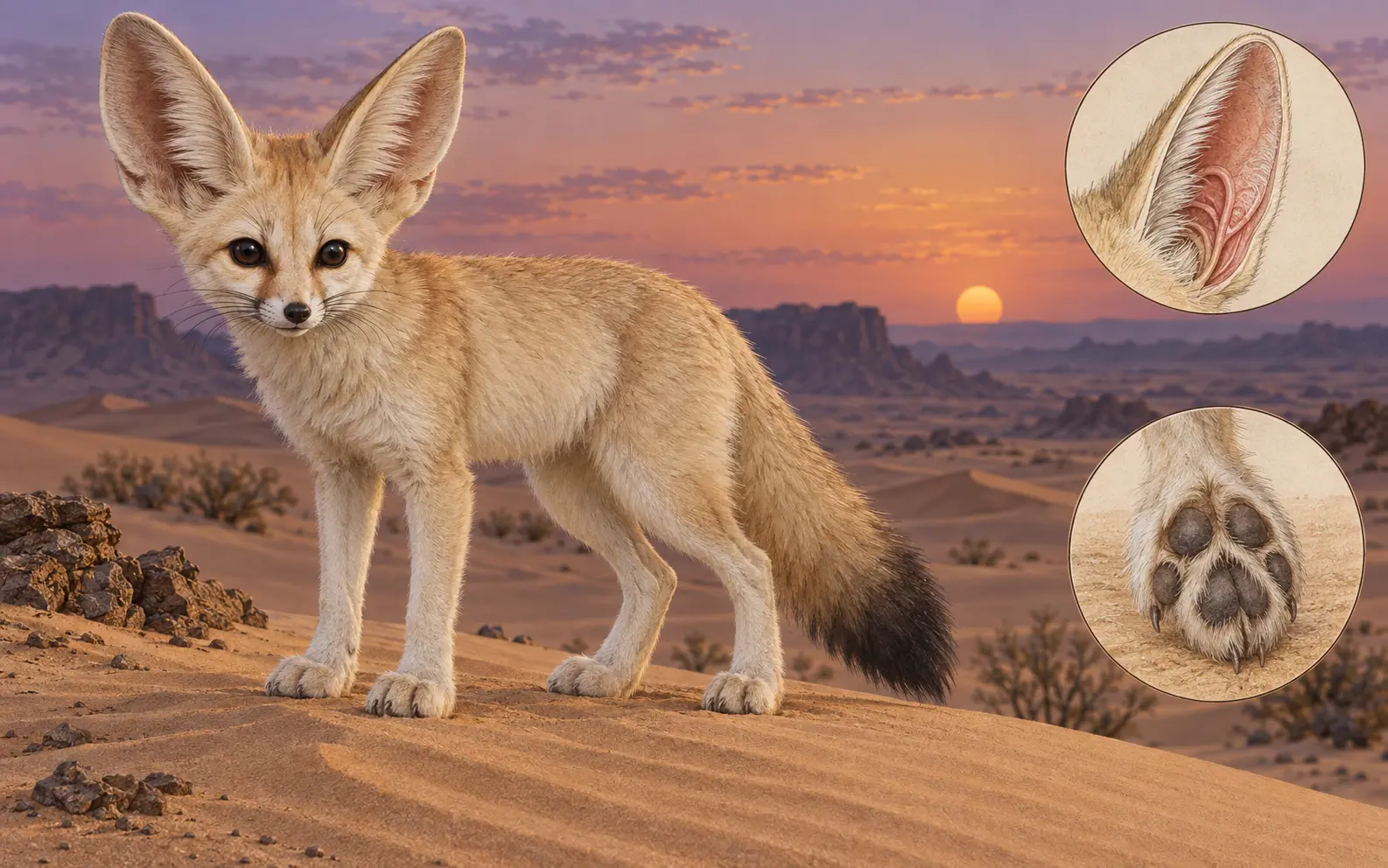
Disproportionately large ears, pointed muzzle, cream-buff coat, pale underside and bushy tail often with a dark tip. Dense fur covers the feet for hot sand.
Large ears aid heat loss and detection of prey under sand; efficient kidneys conserve water, pale fur reflects radiation and furry feet insulate against hot substrate.
Behaviour and ecology
Mainly nocturnal and shelters in burrows by day. Family groups are social, communicating through vocalisations, scent and contact.
Diet
An opportunistic omnivore taking insects, small rodents, reptiles, birds, eggs, fruit and roots. Metabolic water and food moisture support survival where free water is scarce.
Reproduction and life cycle
Usually seasonal, with gestation around 50 days and a small litter born in a den. Kits are blind at birth and receive protection and food from the parents.
Ecosystem role
Predates small animals and insects, disperses some seeds from fruit, and modifies desert microhabitats through burrowing.
Threats & conservation
IUCN lists the species as LC, though population data remain limited in many areas. Trapping, trade and habitat degradation can exert local pressure; CITES Appendix II regulates international trade.
IUCN/CITES status was checked on the profile date; re-verify before any legal or transaction decision.5 sourced facts
Species in five facts
The name “fennec” is linked to the Arabic word for fox.
It is the smallest living member of the dog family.
The ears function in both heat loss and directional hearing.
Fur on the soles insulates and improves traction on sand.
It can meet much of its water requirement through food and metabolism.
Sources
Smithsonian's National Zoo — Fennec foxIUCN Red List searchCITES Checklist