
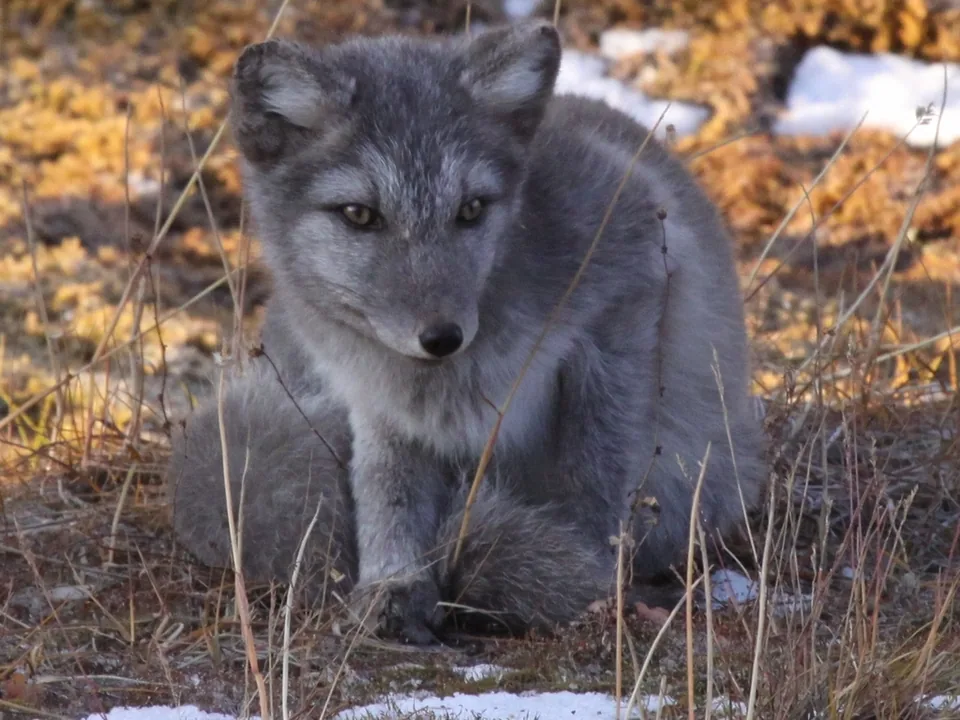
Occurs across treeless tundra in North America, Greenland, Iceland, Scandinavia, Russia and many Arctic islands, commonly using coasts and alpine tundra. [1,2]
NPS reports an average length near 109 cm including a roughly 38 cm tail and mass up to about 4.5 kg for the described Alaskan population; ADW gives a 5.2 kg mean from another dataset. [1,2]
Small rounded ears, short muzzle, bushy tail and furred soles. The white morph shifts from winter white to summer brown-grey; the blue morph remains blue-grey or darker. [1,2]
Dense fur, small ears, a short muzzle and furred feet reduce heat loss; the bushy tail can wrap around the body, while seasonal colour change supports camouflage. [1,2]
Behaviour and ecology
Does not hibernate, may live nomadically and caches food. Breeding dens have multiple entrances and tunnels; some den systems have been reused by generations for centuries. [1]
Diet
An opportunist taking lemmings, voles, birds, eggs, insects, fish, carrion and berries. Coastal foxes also use marine food and remains left by larger predators. [1,2]
Reproduction and life cycle
Pairs breed in dens. Gestation is about 46–58 days; litters commonly contain 5–8 pups but vary strongly with food, especially lemming cycles. [1,2]
Ecosystem role
An important predator of tundra rodents that also scavenges and can move marine-derived nutrients onto land in coastal areas. [1; ecological interpretation]
Threats & conservation
Globally LC, but climate change, competition with red foxes, disease and prey fluctuations can have strong regional effects; historic persecution depleted some northern European populations. [1]
Reviewed 18 September 2026: Animal Diversity Web displays IUCN LC and CITES ‘No special status’. This is an educational index, not transaction-level legal confirmation; local populations, notably in Fennoscandia, may be much more threatened than the global category suggests.5 sourced facts
Species in five facts
The name lagopus roughly means ‘hare-footed’, reflecting its furred feet. [1]
Some dens are reused by generations for centuries. [1]
It does not hibernate through the Arctic winter. [1]
Both white and darker blue colour morphs occur. [1,2]
Litter size changes with food availability. [1]
Sources
[1] Animal Diversity Web — Vulpes lagopus[2] U.S. National Park Service — Arctic Fox[Ảnh] iNaturalist observation 4785 — Drew Avery, CC BY