
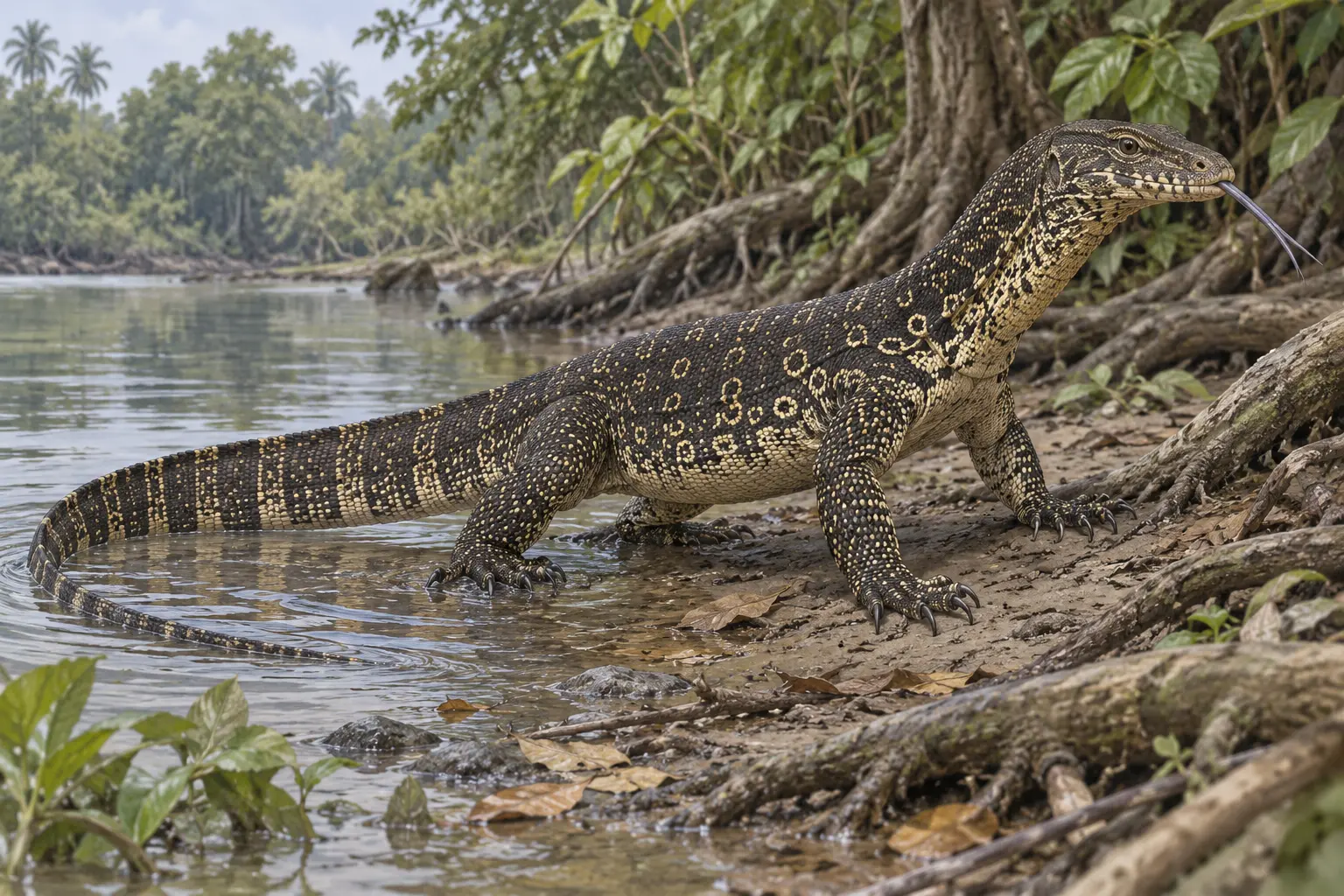
Distributed from South Asia through much of South-East Asia—including Cambodia, Laos and Viet Nam—to many Sunda islands. It uses rivers, lakes, canals, swamps, mangroves and even urban landscapes where water and refuge remain. [1]
Adults commonly reach about 1.5–2 m total length; males exceed females and exceptional individuals may approach or exceed 3 m. The tail accounts for more than half the body length. [1]
A long head and neck, tapered snout, dark body with yellow ocelli or bands, very long laterally compressed tail and deeply forked tongue are characteristic. Juveniles usually show stronger yellow contrast than older animals. [1]
A compressed tail provides underwater propulsion, strong claws support digging and climbing, and the forked tongue carries odour molecules to the vomeronasal organ. Cardiorespiratory and behavioural thermoregulation support both aquatic and terrestrial activity. [1]
Behaviour and ecology
Diurnal and adept at swimming, diving and climbing; it often basks before patrolling water edges. When threatened it may dive, tail-whip, hiss and bite, so handling requires professional risk assessment. [1]
Diet
An opportunistic diet includes fish, crabs, molluscs, frogs, reptiles, birds and eggs, small mammals, insects, carrion and sometimes organic refuse. Diet changes with age, habitat and food availability. [1]
Reproduction and life cycle
Eggs are laid in soil burrows, rotting wood or sometimes termite mounds; clutch size varies with female size and population. Incubation temperature may affect embryonic biology, but one regime should not be generalised across this complex. [1]
Ecosystem role
By preying across many animal groups and consuming carrion, it moves energy between aquatic and terrestrial systems and removes organic material. In settlements this role must be managed alongside safety for people and domestic animals. [1]
Threats & conservation
Although IUCN lists LC, some populations face pressure from skin and meat trade, wetland loss, persecution, pollution and roads. Appendix II requires legal and non-detrimental trade findings; LC is not a trade permit. [1–3]
Reviewed 22 September 2026: IUCN records LC; Varanus salvator is in CITES Appendix II. This is a complex with a history of taxonomic change; name, population, origin and national law must be checked at transaction level.5 sourced facts
Species in five facts
The laterally compressed tail works like a paddle in water. [1]
The forked tongue samples chemical cues for the vomeronasal organ. [1]
It can climb trees, especially when young or seeking refuge. [1]
The native range includes Viet Nam, Laos and Cambodia. [1]
Several forms once treated as subspecies are now recognised as separate species. [1]
Sources
[1] Reptile Database — Varanus salvator[2] IUCN Red List species search[3] CITES Appendices effective 5 March 2026