
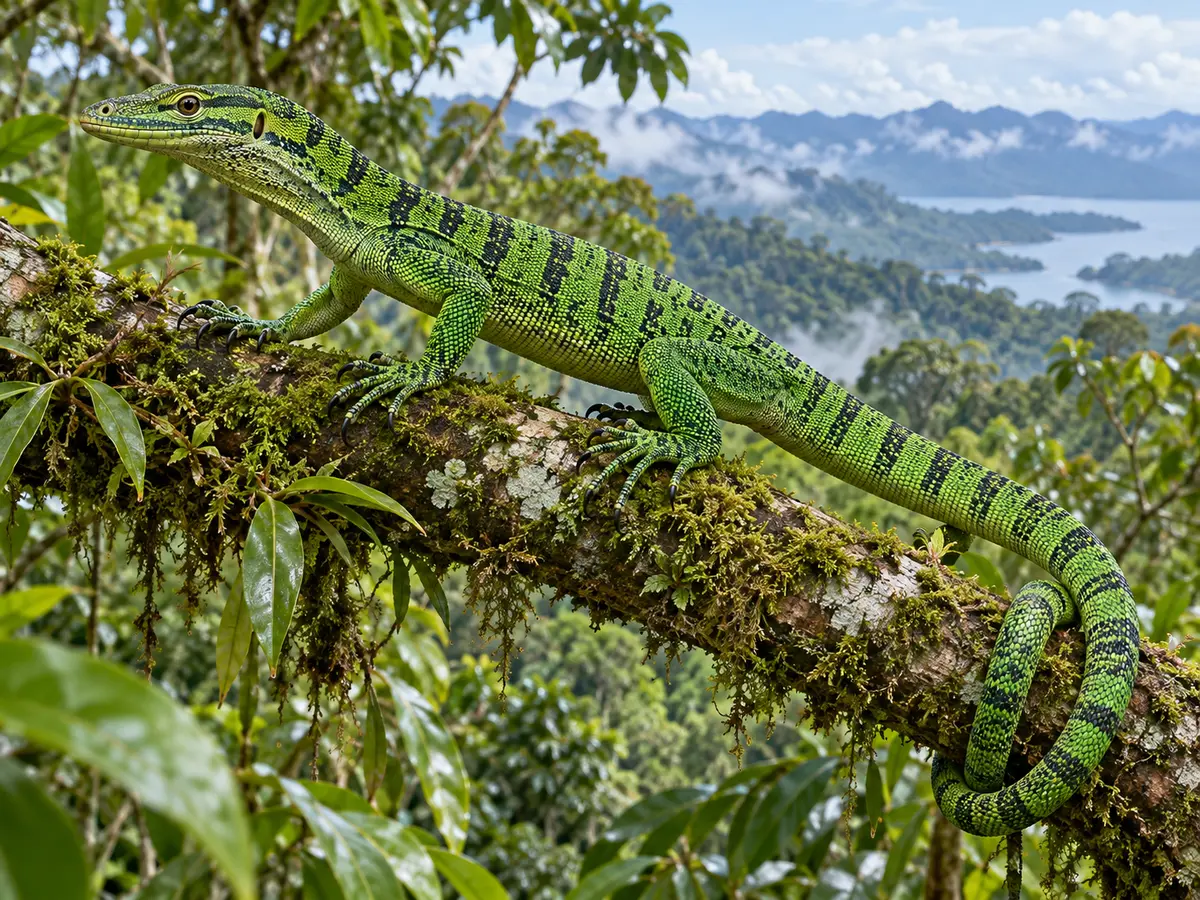
Occurs on New Guinea and several adjacent islands in rainforest, palm stands and some modified habitats retaining trees and prey. Island populations may differ; provenance should be recorded at a useful level rather than simply 'New Guinea'. [1,2]
Total length is about 91 cm, with the tail approximately twice the body length. Total-length figures can make the species sound bulkier than it is because the body is slender and much of the measurement is tail. [1]
Dark jade to lime green with narrow black crossbands over body and tail; the head is narrow, limbs long, claws curved and tail prehensile. Not every green tree monitor should be assigned to V. prasinus because the Hapturosaurus complex contains similar species. [1,2]
The long prehensile tail anchors the body while reaching between branches; curved claws and specialised sole scales increase grip, and green-with-black patterning disrupts the outline among leaves. A slender body reduces load on narrow branches. [1,2]
Behaviour and ecology
Mostly arboreal, using both claws and tail as anchors. Smithsonian describes small groups with a dominant male, several females and some juveniles or other males; this does not mean every managed individual will be compatible. [1]
Diet
Takes large arboreal insects, spiders and other invertebrates, plus frogs, geckos, birds and small mammals. Managed diets need varied prey size and body-condition monitoring; the ability to take vertebrates does not justify a rodent-only diet. [1,2]
Reproduction and life cycle
Females are reported to use termite mounds as natural incubation chambers. Clutches are typically three to seven eggs; Smithsonian reports 164–165 days of incubation and maturity around two years under documented conditions. [1]
Ecosystem role
A mid-sized canopy predator linking insects, amphibians, small reptiles, birds and mammals within the food web. It may also be prey for snakes and raptors; quantitative ecosystem-role data remain limited. [1,2]
Threats & conservation
Local populations can face tree loss, fire, trade and poorly documented collection despite the LC category. DinoJura should prioritise pedigree-backed captive breeding, Appendix-II documentation, origin-country legality and tall, structurally complex housing with monitored humidity and temperature. [1,3]
IUCN lists the species as Least Concern (LC), but this does not replace island-, habitat- or harvest-specific assessment. The genus Varanus is in CITES Appendix II except for certain Appendix-I species; V. prasinus requires appropriate trade records and Indonesian/Papua New Guinean legal checks. [1,3]5 sourced facts
Species in five facts
The prehensile tail is about twice the body length. [1]
Total length is about 91 cm. [1]
A clutch typically contains three to seven eggs. [1]
Termite mounds may serve as incubation chambers. [1]
The species is included in CITES Appendix II. [3]
Sources
[1] Smithsonian's National Zoo — Emerald Tree Monitor[2] Australian Reptile Online Database — Varanus prasinus[3] CITES Appendices effective 5 March 2026