
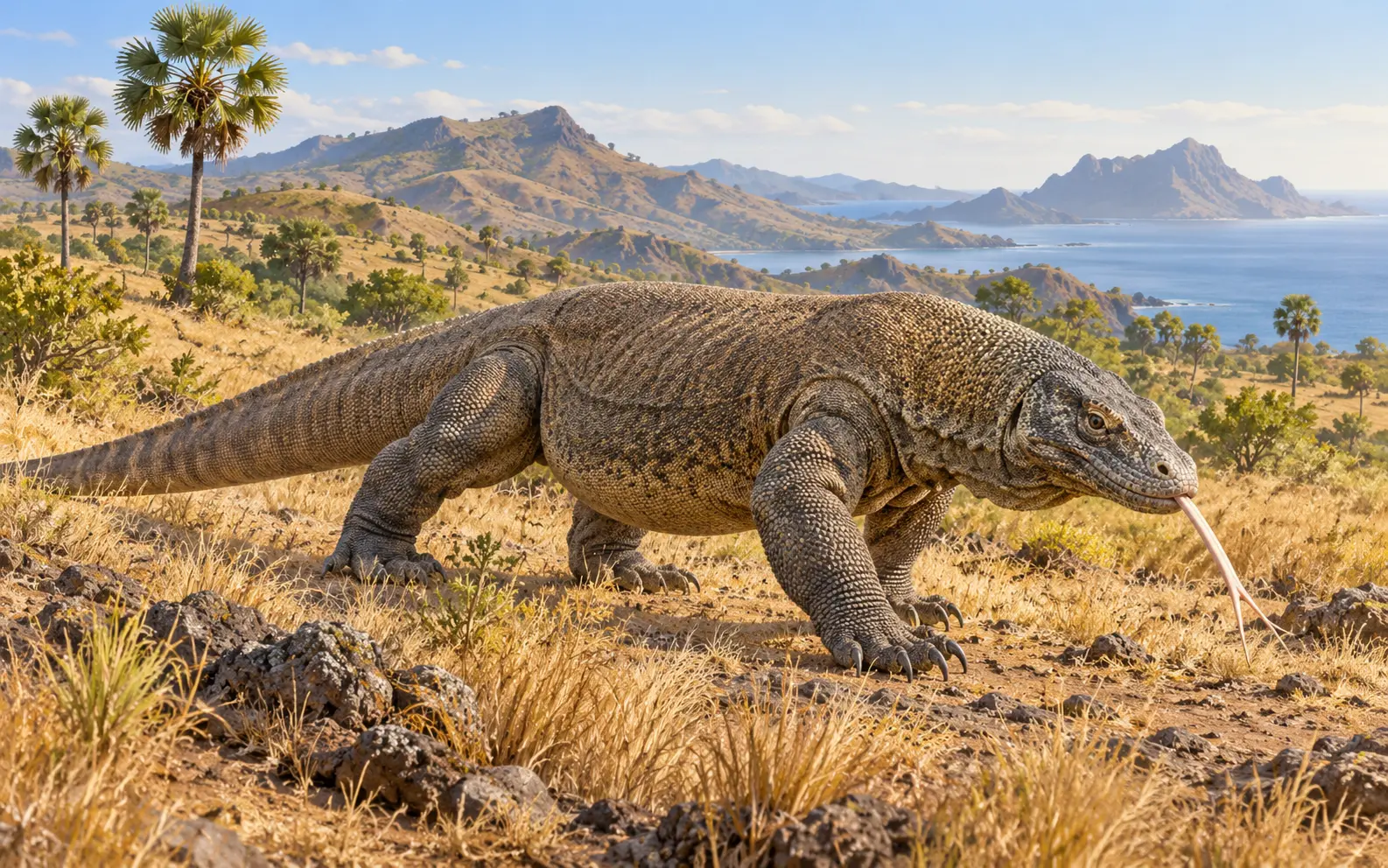
Native to Komodo, Rinca, Flores, Gili Motang and nearby small islands in the Lesser Sundas. It uses dry savanna, monsoon forest and coastal valleys, with shade, seasonal water and viable prey populations especially important. [1–3]
Large individuals may approach 3 m and around 70 kg or more, although most are smaller and males are generally larger than females. These are values for exceptional large animals, not a default size for every Komodo dragon. [1,2]
A robust body, broad head, powerful neck, bowed limbs, long claws and muscular tail are covered by grey-brown scales reinforced with small osteoderms. The yellow forked tongue samples scent particles for the Jacobson's organ; it is not a venom-delivery organ. [1,2]
Curved, cutting teeth, powerful neck muscles and venom glands contribute to blood loss, reduced blood pressure and prey incapacitation; the outcome cannot be assigned to one mechanism alone. Tongue-Jacobson chemoreception supports searching for carrion and prey across dry landscapes. [1,2]
Behaviour and ecology
Mostly diurnal, it patrols on the ground and uses scent to locate food over distance. Juveniles are more arboreal, finding prey and avoiding larger dragons, while adults may excavate burrows for thermal shelter and a stable microclimate. [1,2]
Diet
Carnivorous and scavenging, adults take Timor deer, wild pigs and other vertebrates, while juveniles use more insects, lizards and small animals. Managed diets must match body condition, activity and dental-skeletal health without recreating predation through avoidable risk to live prey. [1,2]
Reproduction and life cycle
Females excavate nests and commonly lay about 15–30 eggs, with incubation lasting roughly 7–9 months depending on temperature and conditions. Parthenogenesis has been documented in human care, but sexual reproduction is normal and genetic management remains essential. [1,2]
Ecosystem role
Komodo dragons regulate ungulates and smaller animals while scavenging carcasses and redistributing nutrients across island habitats. Protecting the species therefore requires its prey network, foraging corridors, nesting areas and seasonal water sources. [1,3]
Threats & conservation
An extremely restricted range, habitat and prey loss, human conflict, sea-level rise and climate extremes are major risks. Any transfer requires competent authorities and a lawful conservation programme; Appendix I does not make captive animals ordinary commercial commodities. [1,3,4]
Reviewed 28 September 2026: the 2021 IUCN assessment lists the species as Endangered (EN), and CITES includes it in Appendix I. Conservation and CITES status do not replace transaction-level provenance, national approvals, quarantine or welfare requirements.5 sourced facts
Species in five facts
It is the largest living lizard species. [1,2]
Juveniles are more arboreal than adults. [1]
The forked tongue samples odours for the Jacobson's organ. [1,2]
Parthenogenesis has been recorded in isolated females in human care. [1]
CITES regulates the species under Appendix I. [4]
Sources
[1] Smithsonian's National Zoo — Komodo dragon[2] The Reptile Database — Varanus komodoensis[3] IUCN Red List species search[4] CITES Appendices effective 5 March 2026