
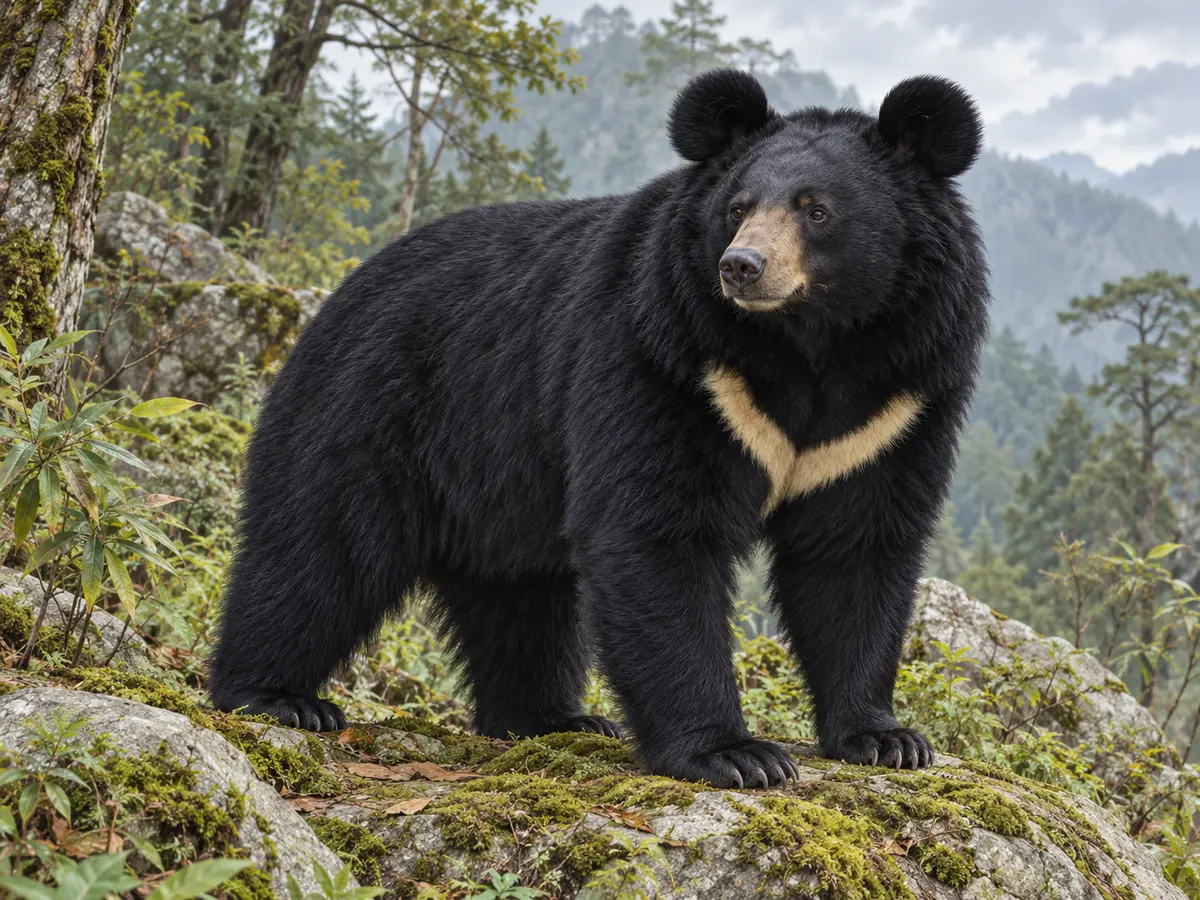
A fragmented range spans 18 countries from southeastern Iran, Pakistan and the Himalayas through Myanmar, China and Southeast Asia to the Russian Far East, Korea, Japan, Taiwan and Hainan. It uses broadleaf, conifer and regenerating forests from sea level to about 3,700–4,300 m. [1]
Adults are about 130–190 cm long and weigh 50–200 kg. Males commonly weigh 100–200 kg, females 50–125 kg; strong curved claws may reach about 5 cm. [1]
Key features are black fur, a mane of longer hair around the neck and shoulders, pale muzzle, proportionately large ears and a cream-white chest mark. Brown or blond colour phases occur, so body colour alone cannot confirm species or subspecies. [1]
Powerful forequarters, curved claws and large heel pads support climbing for food and refuge. Acute smell helps locate scattered resources; fat storage and metabolic reduction support winter survival in colder parts of the range. [1,2]
Behaviour and ecology
Primarily solitary, an adept climber and capable of seasonal movements following food. In colder regions it dens or greatly reduces activity; timing and intensity vary with climate, sex and reproductive condition. [1,2]
Diet
An opportunistic omnivore taking bamboo shoots, berries, hard mast, acorns, insects, honey, carrion and sometimes vertebrates. Energy-rich autumn nuts are especially important for building reserves before seasonal scarcity. [1,2]
Reproduction and life cycle
Females commonly produce a first litter at four to five years, mate from May to August and show delayed implantation. One or two cubs are typical, with a range of one to three; newborns weigh about 230 g and remain with their mother for at least 1.5 years. [1]
Ecosystem role
Bears disperse seeds in faeces, alter understory through branch breaking and digging, and consume insects and carrion. As large omnivores they connect energy flows among canopy, forest floor and animal resources. [1,2]
Threats & conservation
Forest loss and fragmentation, human–bear conflict, killing, snaring and trade in bile or body parts are major threats. DinoJura does not treat former bile-farm bears as commercial stock; any rescue or transfer must involve authorities, Appendix-I documentation, veterinary oversight and a capable specialist facility. [1–4]
The 2016 IUCN assessment lists the Asiatic black bear as Vulnerable (VU A2cd); the specialist account cites an estimated 31% global decline over the preceding 30 years. The species has been in CITES Appendix I since 1979, generally prohibiting international commercial trade in wild specimens. [1–4]5 sourced facts
Species in five facts
Adults are about 130–190 cm long. [1]
Recorded adult mass ranges from 50 to 200 kg. [1]
A litter usually contains one or two cubs. [1]
Cubs remain with their mother for at least about 1.5 years. [1]
The species has been in CITES Appendix I since 1979. [1,3,4]
Sources
[1] International Association for Bear Research and Management — Ursus thibetanus[2] Animal Diversity Web — Ursus thibetanus[3] CITES species gallery — Asiatic black bear[4] CITES Appendices effective 5 March 2026