
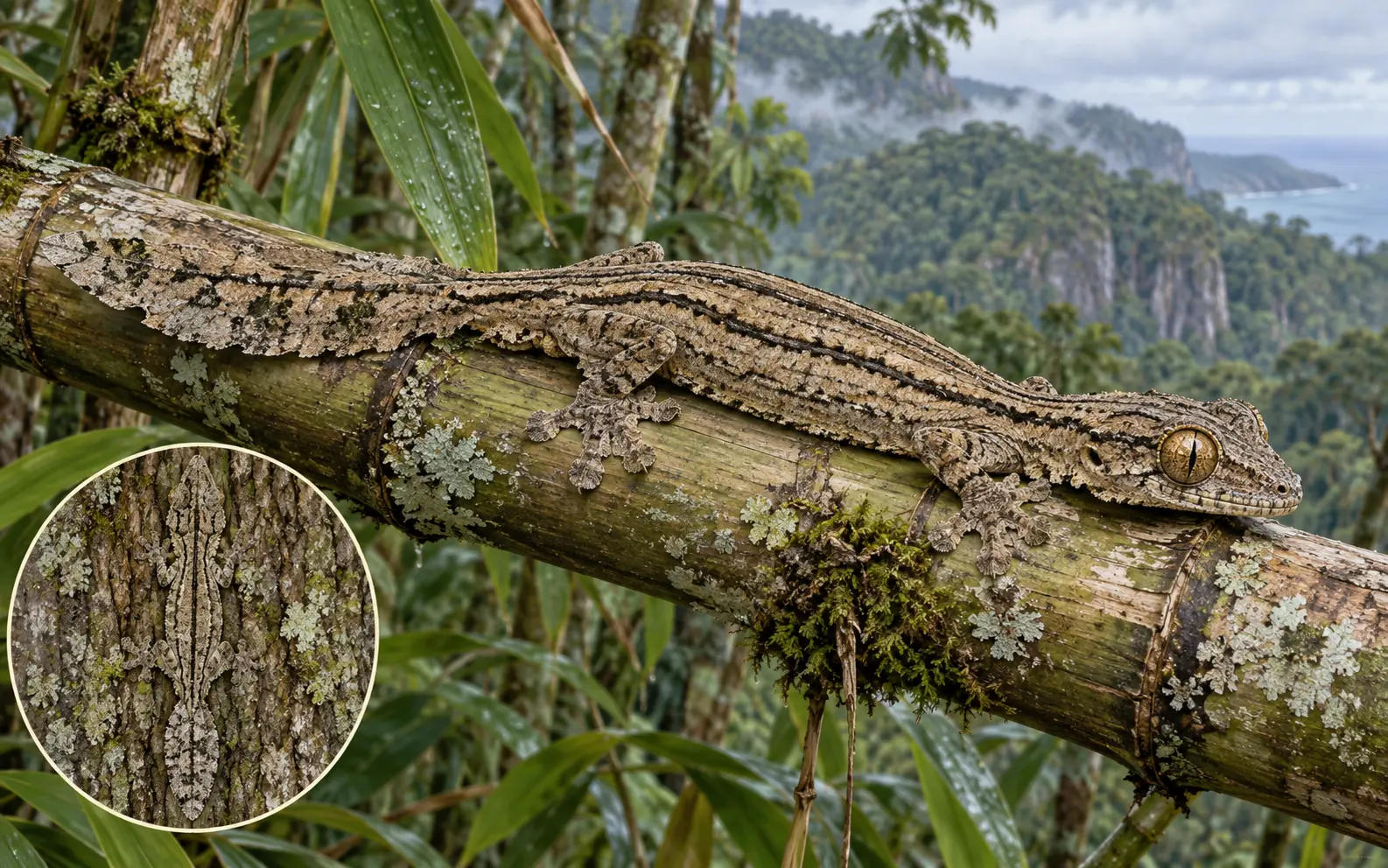
Recorded in eastern Madagascar lowland rainforest and Nosy Boraha, commonly associated with trunks, bamboo and vertical vegetation in humid environments.
Total length may approach 25–27 cm; body and tail are flattened and more elongated than in broad leaf-mimicking Uroplatus.
Brown-black longitudinal lines cross a tan or grey ground colour; elongated head, large eyes, flattened tail and adhesive toes. Colour varies with background and state.
Lines align with bamboo and branches, a flattened body reduces shadow, large eyes support nocturnal vision, and toe pads secure vertical grip.
Behaviour and ecology
Nocturnal; by day it presses against branches to reduce shadow and disrupt its outline. When threatened it may gape, flee or shed its tail.
Diet
Ambushes nocturnal insects and other invertebrates from trunks and branches.
Reproduction and life cycle
Oviparous; females generally hide eggs in leaf litter or forest substrate. Clutch and incubation data vary with population, temperature and humidity.
Ecosystem role
An insect predator in lower forest strata and prey for snakes, nocturnal birds and small carnivores.
Threats & conservation
IUCN lists it as LC, but deforestation and illegal collection remain local risks. The genus Uroplatus is in CITES Appendix II, so international trade requires permits.
IUCN/CITES status was checked on the profile date; re-verify before any legal or transaction decision.5 sourced facts
Species in five facts
The name lineatus refers to longitudinal body stripes.
It mimics branches and bamboo more than a broad leaf.
Large eyes support nocturnal activity.
The tail can be shed under threat.
It is endemic to Madagascar.
Sources
Reptile Database — Uroplatus lineatusIUCN Red List searchCITES Checklist