
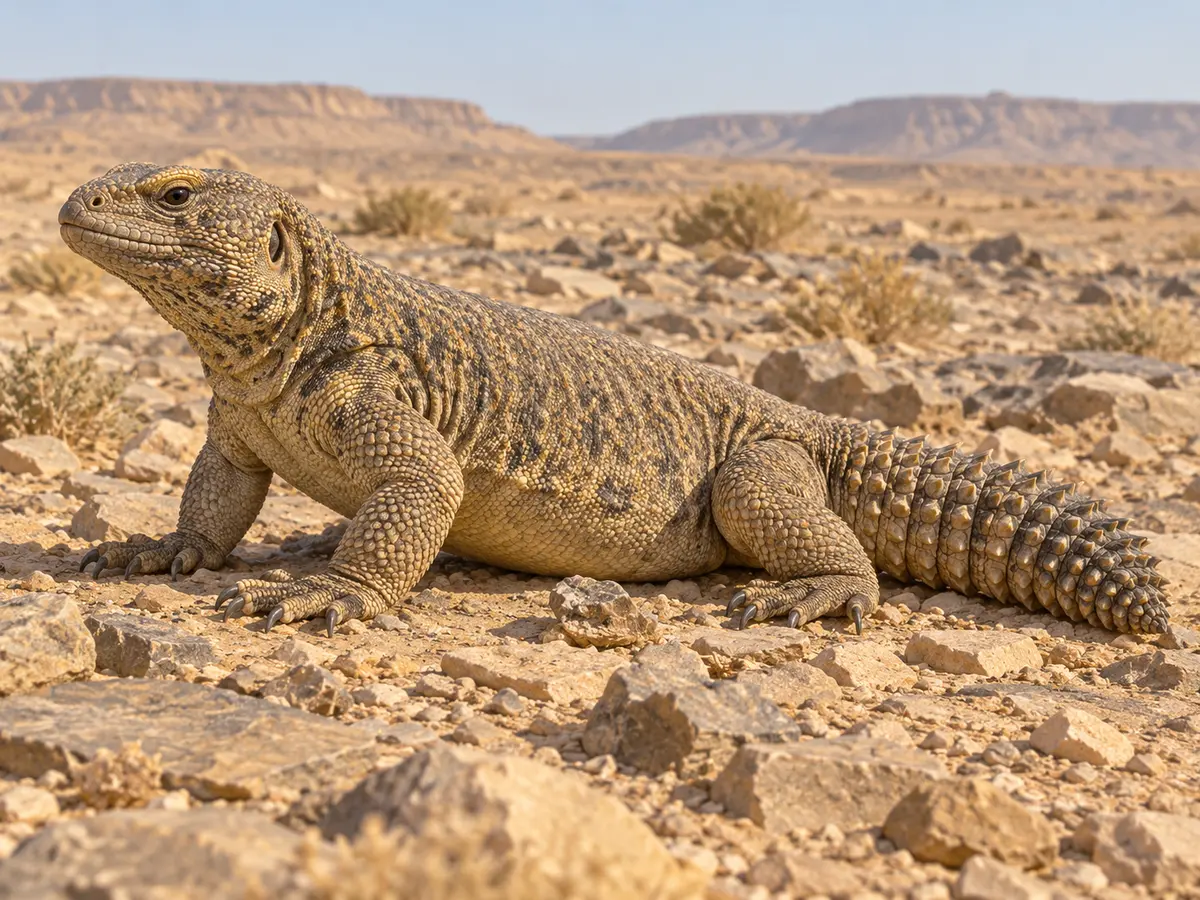
Ranges from Egypt east through Sinai, Israel, Jordan, Syria and Iraq, across the Arabian Peninsula to south-west Iran. It favours flat gravel and rocky plains, wadis and desert soils stable enough for burrows, from sea level to roughly 1,500 m. [2,4]
A very large spiny-tailed lizard; one population health survey recorded mean total lengths of 62.1 cm for males and 49.4 cm for females. These are sample means, not universal maxima for every population. [3]
A broad blunt head, thick torso, powerful limbs and a short flattened tail bearing many rings of pointed scales are diagnostic. Colour is usually sandy grey to brown and can darken with temperature; subspecies should not be assigned from colour photographs alone. [2,4]
Strong claws and muscular forelimbs excavate thermally buffered burrows; the spiny tail acts both as an entrance shield and weapon. Cooler individuals darken to absorb heat, while the gut is adapted to dry plant foods. [2,4]
Behaviour and ecology
Diurnal, basking near its burrow before foraging within a familiar area. When threatened it retreats underground, braces its body and spiny tail in the entrance, or tail-whips defensively. The burrow buffers daytime heat and night cold. [2,4]
Diet
Adults feed chiefly on desert leaves, shoots, flowers and seeds; juveniles may take opportunistic invertebrates more often. Managed diets require fibre-rich safe plant variety and appropriate minerals, not insects as the assumed staple. [2,4]
Reproduction and life cycle
Oviparous, depositing eggs in an underground nest chamber or burrow; clutch size and season vary with size, population and conditions. Hatchlings are independent, while slow maturation makes the species vulnerable to persistent harvest impacts. [1,2]
Ecosystem role
As a large desert herbivore it influences low vegetation and seed–nutrient movement. Its burrows create sheltered microhabitats, although use by other species varies by site and should not be overstated. [1,2]
Threats & conservation
Infrastructure development, desert fragmentation, vehicles, hunting for food or medicine and pet collection all create pressure. A 2026 study shows conservation translocation requires post-release monitoring; DinoJura should consider only fully traceable captive-bred animals with Appendix-II documents. [1,5]
IUCN lists Uromastyx aegyptia as Vulnerable (VU) in a 2012 assessment, whose age should be stated. The entire genus Uromastyx is included in CITES Appendix II. Appendix II does not prohibit every transaction, but requires legal origin, permits and appropriate non-detriment findings. [1,2,5]5 sourced facts
Species in five facts
The tail carries rings of large spines and can be swung in defence. [2,4]
The burrow is an important thermal buffer in desert climates. [2]
A population survey recorded males averaging longer and heavier than females. [3]
The species is primarily herbivorous, especially as an adult. [2,4]
A development-displacement translocation was monitored and reported scientifically in 2026. [5]
Sources
[1] IUCN Red List 2012 — Uromastyx aegyptia[2] The Reptile Database — Uromastyx aegyptia[3] PubMed — health assessment of U. aegyptia microlepis[4] Virginia Zoo — Egyptian Spiny-tailed Lizard[5] Elmirghani et al. 2026 — post-translocation monitoringCITES Appendices effective 5 March 2026