
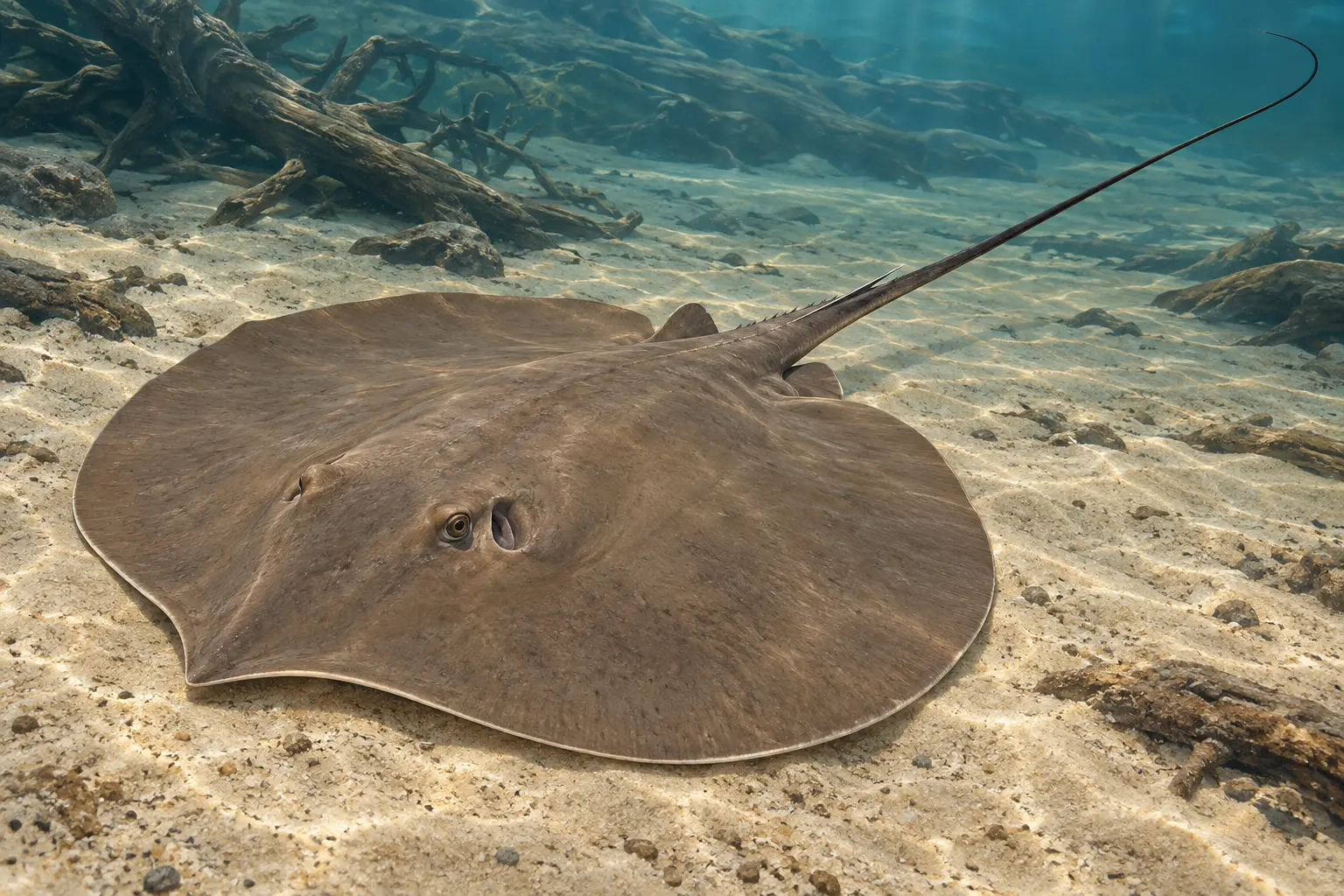
Recorded from major Southeast Asian basins and estuaries, including the Mekong, Chao Phraya–Mae Klong systems and rivers of Borneo and nearby areas. It favours sand or mud bottoms; population boundaries and some coastal records remain uncertain. [1–3]
FishBase compiles a maximum disc width near 240 cm and total length up to 500 cm, but these are extremes rather than typical size. A Cambodian individual recorded in 2022 weighed about 300 kg, measured 3.98 m long and 2.2 m wide. [1,2,4]
The very broad near-round to oval disc has a pointed triangular snout, with eyes and spiracles dorsally placed. The upper surface is fairly uniform grey-brown, the underside pale with darker margins, and the long thin tail bears a defensive spine; it lacks manta cephalic lobes. [1,2]
The broad disc generates lift close to the bottom, dorsal spiracles draw water while the mouth faces the substrate, and electroreception finds prey in turbid water. The tail spine is defensive rather than a hunting tool. [1,2]
Behaviour and ecology
It spends much of its time resting or moving along the bottom, sometimes buried with only the eyes and spiracles exposed. Migration knowledge remains limited; tagging and long-term tracking are more informative than single encounters. [2,3]
Diet
Preys on bottom-dwelling crustaceans, molluscs and fish, using electroreceptors around the head to detect prey hidden in sediment. Local diet data are sparse, so one fixed food list should not be applied across all basins. [1,2]
Reproduction and life cycle
Fertilisation is internal and young are born live; embryos lack a true placenta and receive additional uterine nourishment. Reported litters are very small, often about 1–3 pups, with newborn disc width near 30 cm, limiting recovery from exploitation. [1–3]
Ecosystem role
As a large benthic predator it links fish and invertebrate communities. Adult survival requires deep reaches, sand–mud flats and hydrological connectivity, making the species an indicator of whole-basin condition. [2,3]
Threats & conservation
Bycatch and targeted fishing, dams and river engineering, pollution, prey decline and low reproduction are key risks. Entangled rays require trained teams, avoidance of the tail zone and safe release; any managed care would need a purpose-built large-scale aquatic system, not an ordinary display tank. [2,3]
Reviewed 24 September 2026: IUCN records EN. Urogymnus polylepis was not located in the CITES Appendices effective 5 March 2026 during review; absence from the Appendices is not permission to collect or trade, and national fisheries and conservation law still applies. [3,5,6]5 sourced facts
Species in five facts
A Cambodian individual recorded in 2022 weighed about 300 kg. [4]
Dorsal spiracles move water across the gills while the ray rests on the bottom. [1,2]
The tail spine is defensive, not used to kill prey. [2]
Litters are typically very small, around one to three pups. [3]
The scientific name has changed in the literature, so synonyms must be checked in older records. [1–3]
Sources
[1] FishBase — Urogymnus polylepis[2] FishBase Field Guide — Giant freshwater whipray[3] Water — Review of giant freshwater stingray ecology and conservation[4] Smithsonian Magazine — 2022 Cambodian freshwater-fish record[5] IUCN Red List species search[6] CITES Appendices effective 5 March 2026