
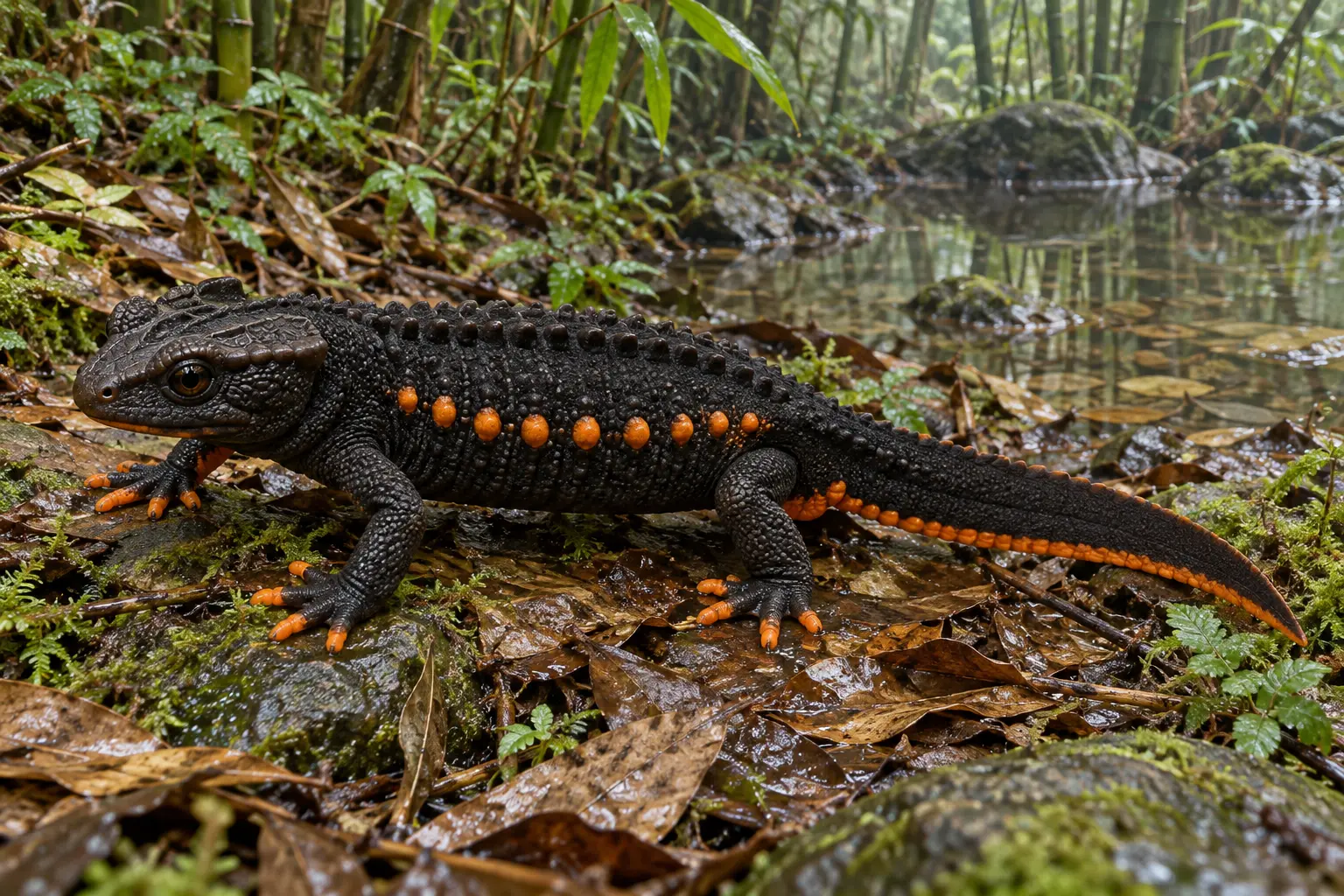
Recorded in montane northern Vietnam, including Ha Giang and Cao Bang, and adjacent Yunnan, China; parts of the potential range need further confirmation. Habitat is humid subtropical evergreen forest, often with bamboo, streams and small ponds at roughly 885–1,750 m. [1–3]
The original description reported snout-vent length around 54–68 mm in males and about 71 mm in the female specimen; later surveys extended observed ranges to nearly 89 mm in males and 99 mm in females. Snout-vent length must be stated rather than mixed with total length including the tail. [1–3]
A broad head with raised bony ridges, rough black skin, segmented vertebral ridge and conspicuous orange rib nodules characterise the species; digits, vent and lower tail edge may also be orange. The tail is laterally compressed, and separation from related Tylototriton may require measurements, pattern and molecular data. [1–3]
Glandular skin provides defensive secretions, and bony ridges with rib nodules make the body harder to swallow; contrasting orange may serve as warning colour. The compressed tail aids swimming in breeding ponds, while the robust body and limbs suit forest floor movement. [1–3]
Behaviour and ecology
Outside the breeding season, adults are secretive beneath leaf litter, wood and stones on humid forest floor; in the rains they move to ponds. Low detectability outside a short activity window is not evidence that a population has disappeared. [2,3]
Diet
Consumes small terrestrial or aquatic invertebrates appropriate to its life stage, but quantitative species-specific diet data remain limited. Prey lists or managed diet formulas from other Tylototriton must not be assigned to this species without evidence. [2,3]
Reproduction and life cycle
Breeds in the rainy season, commonly around April–July; eggs are placed on moist ground near ponds and larvae are aquatic. A captive study recorded metamorphosis after roughly 77–79 days under its conditions, not a fixed timetable for every wild population. [2,3]
Ecosystem role
Ziegler's crocodile newt consumes invertebrates and is prey for larger animals; aquatic larvae followed by terrestrial adults move nutrients between pond and forest. The species is a useful indicator of continuous clean, humid microhabitat. [2,3]
Threats & conservation
Forest loss and fragmentation, altered breeding ponds, pollution, roads, amphibian disease and collection are major risks. Sensitive coordinates should not be publicised; research, rescue and transfer must follow Vietnamese or Chinese law, CITES and disease-control disinfection protocols. [3–5]
Reviewed 30 September 2026: IUCN lists the species as Vulnerable (VU) in its 2017 assessment; the genus Tylototriton is included in CITES Appendix II. A small range, limited data and taxonomic change mean every record must preserve species, locality and specimen origin. [1–5]5 sourced facts
Species in five facts
The species was formally described in 2013. [1]
A row of orange rib nodules contrasts with the black body. [1–3]
Eggs occur on moist ground near ponds, while larvae develop in water. [2,3]
It needs both breeding ponds and surrounding forest to complete its life cycle. [2,3]
CITES regulates the entire genus Tylototriton under Appendix II. [5]
Sources
[1] Amphibian Species of the World — Tylototriton ziegleri[2] ZooKeys — Confirmation in China and taxonomic discussion[3] Ghent University repository — Tylototriton ziegleri research[4] IUCN Red List species search[5] CITES Appendices effective 5 March 2026