
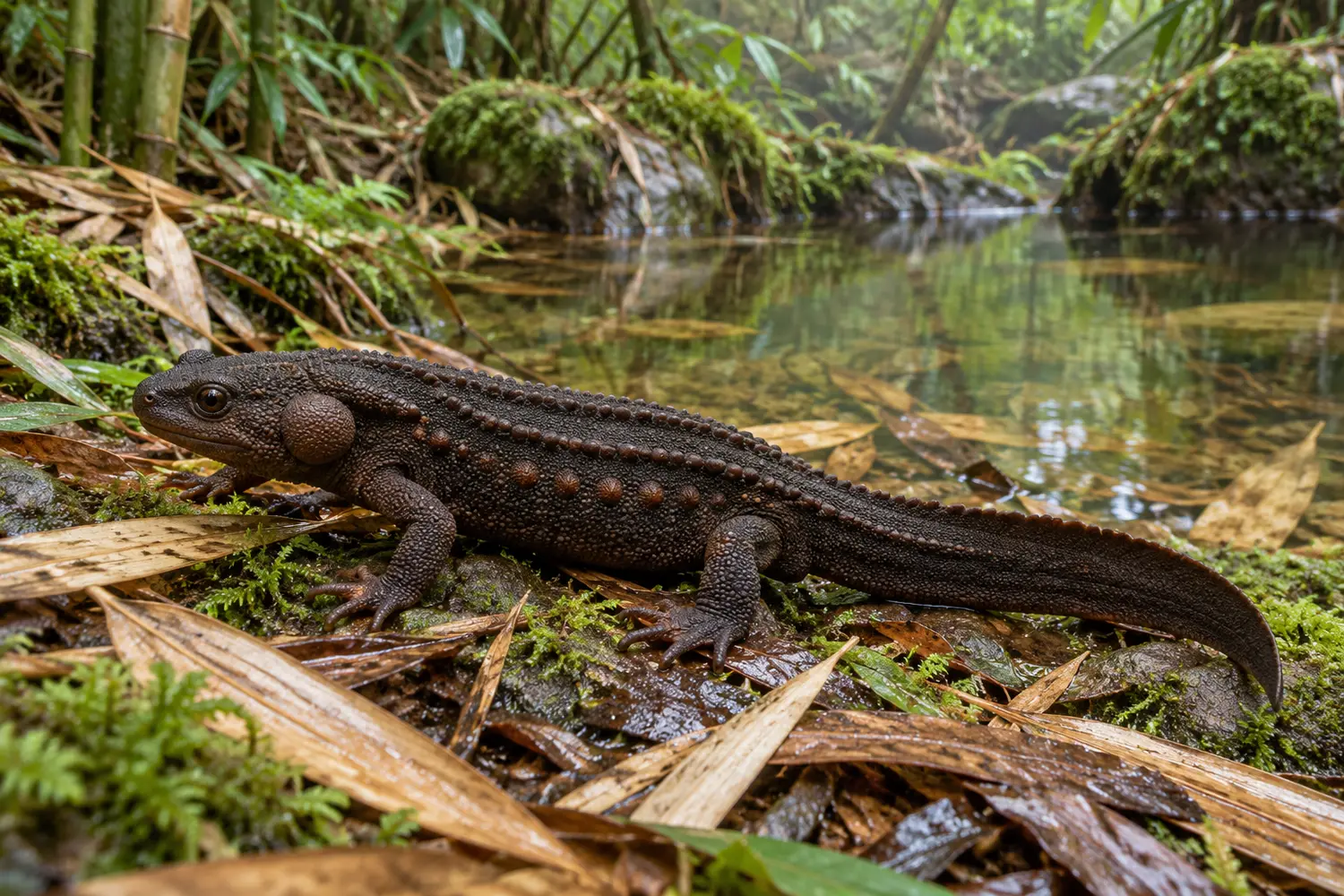
Confirmed from a limited number of northern Vietnamese localities including Quang Ninh, Bac Giang and nearby areas, in evergreen or bamboo forest with small permanent or temporary ponds and slow water. The narrow known range makes each breeding site important. [1–4]
Described specimens had a snout-vent length around 48–54 mm and total length around 114–122 mm, while some husbandry sources report larger individuals. Measurement method must be stated and data from similar species must not be mixed. [1,2]
Dark brown to nearly black, with warty skin, a broad rounded head, large parotoid glands, one mid-dorsal ridge and paired rows of prominent rib nodules; the tail is laterally compressed. Orange-red can be limited, so colour alone is unreliable. [1,2]
Glandular skin produces defensive secretions, while bony ridges and rib nodules make the body harder to swallow; a compressed tail aids swimming in the breeding season. These glands are defence, not a reason to handle the animal. [1,2]
Behaviour and ecology
Mostly secretive and terrestrial outside breeding, sheltering under rotten wood, stones and moist litter; adults move to ponds during the rainy breeding period. Activity depends strongly on temperature and humidity, so low detectability does not mean absence. [2–4]
Diet
Takes small invertebrates such as worms, insects, larvae and small crustaceans, while aquatic larvae use size-appropriate prey. Managed diets must avoid prey contaminated by pesticides or parasites. [2,3]
Reproduction and life cycle
Breeding is tied to forest ponds in the rainy season; eggs are placed in or near wet habitat and aquatic larvae develop before metamorphosing onto land. Timing, clutch size and development vary by locality and microclimate and must not be borrowed from other Tylototriton. [2–4]
Ecosystem role
It consumes invertebrates and is prey for larger animals, while its two-environment life cycle transfers nutrients between pond and forest floor. Its presence reflects continuity of clean, humid microhabitats. [2–4]
Threats & conservation
Forest loss and fragmentation, altered breeding ponds, pollution, roads, amphibian disease and collection are major risks. Sensitive coordinates should not be published; all research, rescue or transfer must follow Vietnamese law, CITES and biosecurity protocols. [2–5]
Reviewed 29 September 2026: the current IUCN index uses Vulnerable (VU); older secondary sources may show another category, so the original assessment must be checked for decisions. Tylototriton is included in CITES Appendix II. Taxonomy in this group changes rapidly and requires provenance and expert confirmation.5 sourced facts
Species in five facts
The species was formally described only in 2005. [1]
It is a confirmed northern Vietnam endemic. [1–3]
Larvae are aquatic before metamorphosing onto land. [2,3]
Rib nodules and parotoid glands are prominent defensive structures. [1,2]
CITES regulates the genus Tylototriton under Appendix II. [5]
Sources
[1] Amphibian Species of the World — Tylototriton vietnamensis[2] AmphibiaWeb — Tylototriton vietnamensis[3] Bernardes et al. — Habitat and potential distribution[4] IUCN Red List species search[5] CITES Appendices effective 5 March 2026