
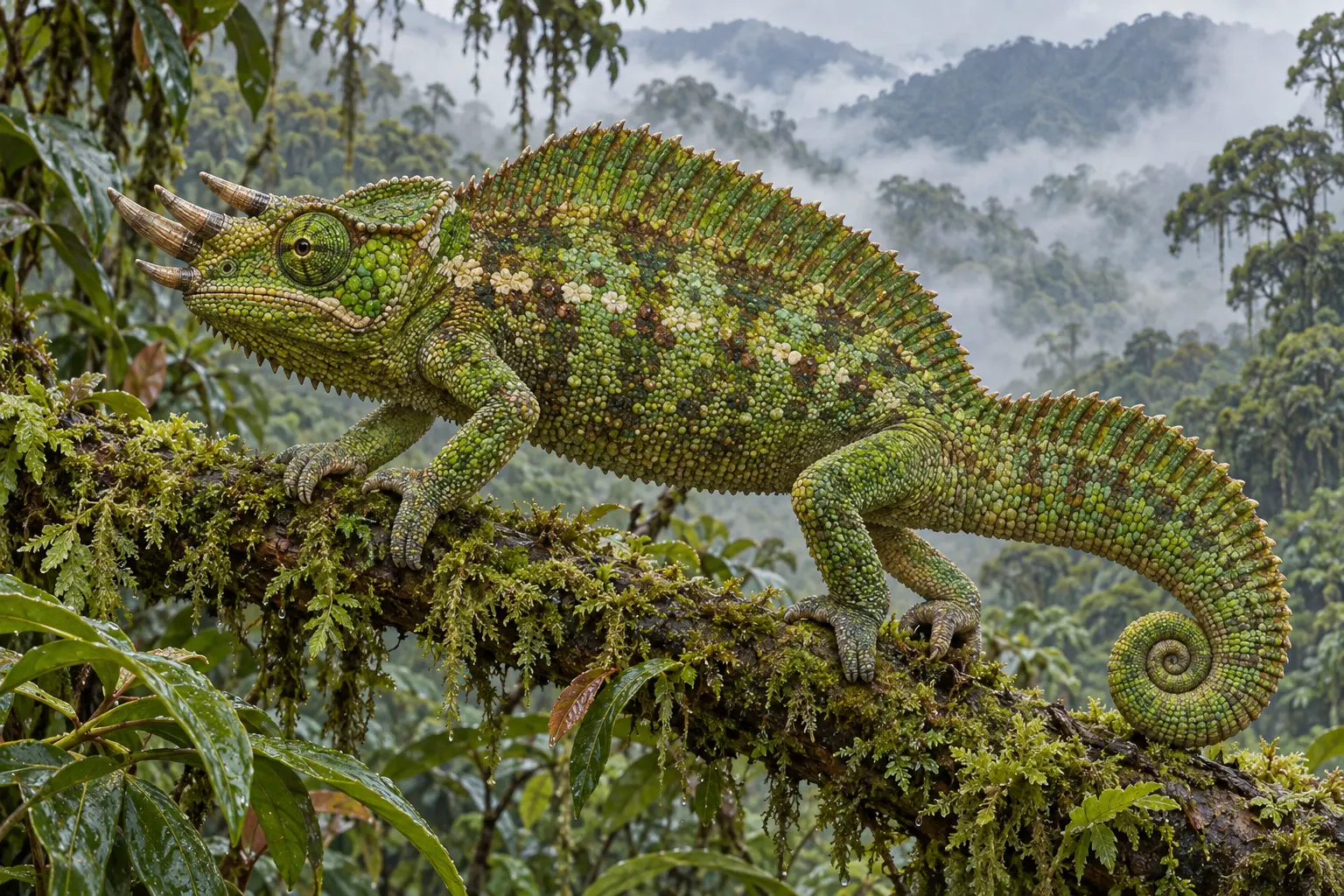
Recorded from Cameroonian massifs including Manengouba, Kupe, Bamboutos, Lefo and Oku, and Nigeria's Obudu Plateau. Populations occupy montane forest and edges, commonly around 1,150–2,400 m depending on locality. [1–3]
A medium-to-large chameleon; adult males are commonly reported at roughly 25–35 cm total length, with females smaller. Size and horn structure differ among localities and taxonomic forms, so locality and actual measurements should be retained. [1,3]
Males usually have four short, slightly upturned rostral horns, sometimes with additional small horns, plus a very high dorsal-tail crest; females are commonly hornless. Split toe bundles, turreted eyes and a prehensile tail identify the chameleon form; it is not the three-long-horned Jackson's chameleon. [1,3]
Grasping feet and a prehensile tail create three-point support on wet branches; turreted eyes broaden visual coverage and the projectile tongue reduces the need to lunge from a perch. The high crest and horns contribute to male identity, display and body outline. [1,3]
Behaviour and ecology
Diurnal and arboreal, it usually moves slowly through lower and middle vegetation. The eyes scan semi-independently and converge on prey, while posture, body compression, colour and gaping signal distance; co-housing can therefore create subtle chronic stress. [3]
Diet
It captures insects and other invertebrates with a projectile tongue. Managed care requires appropriately sized prey diversity, gut loading, controlled mineral provision and leaf-drip hydration rather than simply increasing one feeder type. [3]
Reproduction and life cycle
Oviparous, depositing eggs in soil. A CITES review summarises roughly two to three clutches of 8–15 eggs per year, about two months of gravidity and hatching near five months; these are compiled observations, not mandatory targets for every individual. [2]
Ecosystem role
It is a montane-forest insect predator and prey for birds, snakes and small mammals. Its occurrence on mountain 'islands' means forest disconnection can isolate populations more severely than a broad range map suggests. [1,2]
Threats & conservation
Montane-forest conversion, burning and fragmentation are primary pressures, with collection, export and local persecution adding risk. Any acquisition requires locality, permits, veterinary records and provenance evidence; cool, humid, ventilated conditions cannot be replaced by a generic chameleon formula. [1–4]
Reviewed 27 September 2026: IUCN records VU in the 2015 assessment. CITES regulates the species in Appendix II as a chamaeleonid; the name 'four-horned' reflects quadricornis, although some males may carry four to six short rostral horns and females are often effectively hornless. [1–4]5 sourced facts
Species in five facts
Quadricornis means 'four-horned'. [1]
Some males have four to six short horns, while females are usually effectively hornless. [3]
The species occupies Cameroonian montane forests and Nigeria's Obudu Plateau. [1,2]
A high crest continues from the male's back onto the tail. [3]
CITES regulates the species under Appendix II. [4]
Sources
[1] The Reptile Database — Trioceros quadricornis[2] CITES Animals Committee — Trade in chameleons (AC27 Doc. 12.4)[3] Chameleon Academy/Forums — Trioceros quadricornis species tour[4] CITES Appendices effective 5 March 2026[5] IUCN Red List assessment DOI