
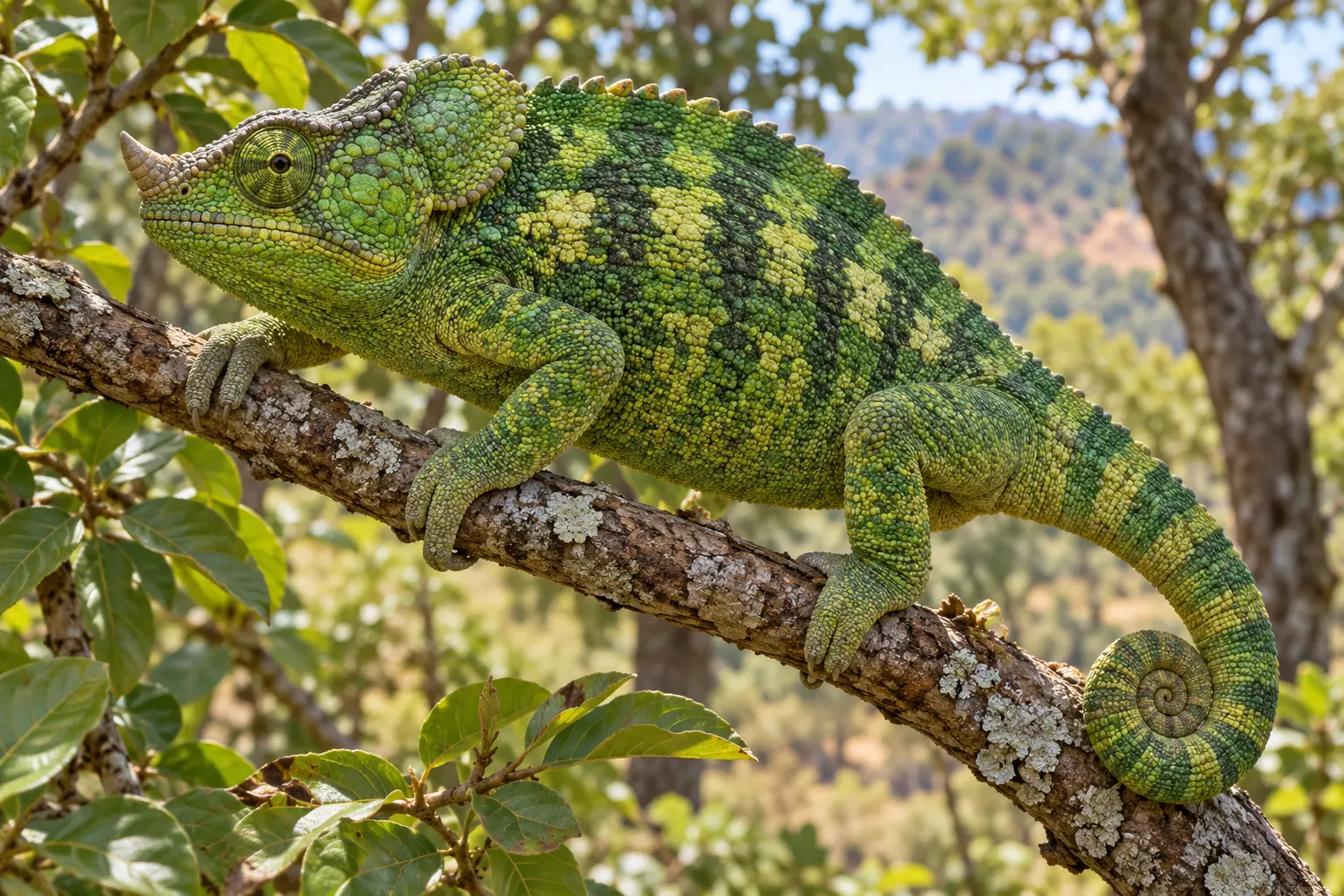
Recorded from Malawi, northern Mozambique and Tanzania in miombo woodland, bushy savanna, forest edges and large trees in farmed landscapes. Its range should not be generalised to all of East Africa without verified records. [1]
Adults commonly reach roughly 45–60 cm total length, with exceptional individuals larger. It is heavy-bodied for a chameleon, so support branches and movement space must be designed around actual mass. [2,3]
The elongate head bears one small rostral horn, very large occipital lobes, a low scalloped dorsal crest and a relatively short tail. Green skin may carry yellow and dark markings; colour changes with state and cannot independently prove sex or locality. [1,2]
Split toe bundles and a prehensile tail secure the body on branches, while turreted eyes broaden visual coverage. The tongue rapidly projects an adhesive pad to prey, and the large occipital lobes can broaden the head outline in defence. [2,3]
Behaviour and ecology
Diurnal and arboreal, it generally avoids close contact with conspecifics outside breeding contexts. The eyes scan semi-independently and converge on prey, while posture, body compression, gaping and colour form a defensive signal system. [2,3]
Diet
It primarily captures insects and other invertebrates with a projectile tongue; large individuals may take small vertebrate prey. In managed care, prey diversity, gut loading, controlled mineral provision and appropriate hydration matter more than simply increasing food volume. [2,3]
Reproduction and life cycle
Oviparous, depositing eggs in soil; a large female may produce a clutch numbering many dozens. Captive records show broad variation in clutch and incubation, so no single figure should be treated as a universal breeding standard. [1,3]
Ecosystem role
It is a lower-canopy insect predator and prey for snakes, raptors and small mammals. Dependence on connected vegetation and microclimate means its presence can reflect structural quality in scrub-woodland habitat. [1,2]
Threats & conservation
Although assessed LC, tree loss, fire, collection and trade create local pressure. Wild-caught imports have historically suffered high mortality; operational priorities are traceable captive-bred origin, veterinary quarantine, solitary housing and very large, ventilated space. [2–4]
Reviewed 25 September 2026: IUCN records LC in a 2014 assessment, while the Reptile Database confirms taxonomy and range. CITES regulates the species in Appendix II as a member of Chamaeleonidae; LC does not mean unregulated trade.5 sourced facts
Species in five facts
It is the largest chameleon native to mainland Africa. [2,3]
The snout bears one small horn, not the three horns of a Jackson's chameleon. [2]
The Reptile Database records the species as oviparous. [1]
Its large occipital lobes inspire the German name meaning 'elephant-ear chameleon'. [1]
The current name is Trioceros melleri; older literature may use Chamaeleo melleri. [1]
Sources
[1] The Reptile Database — Trioceros melleri[2] IUCN Red List — Trioceros melleri (2014 assessment)[3] Chameleon Academy — Meller's Chameleons[4] CITES Appendices effective 5 March 2026