
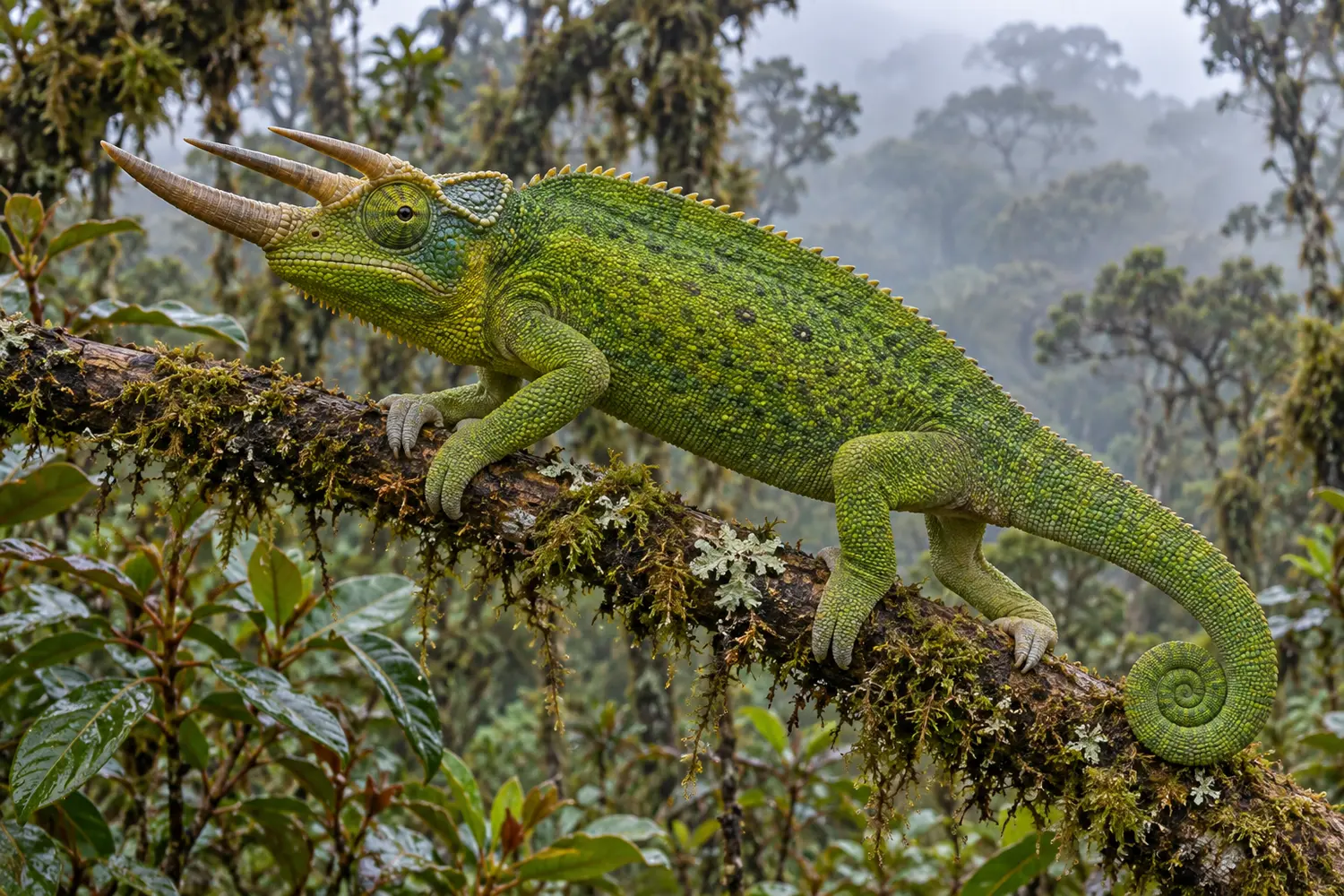
Native to highlands of Kenya and northern Tanzania, with introduced populations established in Hawaii. In its natural range it uses montane forest, edges, shrubland and wooded gardens with cool humidity and dense branching structure. [1–3]
Total length is commonly around 20–35 cm depending on subspecies, sex and measurement method, with the tail contributing much of that length. These values should not be treated as one standard for all three recognised subspecies. [1,2]
Adult males usually have one rostral and two preocular horns; females are generally hornless or reduced-horned. Turreted eyes, opposing toe bundles, a prehensile tail and low dorsal crest are characteristic. [1,2]
Male horns are display structures also used in contests; grasping feet and a prehensile tail provide multiple anchors on branches. Live-bearing suits cool montane environments where soil incubation may be less predictable. [1–3]
Behaviour and ecology
Diurnal, arboreal and largely solitary. The eyes scan semi-independently then converge on prey, while morning basking, posture and colour changes support thermoregulation, warning and courtship. [1,2]
Diet
Primarily captures insects, spiders and other invertebrates with a projectile tongue; larger individuals may take other small prey. Water is commonly lapped from droplets on leaves, so humidity is not equivalent to a constantly wet substrate. [1,2]
Reproduction and life cycle
Ovoviviparous: embryos develop inside the female and young are born in thin membranes rather than hard-shelled eggs laid in soil. Gestation lasts several months and litter size varies with individual, subspecies and conditions. [1,2]
Ecosystem role
It is both an insect predator and prey for birds, snakes and small mammals, linking trophic levels in low vegetation. Introduced populations require different management from native conservation populations. [2,3]
Threats & conservation
Habitat loss and collection for trade can affect subspecies unevenly, especially narrow-range populations. Any sourcing must confirm subspecies, lawful origin, CITES permits and import-export rules; Hawaiian populations cannot indicate the status of East African populations. [3,4]
Reviewed 29 September 2026: IUCN records the species as Least Concern (LC) in its 2014 assessment; Chamaeleonidae is included in CITES Appendix II except for separately noted exceptions. LC does not replace provenance, permits, quarantine or population/subspecies review.5 sourced facts
Species in five facts
Typical males have exactly three facial horns. [1,2]
The species bears live young rather than laying hard-shelled eggs in soil. [1,2]
Its eyes can scan separately and then converge on prey. [1]
Three subspecies are recognised, so provenance should be recorded at the appropriate level. [2,3]
CITES regulates international trade under Appendix II. [4]
Sources
[1] Animal Diversity Web — Jackson's chameleon[2] The Reptile Database — Trioceros jacksonii[3] IUCN Red List species search[4] CITES Appendices effective 5 March 2026