
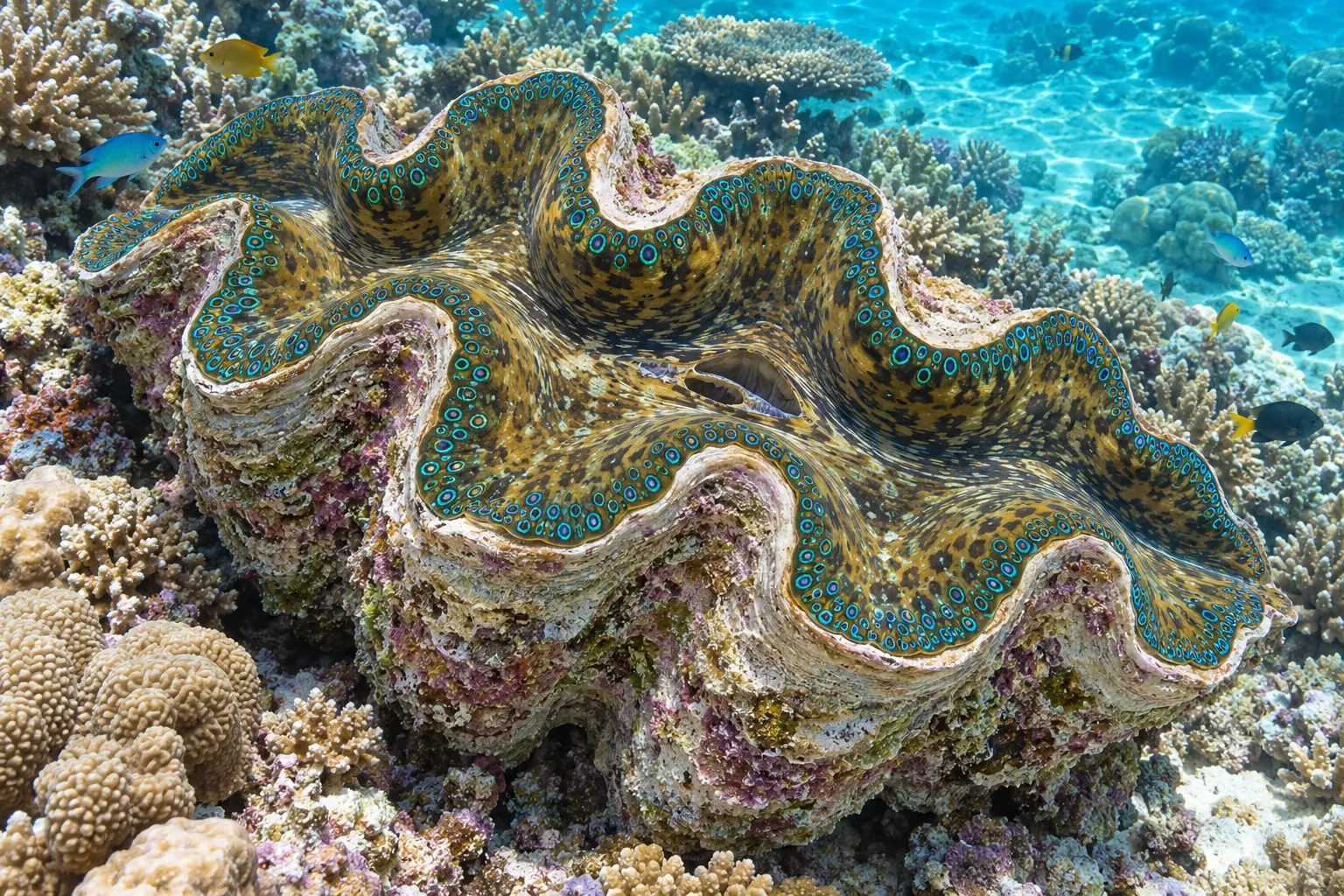
Native to the Indo-Pacific and found on shallow coral reefs at roughly 2–20 m according to NOAA. Adults remain fixed on well-lit reef substrate; historical range occupancy has contracted and abundance is very low in many areas after harvesting. [1,2]
NOAA reports lengths up to about 51 inches—nearly 1.3 m—and weights above 500 pounds, or over 225 kg. These are maximum values; juveniles and most individuals are far smaller. [1]
The massive shell has 4–5 strong radial folds, a wavy margin and a small byssal opening; the mantle is often yellow-brown to olive with iridescent blue-green rings or spots. Mantle colour alone is unsafe because lighting and individuals vary greatly. [1,2]
An expanded mantle houses symbiotic algae and reflective structures that distribute light through tissue; light-sensitive organs detect shadows and trigger closure. The massive shell protects the body but demands stable support in managed care. [1–3]
Behaviour and ecology
Adults are essentially sessile, opening to expose the mantle to light and closing when shaded or disturbed. They do not ‘hunt’ or trap people; handling risk centres on damaging the clam’s soft tissue, hinge or attachment substrate. [1,2]
Diet
It receives much of its energy from photosynthate produced by mantle symbionts while also filtering plankton and dissolved organic material from the water. More food cannot compensate for unsuitable light or unstable water quality. [2,3]
Reproduction and life cycle
A simultaneous hermaphrodite and broadcast spawner, usually releasing sperm before eggs to reduce self-fertilisation. Planktonic larvae later settle and acquire symbionts; synchronised spawning means removal of adults can sharply reduce fertilisation. [2,3]
Ecosystem role
It filters water, recycles nutrients, supplies hard structure and produces eggs and larvae for reef food webs. Living and dead shells both create microhabitat, so losing large clams reduces biological function and physical complexity. [2,3]
Threats & conservation
Harvest for meat and shell, reef loss, heat-driven bleaching, acidification, pollution and disease are major pressures. Every transfer requires species identity, cultured origin, Appendix II documents and national-law checks; a U.S. ESA proposal must not be presented as an effective final ban. [1–5]
Reviewed 3 October 2026: IUCN retains VU from a 1996 assessment, which is old; NOAA currently describes a proposal to list the species as Endangered under U.S. law, but a proposal is not a final rule. CITES regulates it in Appendix II. These three frameworks have different scopes and must not be merged into one legal conclusion. [1–5]5 sourced facts
Species in five facts
It is the largest living bivalve. [1]
Exceptional individuals can approach 1.3 m and exceed 225 kg. [1]
Symbiotic algae in the mantle provide much of its photosynthetic energy. [2,3]
It releases sperm before eggs during a spawning event, reducing self-fertilisation. [2,3]
All giant clams have been in CITES Appendix II since 1985. [3,5]
Sources
[1] NOAA Fisheries — True Giant Clam[2] NOAA Fisheries — Giant clam resources[3] NOAA Fisheries — Proposed giant-clam rule FAQ[4] IUCN Red List search — Tridacna gigas[5] CITES Appendices effective 5 March 2026