
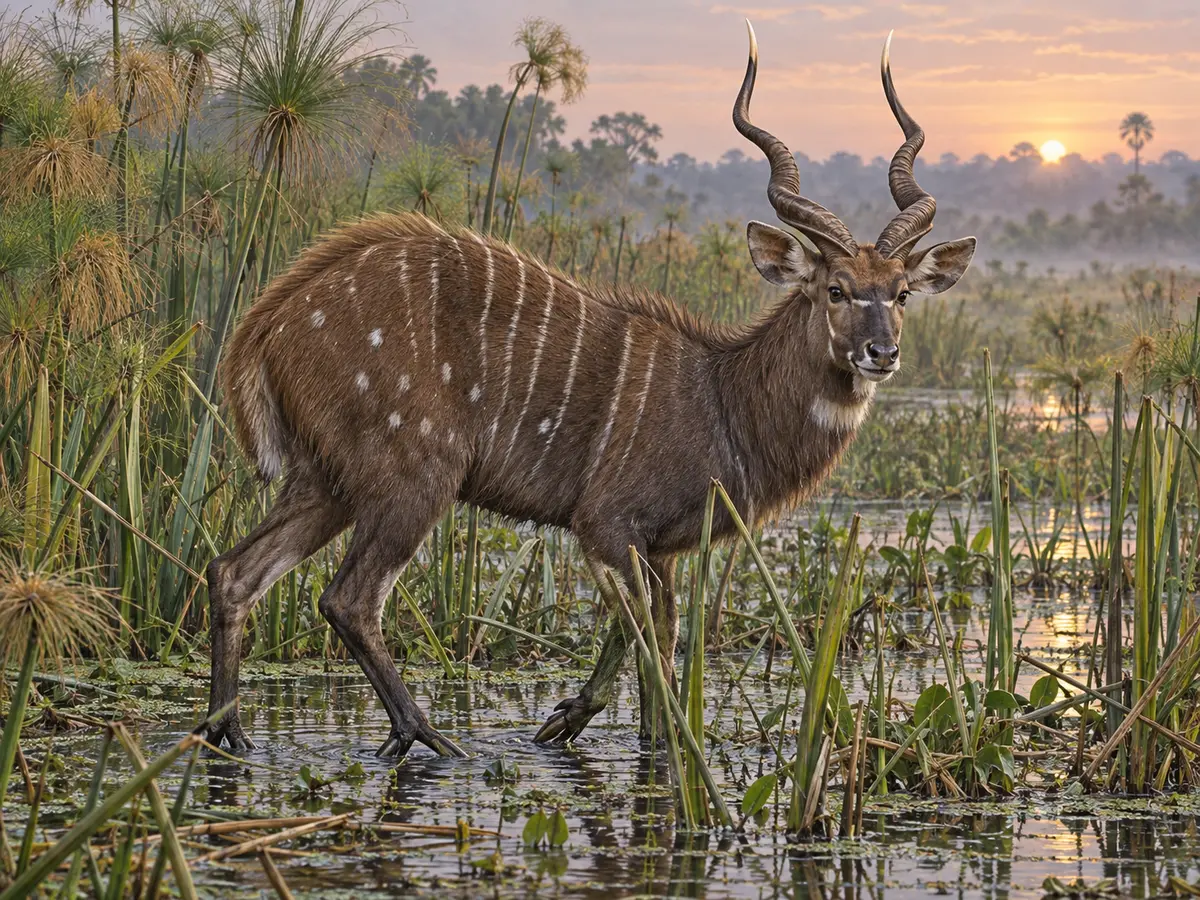
Patchily distributed in Central, East and parts of southern Africa, tied to swamps, reedbeds, papyrus, lake margins and seasonally flooded forest. Populations can become isolated when wetlands are drained or fragmented. [1,2]
Smithsonian reports females around 115 cm long, males around 160 cm, and species mass roughly 50–125 kg. Males are markedly larger and horned; these values are not universal targets for every subspecies or age. [1]
Adult males are chocolate to grey-brown with spiral horns; females and young are chestnut. Both sexes carry variable white spots and stripes; long, widely separated flexible hooves leave distinctive tracks in mud. [1]
Splayed hooves enlarge contact area and reduce sinking, while flexible lower limbs suit unstable substrate. Water-resistant hair, longer hind legs and closable nostrils aid swimming and immersion in swamps. [1]
Behaviour and ecology
Often solitary or in small groups and most active around dawn and dusk. When alarmed, a sitatunga may enter reeds or submerge nearly its whole body with only the nostrils exposed; it also rests on compressed vegetation platforms. [1]
Diet
Browses and grazes on grasses, shoots, leaves, flowers, seeds, papyrus and reeds and may enter crops. As a ruminant it requires varied roughage and gradual diet changes to protect rumen microbes. [1]
Reproduction and life cycle
Gestation is about seven months and usually produces one calf of roughly 3.5–4 kg. Calves lie hidden in vegetation and are visited for nursing; females mature around one year and males later. [1]
Ecosystem role
Feeding on reeds, grasses and aquatic plants alters vegetation structure; sitatunga also transport seeds and serve as prey for large carnivores. Hooves and trails open small routes through marsh vegetation. [1]
Threats & conservation
Wetland drainage, development, habitat isolation and hunting cause local declines. Managed care needs soft but stable footing, escapable water, secure barriers and hoof-skin monitoring; swamp adaptation does not mean tolerance of continuously fouled wet substrate. [1,2]
IUCN and the Mammal Diversity Database record the species as Least Concern (LC). Tragelaphus spekii was not located in the CITES Appendices effective 5 March 2026; neither LC nor an unlocated CITES name replaces hunting, origin, veterinary, quarantine or welfare law. [2,3]5 sourced facts
Species in five facts
Long splayed hooves distribute weight over mud. [1]
It is a strong swimmer and can submerge almost completely. [1]
Only males carry long spiral horns. [1]
Calves usually hide rather than follow the mother continuously. [1]
Sitatunga rest on compressed vegetation platforms in swamps. [1]
Sources
[1] Smithsonian's National Zoo — Sitatunga[2] Mammal Diversity Database — Tragelaphus spekii[3] CITES Appendices effective 5 March 2026