
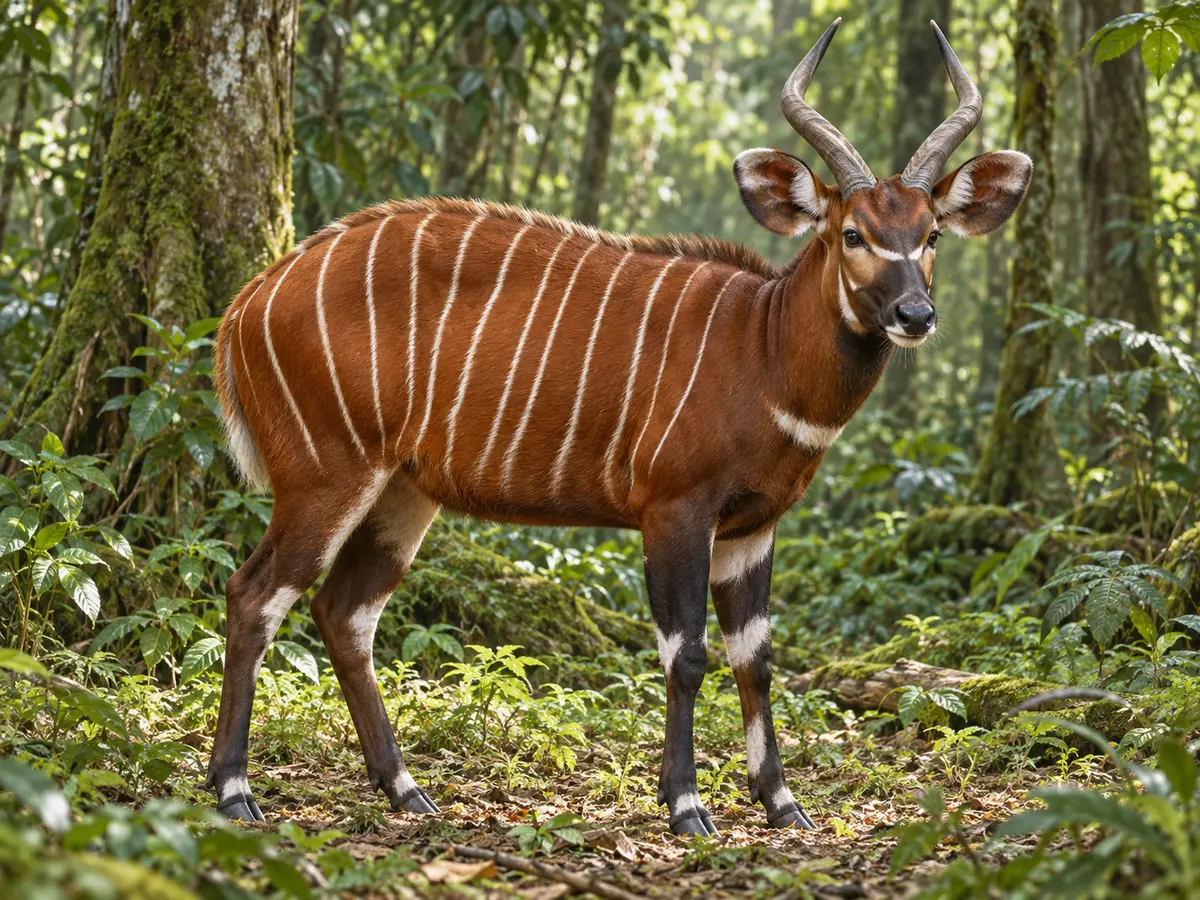
Fragmented populations occupy rainforest and forest-transition habitats in West and Central Africa; the small mountain-bongo population persists in Kenyan highland forests. The species uses dense understory, forest openings and areas with bamboo or fresh growth, and commonly visits mineral licks. [1–3,6]
Animal Diversity Web reports females around 210–235 kg, males 240–405 kg and horns about 75–99 cm long; zoo sources may give lower ranges for managed populations. These are reference ranges, not stand-alone criteria for age or sex. [2,3]
A robust body, relatively short legs for dense cover, large ears, a short dorsal crest and pale white-to-yellow stripes running down the flanks are characteristic. Both sexes have open spiralled horns; mature males are often darker, although forest light strongly alters apparent colour in photographs. [2,3]
Vertical stripes break up the body outline in dappled forest light; large ears aid sound detection in cover and backward-sweeping horns help passage through vegetation. Broad split hooves provide purchase on soft ground. [2,3]
Behaviour and ecology
Bongos are secretive and may be active by day or night, often resting in cover and visiting mineral licks when disturbance is low. Females and young may form small to large groups, whereas mature males are more often solitary. [2,3]
Diet
The species is herbivorous, browsing leaves, shoots, twigs and flowers while also taking grasses and some fruit; mineral licks supply salts and minerals. Managed diets need high fibre and safe browse rather than assumptions based on open-grassland grazers. [2,3]
Reproduction and life cycle
ADW reports gestation of about 282–285 days and usually a single calf. Calves hide in vegetation early in life before following the mother; slow maturation and long reproductive intervals limit recovery when adults are removed from the wild. [2]
Ecosystem role
By browsing, eating fruit and moving between openings and dense forest, Bongos influence plant regeneration and seed movement. This role is inferred from documented diet and movement, not a quantified effect for every forest. [1,2]
Threats & conservation
Forest loss and fragmentation, hunting and population isolation are major pressures. The mountain bongo T. e. isaaci is at far greater risk than the species-level NT category; every acquisition record must verify subspecies, lawful captive origin, pedigree and national permits before consideration. [1,6]
The IUCN assessment published in 2016 lists the species as Near Threatened (NT). Ghana formerly listed the Bongo in CITES Appendix III, but that entry was deleted effective 3 May 2007; the name is absent from the Appendices effective 5 March 2026. Some older pages still show Appendix III and should not be used for current status. Absence from CITES is not permission for unrestricted collection or trade. [1,4,5]5 sourced facts
Species in five facts
Both males and females carry spiralled horns. [2,3]
The coat commonly bears 10–15 pale vertical stripes. [2]
Gestation lasts roughly nine months and usually produces one calf. [2]
Bongos regularly visit natural mineral licks. [2,3]
The former CITES Appendix III entry was deleted in 2007. [4,5]
Sources
[1] IUCN Red List 2016 — Tragelaphus eurycerus[2] Animal Diversity Web — Tragelaphus eurycerus[3] North Carolina Zoo — Bongo[4] CITES Appendices effective 5 March 2026[5] CITES — History of listings[6] 2025 genomic study — mountain and lowland bongo