
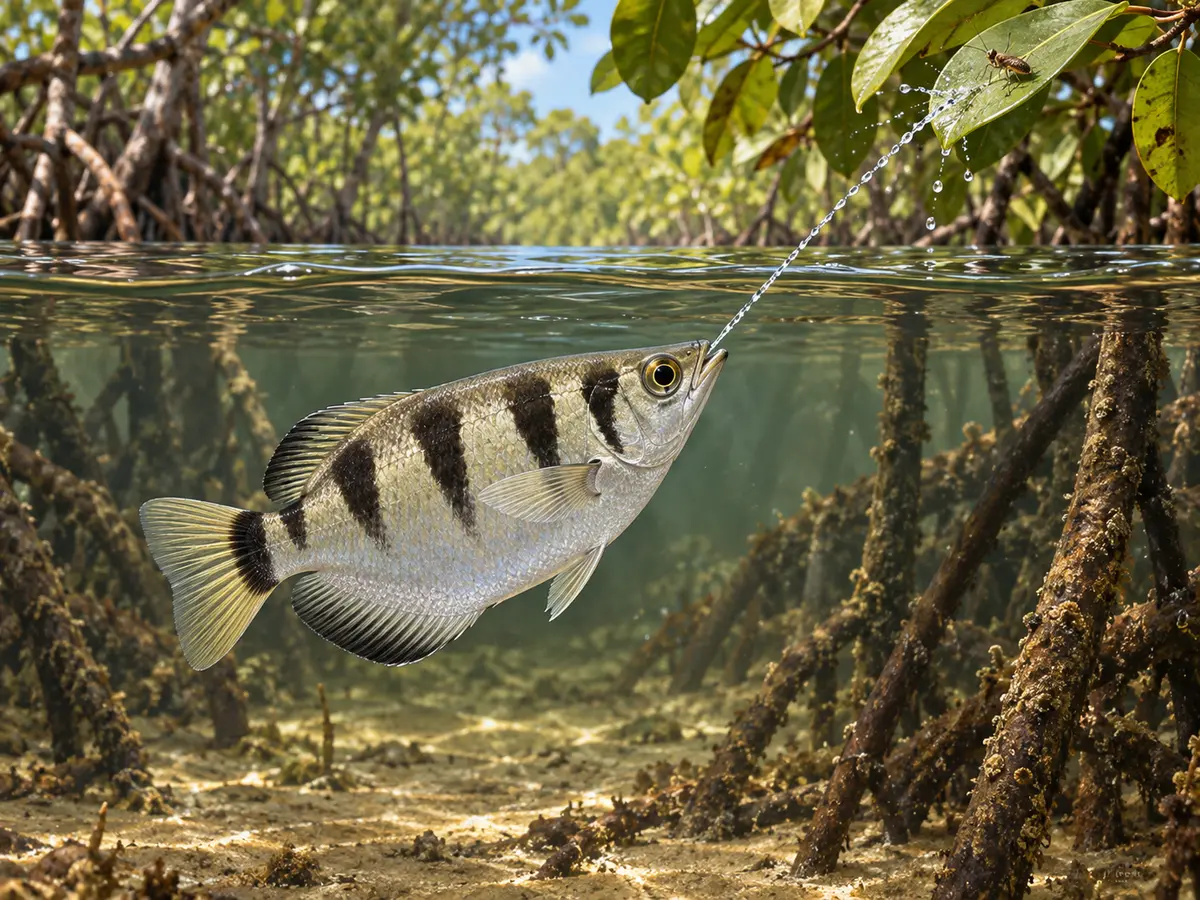
Widely distributed in the Indo-Pacific from South Asia through Southeast Asia, the Philippines and New Guinea to northern Australia. It occurs mainly in mangroves, estuaries and brackish water; the Australian Museum notes that it is only rarely encountered in freshwater. [2,3]
The Australian Museum reports a maximum size of about 30 cm. Fish in trade are often much smaller, and length does not reveal whether an individual has been acclimated to fresh or brackish water. [2]
The body is silver-white and laterally compressed, with an upturned mouth and posterior dorsal fin; 4–5 wedge-shaped black bars mark the upper half. Bar number and shape require checking because other Toxotes bear spots or additional bands. [2]
The tongue presses against a groove in the roof of the mouth to form a tube; rapid gill-cover closure forces water through it as a jet. Large eyes, an upturned mouth and targeting through a refractive interface form an integrated surface-hunting system. [2]
Behaviour and ecology
The fish patrols just below the surface, targets insects on foliage and fires a water jet; large archerfishes can hit targets 2–3 m away according to the Australian Museum. It also rushes to the landing point and forages within the water. [2,3]
Diet
Feeds on terrestrial and aquatic insects, crustaceans, larvae and occasionally small fishes; research in Malaysian coastal waters describes T. jaculatrix as an opportunistic predator. Some plant material may be swallowed, but that does not make it herbivorous. [3,5]
Reproduction and life cycle
Wild reproduction remains poorly documented. Sampling in coastal Johor, Malaysia found mature females and spawning concentrated in November–December during the monsoon; this locality-specific result should not be transferred unchanged across the whole range. [5,6]
Ecosystem role
By consuming insects that fall or are shot from vegetation, the fish transfers energy from mangrove canopy into aquatic food webs while also taking crustaceans and small fishes. It is a clear example of ecological linkage across the water surface. [2,5]
Threats & conservation
Mangrove loss, estuarine degradation, pollution and poorly controlled collection can affect populations despite the 2011 LC assessment. DinoJura must verify captive origin, salinity history, aquatic quarantine and a tall, broad enclosure with above-water space; neither fish nor tank water should enter natural waterways. [1,3,5]
FishBase cites an IUCN assessment dated 16 September 2011 listing Toxotes jaculatrix as Least Concern (LC); the age of this assessment must be stated. The name was not located in the CITES Appendices effective 5 March 2026. Neither point permits unrestricted collection, import, export or release. [1,4]5 sourced facts
Species in five facts
Large archerfishes can hit targets 2–3 m away. [2]
T. jaculatrix usually has 4–5 black bars on the upper body. [2]
The Australian Museum gives a maximum length of about 30 cm. [2]
The tongue and roof of the mouth form the water-shooting tube. [2]
A Johor study found spawning concentrated in November–December. [5,6]
Sources
[1] FishBase — Toxotes jaculatrix[2] Australian Museum — Banded Archerfish[3] Animal Diversity Web — Toxotes jaculatrix[4] CITES Appendices effective 5 March 2026[5] Simon et al. — population, trophic level and reproduction[6] Simon et al. — reproductive biology of archerfishes