
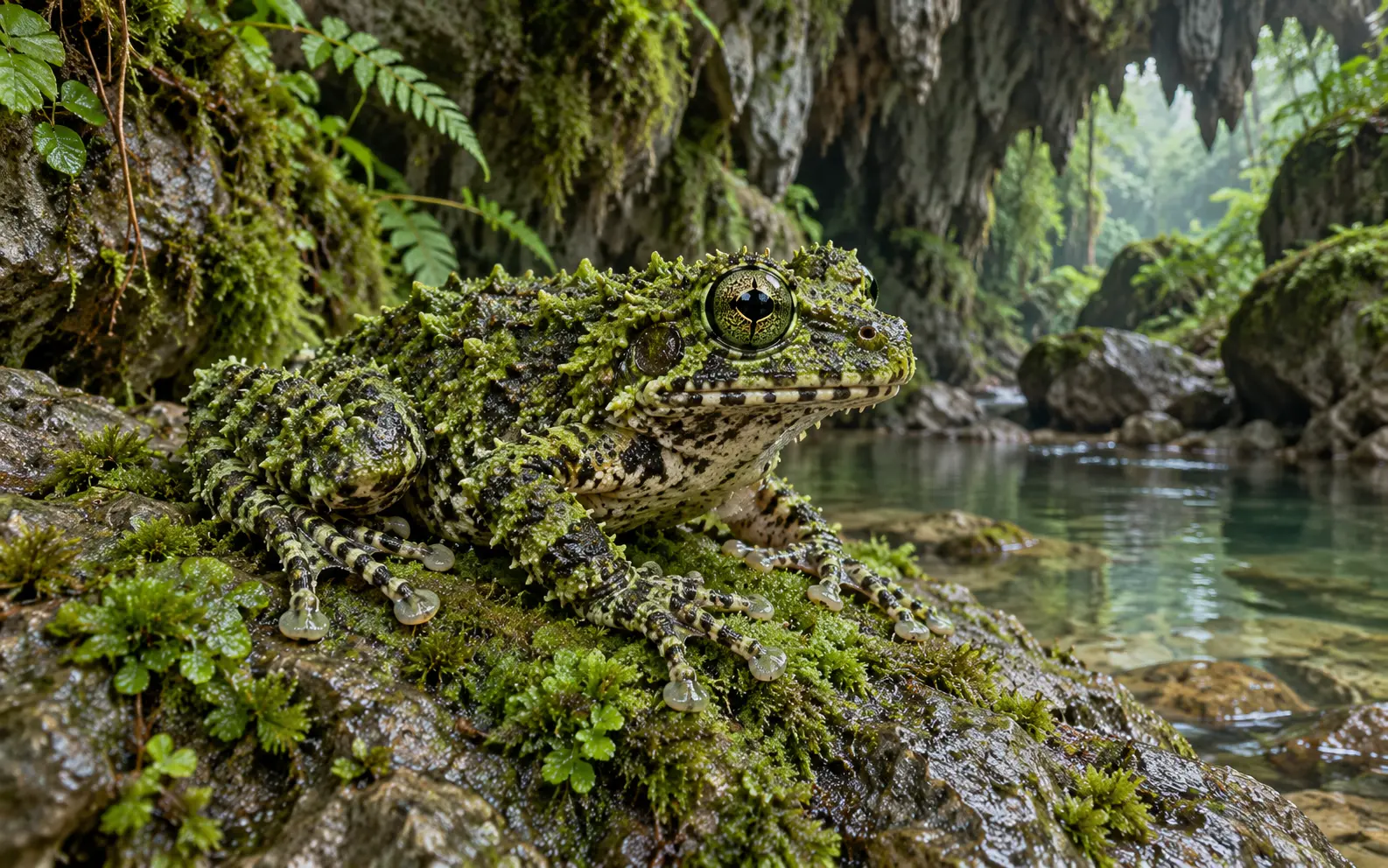
Described from northern Vietnam and now recorded more broadly from northern Vietnam and parts of adjacent southern China and Laos depending on taxonomic treatment. It is often found near pools, rock cavities, caves and forest streams, with many records around 700–1,000 m. [1–3]
Adults commonly measure about 7–8 cm snout-to-vent, with females generally larger than males. It is a medium-sized frog whose tuberculate skin makes the outline appear bulkier than its actual dimensions. [1]
The back bears green, brown and black tubercles and folds; the dark belly has pale marks, with large eyes and expanded toe discs. Colour alone cannot confirm the species because several Theloderma share moss-like camouflage; locality, call and morphology require comparison. [1–3]
Tuberculate skin and irregular colours mimic moss and lichen, while expanded toe discs grip wet surfaces. Remaining still or feigning death only works when the microhabitat retains natural structure that conceals the outline. [1]
Behaviour and ecology
Nocturnal, it climbs rock and vegetation near water and hides in crevices or remains tightly curled by day. When threatened it may draw in the limbs, flatten the body and feign death, merging with moss rather than fleeing immediately. [1]
Diet
It hunts insects and other small invertebrates; in managed care it may take crickets, cockroaches and appropriately sized prey. Prey diversity, gut loading and controlled mineral supplementation matter more than simply increasing one feeder species. [1]
Reproduction and life cycle
Females place clusters of about 8–10 eggs on rock or vegetation just above water; they hatch after roughly 7–14 days and the tadpoles drop into the water. Metamorphosis may take about three months depending on temperature and water quality. [1]
Ecosystem role
As an insect predator and prey for snakes, birds and other animals, it links the tadpole's aquatic phase to the adult terrestrial food web. Permeable skin makes population health responsive to both water quality and streamside forest. [1,2]
Threats & conservation
Deforestation, development that alters water flow and collection for the pet trade create local pressure despite global LC status. Facilities need lawful origin, chytrid and ranavirus quarantine, clean cool water and balanced humidity-ventilation; captive frogs must never be released. [1,2]
Reviewed 28 September 2026: AmphibiaWeb reports IUCN Least Concern (LC) and no CITES listing; the name was also not located in the Appendices effective 5 March 2026. The recognised range has changed with taxonomic synonymy, so individual geographic provenance and veterinary records remain essential.5 sourced facts
Species in five facts
Tuberculate skin breaks up the body outline among moss and wet rock. [1]
Adults are commonly about 7–8 cm long. [1]
Eggs are placed above water rather than submerged directly in a pool. [1]
When threatened, the species may curl up and feign death. [1]
The name was not located in the CITES Appendices effective 5 March 2026. [2,4]
Sources
[1] Smithsonian's National Zoo — Vietnamese mossy frog[2] AmphibiaWeb — Theloderma corticale[3] American Museum of Natural History — Amphibian Species of the World[4] CITES Appendices effective 5 March 2026