
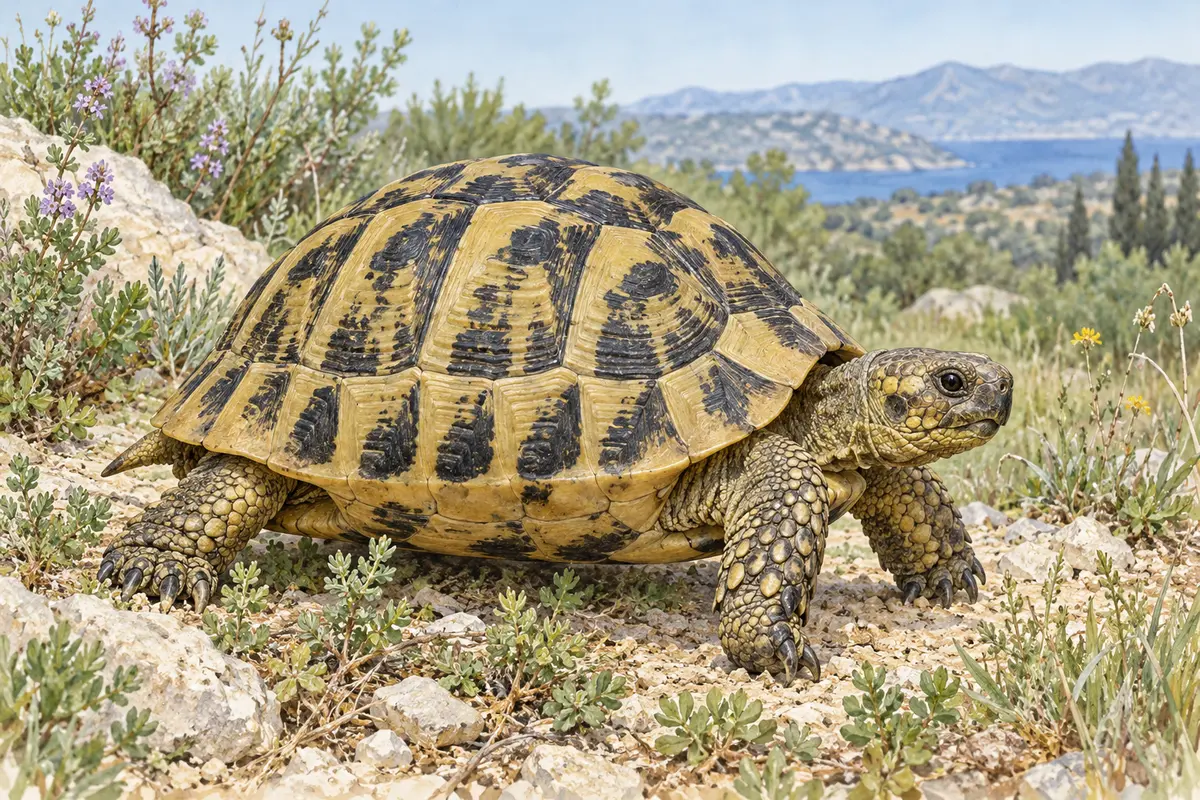
Patchily distributed from Spain and France through Italy and the Balkans to European Turkey. Favours semi-open mosaics of low vegetation, shrubs and cover. [3]
The specialist account gives average shell lengths around 13–18 cm depending on population; females are usually larger. Shell length excludes head and tail. [3]
A domed yellow-and-black shell, sturdy scaled limbs, horny tail tip and usually divided supracaudal scute help distinguish it from other Testudo tortoises. [4]
The shell protects the body, and head and limbs can retract. Activity timing and shelter use help this ectotherm regulate temperature. [4]
Behaviour and ecology
Diurnal, with reduced activity in cold conditions and shelter-seeking during intense heat. Cycles depend on locality; one hibernation timetable cannot fit every individual. [4,5]
Diet
Feeds mainly on grasses, leaves and flowers. Natural diet descriptions do not replace nutritional assessment and safe plant selection in care. [5]
Reproduction and life cycle
Eggs are buried in soil nests, usually in 1–2 clutches annually. The specialist account gives average clutches around 3–4 eggs, varying among populations. [3]
Ecosystem role
Consumes low vegetation; eggs and young also enter prey networks. Nutrient-cycling implications follow from diet and are not quantified here. [4,5]
Threats & conservation
Habitat loss, fragmentation, fire and collection are pressures. Landscape protection and preventing wild collection should accompany provenance management in captivity. [2,3,5]
Reviewed 20 October 2026: indexed IUCN material and its 2025 reptile report give VU, superseding NT on older pages. Direct assessment details were unavailable. Zoo material corroborates CITES II; a direct current full-text check remains incomplete. [1,2,5,6]5 sourced facts
Species in five facts
The NT category on some older pages is outdated. [1,2]
Females are usually larger than males. [3]
Head and limbs can retract into the shell. [4]
Eggs are buried in soil. [3]
The tail ends in a horny tip. [4]
Sources
[1] IUCN — indexed Testudo hermanni record[2] IUCN — European Red List Pulse, Reptiles 2025[3] IUCN/SSC Tortoise Specialist Group — biological account, older category superseded[4] Animal Diversity Web — biology only[5] Gdańsk Zoo — diet, behaviour and CITES; old IUCN category not used[6] CITES Appendix text — current retrieval incomplete