
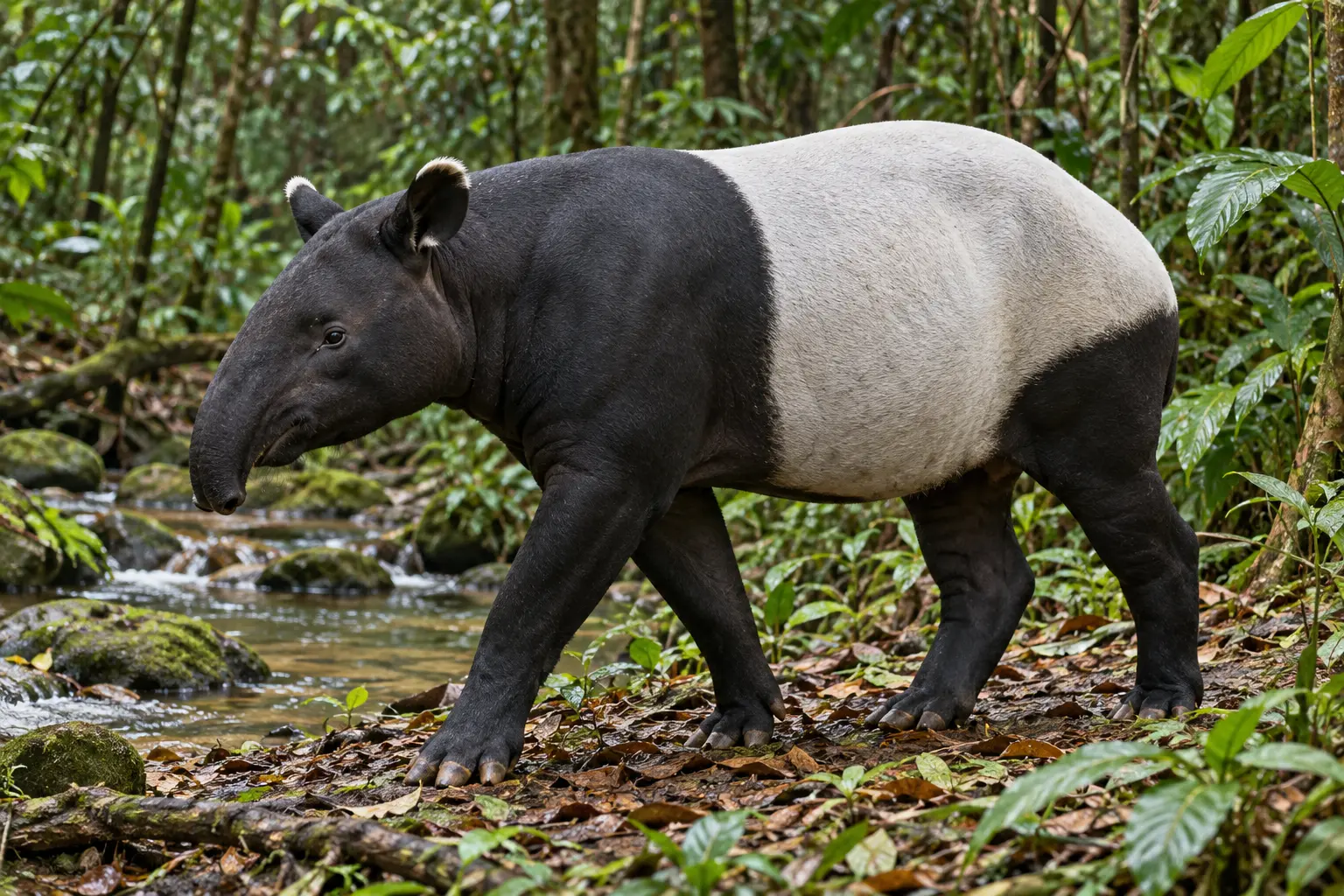
Now fragmented across southern Myanmar and Thailand, Peninsular Malaysia and Sumatra south of Lake Toba. It uses lowland rainforest, swamp forest, river margins and connected secondary forest, typically needing water and dense cover. [1]
Roughly 1.8–2.5 m long and up to about 320 kg according to the IUCN SSC Tapir Specialist Group. Females are generally larger than males, with mass varying by age, sex and body condition. [1]
Head, neck, shoulders and legs are black, with a broad cream-white saddle across the back and flanks before black hindquarters. Rounded ears have white rims and the snout forms a short flexible proboscis; calves are dark with pale stripes and spots. [1,2]
The proboscis is an extended nose and upper lip used for smell and food manipulation. Four front toes and three hind toes spread weight on soft ground; black-white colour disrupts the outline in patchy forest light. [2]
Behaviour and ecology
Mostly solitary and strongly crepuscular-nocturnal, it follows familiar paths among feeding sites, water and mineral licks. It swims well and can submerge briefly; scent, calls and dung sites aid communication in dense forest. [1,2]
Diet
Feeds on young leaves, shoots, soft twigs, aquatic plants and many fallen fruits. The short proboscis pulls browse and picks food; managed diets require high fibre, diverse browse and controlled energy. [1,2]
Reproduction and life cycle
Gestation is about 13 months and usually produces one calf. The striped-spotted young gradually develops adult colour during its early months. Long birth intervals make populations slow to recover from hunting or fragmentation. [2]
Ecosystem role
By eating fruit and depositing seeds along travel routes, it helps disperse large seeds and move material among forest patches. Dung feeds beetles and decomposers, returning nutrients to soil. [1]
Threats & conservation
Forest loss and fragmentation, roads, vehicle collisions, wire snares and hunting are major pressures. Projects should withhold sensitive localities, audit corridors and road crossings, exclude animals of uncertain origin and consider transfers only through authority-approved conservation programmes. [1–4]
Reviewed 25 September 2026: IUCN records EN; CITES Appendix I strictly controls international trade. Local population estimates carry substantial uncertainty, so this profile does not turn dated figures into a global population claim.5 sourced facts
Species in five facts
It is the only tapir native outside the Americas. [1]
The Malayan tapir is the largest of the four living tapir species. [1]
Calves carry pale stripes and spots instead of the adult white saddle. [2]
Forefeet have four toes and hind feet have three. [2]
It swims well and commonly links travel routes to water. [2]
Sources
[1] IUCN SSC Tapir Specialist Group — Malayan tapir[2] San Diego Zoo Wildlife Alliance — Tapir[3] IUCN Red List species search[4] CITES Appendices effective 5 March 2026