
Breeds patchily in Europe, North Africa and much of Central Asia, with many populations moving south in winter. Uses fresh or saline lakes, rivers, marshes, grasslands and open ground near water. [1,2]
About 58–70 cm long with a wingspan near 110–135 cm; a large, fairly long-necked shelduck with broad wings. [2]
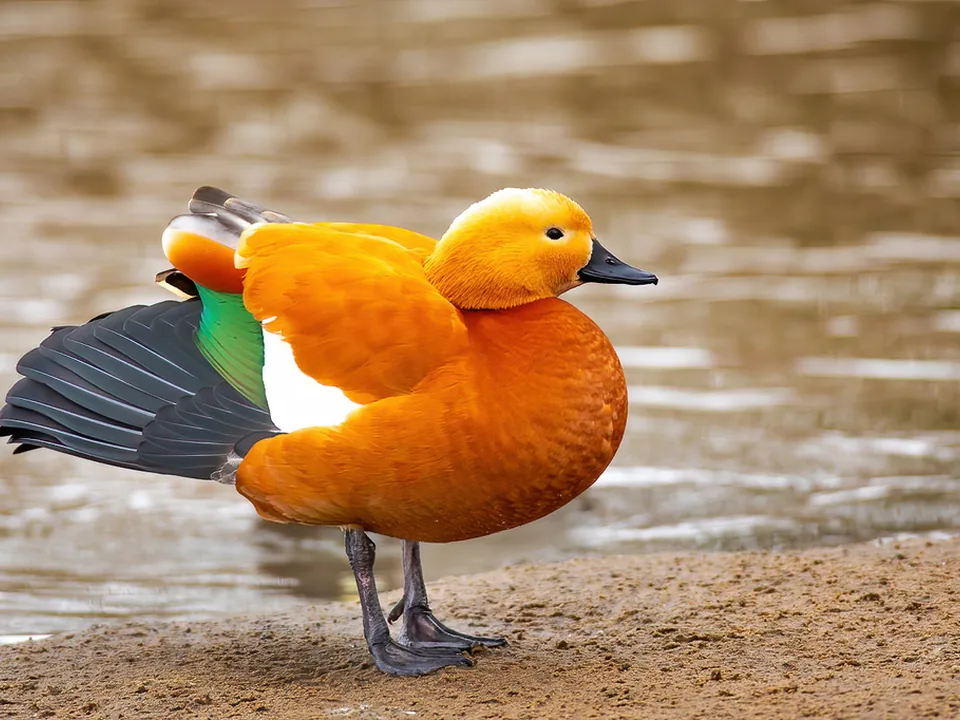
Russet-orange body, paler head, large white wing panels and black flight feathers; breeding males have a narrow black neck ring, while females often show a paler face. [2]
Strong legs support both swimming and terrestrial feeding; bold white-and-black wing panels aid in-flight recognition, while flexible cavity use broadens nesting options. [2]
Behaviour and ecology
Usually paired in the breeding season and flocking outside it. Swims and grazes along shores, and may fly long distances among breeding, moulting and wintering sites. [1,2]
Diet
Diet centres on grasses, shoots, seeds, grain and aquatic plants, supplemented by insects, crustaceans, molluscs and other small aquatic animals. [1,2]
Reproduction and life cycle
Nests in rock clefts, tree cavities, animal burrows or buildings, sometimes far from water. Around eight eggs are usual; the female incubates for nearly four weeks and both parents guard the young. [1,2]
Ecosystem role
Feeds on plants and invertebrates at the land-water interface, contributing to nutrient cycling; eggs and young also feed a range of predators. [1; ecological interpretation]
Threats & conservation
BirdLife evaluates the species globally as LC, while local populations may face wetland loss, hunting, breeding-site disturbance and declining water quality. LC does not imply every population is stable. [1]
Reviewed 18 September 2026: BirdLife, the IUCN Red List authority for birds, evaluates the species as LC. Its name could not be reliably confirmed against the current CITES Appendices through the available interface; no trade entitlement is inferred and national rules still require checking.5 sourced facts
Species in five facts
Breeding males have a narrow black neck ring. [2]
Nests may lie far from water in rock cavities or animal burrows. [2]
Both parents defend the brood. [2]
The species uses both fresh and saline lakes. [1]
BirdLife evaluates its global status as Least Concern. [1]
Sources
[1] BirdLife DataZone — Ruddy Shelduck[2] Cincinnati Zoo — Ruddy Shelduck[Ảnh] iNaturalist observation 72753388 — egorbirder, CC BY