
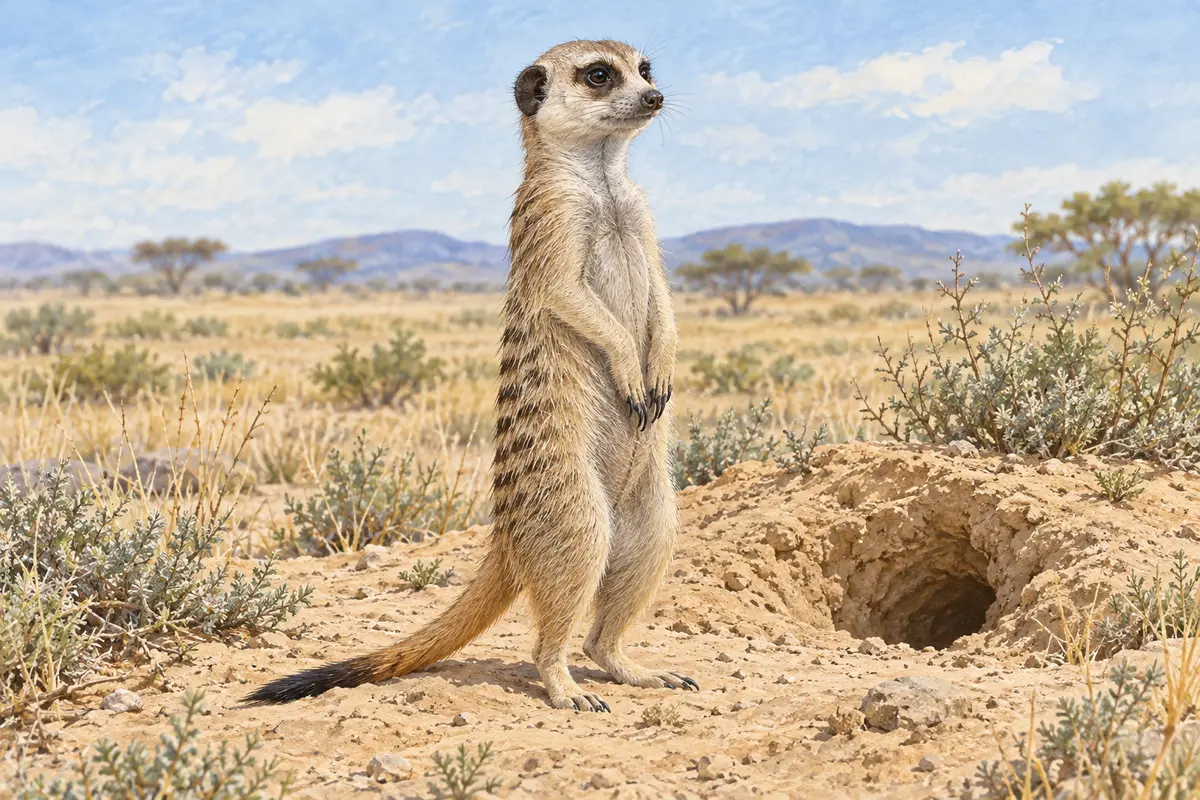
ASM records Angola, Botswana, Namibia and South Africa. The species uses dry, open landscapes with diggable ground and suitable foraging habitat. [3,4]
San Diego Zoo reports a 24–29 cm body and mass of 620–969 g. This excludes the tail and does not describe all mongoose species. [2]
A slender body, pointed snout, small ears, dark eye patches and transverse back bars are characteristic. The long thin tail differs from bushy-tailed lookalikes. [2,3]
Long foreclaws aid digging and the ears can close against soil. Burrows offer thermal refuge as well as sleeping shelter. [2]
Behaviour and ecology
Diurnal animals bask before digging for food. Individuals watch from vantage points while the group forages; alarm calls help trigger retreat to shelter. [3]
Diet
Primarily insects and larvae, supplemented by other small animals and occasional plant material. Composition varies by season and location. [1]
Reproduction and life cycle
Smithsonian reports roughly 11 weeks of gestation, 2–5 pups and weaning around 6–9 weeks. Non-breeding members also help care for young. [1]
Ecosystem role
Consumes invertebrates and is prey for raptors and jackals. DinoJura inference: digging disturbs soil, but its magnitude is not quantified here. [3]
Threats & conservation
LC does not imply suitability for solitary pet keeping. Social, burrowing and foraging needs require provision; habitat protection and professional welfare assessment remain priorities. [1,2,4]
Reviewed 20 October 2026: ASM and Smithsonian report IUCN Least Concern; the direct assessment was unavailable. An earlier CITES check found no Suricata entry, but current Appendix retrieval errors prevent independent confirmation today. [1,4,5,6]5 sourced facts
Species in five facts
A mongoose, not a cat. [4]
Digging claws are not retractile like cats' claws. [2]
Non-breeders can help rear pups. [1]
Lookout duty is shared. [3]
Ears can close during digging. [2]
Sources
[1] Smithsonian National Zoo — Meerkat[2] San Diego Zoo Wildlife Alliance — Meerkat[3] Animal Diversity Web — Suricata suricatta[4] American Society of Mammalogists — taxonomy and IUCN status[5] CITES text effective 05/03/2026 — retrieval incomplete[6] IUCN assessment — direct access restricted