
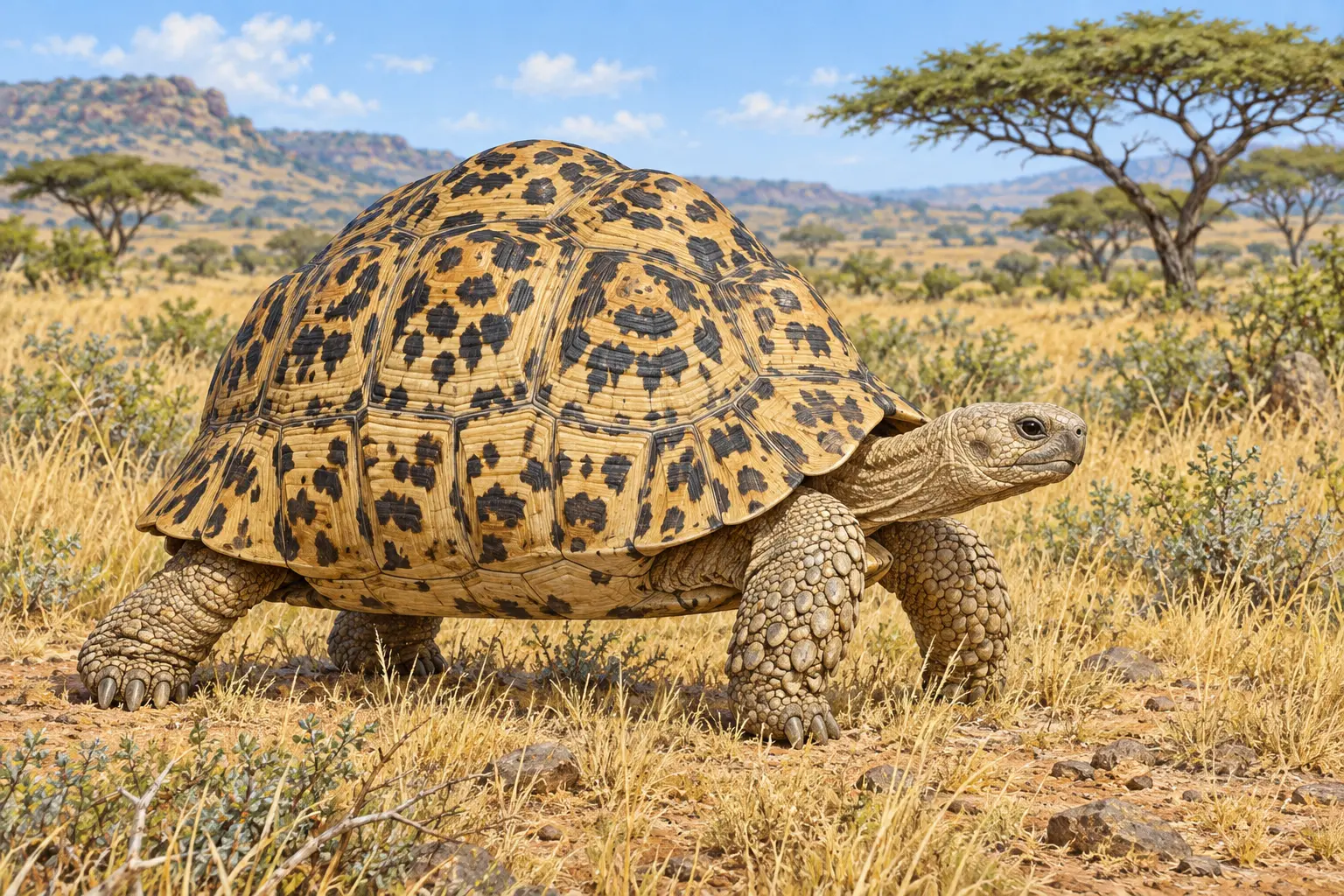
Broadly but discontinuously distributed from East Africa into southern Africa, in habitats ranging from dry savanna and semi-desert to moister grassland. It generally avoids closed dense forest and needs low vegetation, thermal refuges and suitable nesting ground. [1,2]
Large individuals can exceed 50 cm in carapace length and 30 kg, although most are substantially smaller; size varies with region and sex. These are values for large animals, not a default size for every leopard tortoise. [1]
The shell is strongly domed, usually cream-yellow to brown with irregular dark blotches, rings or streaks on each scute, and the columnar limbs carry large scales. Markings may fade in older animals, so contrast alone cannot determine age or locality. [1,2]
A domed shell and sturdy limbs protect the animal across grass and rocky ground, while the long neck reaches higher browse than in many tortoises. Seasonal drought tolerance does not justify withholding water, shade or microclimate choice in managed care. [1]
Behaviour and ecology
Diurnal but temperature-dependent, it commonly forages in the morning or late afternoon and shelters under shrubs, in shallow retreats or rock shade during heat. Males may ram, bite and attempt to overturn rivals during breeding. [1]
Diet
Primarily a grazer of fibrous grasses and low plants, with opportunistic use of leaves, flowers, fallen fruit and succulents. In managed care, high fibre, adequate calcium-UVB provision and controlled energy are more appropriate than sweet fruit or protein-rich foods. [1]
Reproduction and life cycle
Females excavate soil nests and lay hard-shelled eggs, sometimes producing multiple clutches in a favourable season. Clutch size and incubation vary with body size, temperature and region, so one captive-breeding figure should not be applied to every population. [1,2]
Ecosystem role
As a large herbivore it crops low vegetation, transports seeds and redistributes nutrients in dung. Movement and nesting also disturb soil at small scales, linking grazing to microhabitat structure. [1]
Threats & conservation
Habitat loss, fire, electric fencing, collection for food, traditional medicine and trade create local pressure. Release programmes must address provenance genetics, disease and habitat; captive animals should never be released or mixed across regions without authority-led assessment. [1,3–5]
Reviewed 27 September 2026: IUCN records LC in the 2015 assessment. CITES regulates the species in Appendix II through the Testudinidae listing; LC status or captive breeding does not replace permits, specimen identification and a continuous provenance record.5 sourced facts
Species in five facts
Large individuals can exceed 50 cm and 30 kg. [1]
It uses both semi-arid country and moister grassland, not a single savanna type. [1,2]
The Reptile Database does not currently recognise the historical subspecies once widely used. [2]
Genetics can help identify an appropriate source region for release. [1]
CITES regulates international trade under Appendix II. [5]
Sources
[1] Senckenberg — Return to nature: leopard tortoises released in South Africa (2026)[2] The Reptile Database — Stigmochelys pardalis[3] IUCN Red List species search[4] SANBI Species Status — Leopard tortoise[5] CITES Appendices effective 5 March 2026