
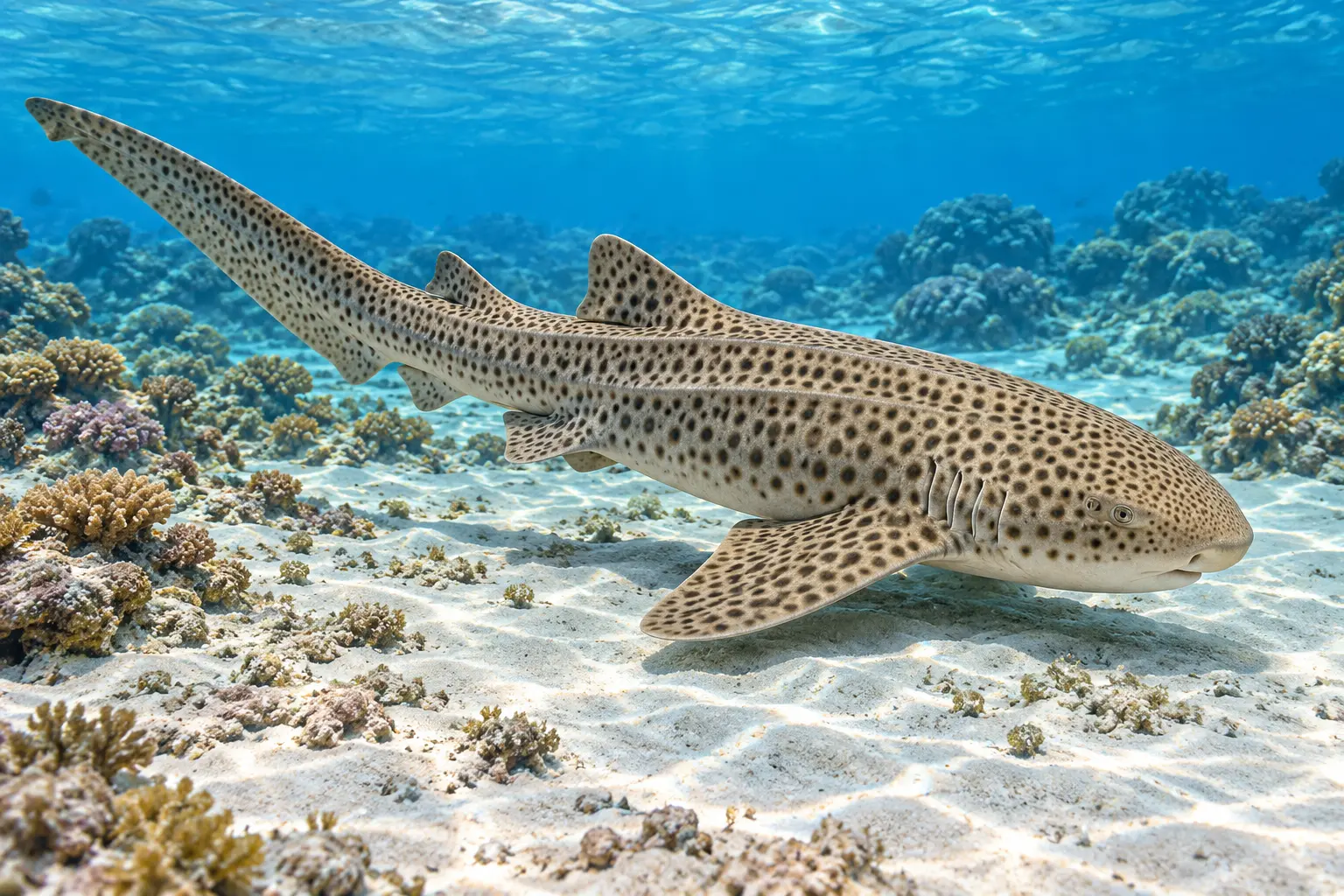
Widely distributed across the tropical Indian and western Pacific Oceans, from the Red Sea and East Africa through South and Southeast Asia to southern Japan, northern Australia and western Pacific islands. It uses shallow sand, coral and rubble bottoms, usually around 5–30 m but sometimes deeper. [2,3]
Reliably documented length is about 2.5 m; FishBase reports a 3.54 m maximum from its references, which should be interpreted cautiously. The tail approaches half the total length, so managed-space calculations cannot use pre-caudal body length alone. [2,3]
The broad head has a rounded snout with small sensory barbels, five gill slits and two close spineless dorsal fins. Adults carry five longitudinal ridges, dense dark spots and a tiny lower tail lobe; juveniles below roughly 70–90 cm remain striped and were once mistaken for another species. [2,3]
The long tail supports stable swimming near the bottom, dorsal ridges stiffen the body and age-changing pattern suits different life stages. A flexible body, sensory barbels and suction feeding form a toolkit for extracting prey from crevices inaccessible to many larger predators. [2–4]
Behaviour and ecology
Usually rests on the bottom by day, sometimes propping on pectoral fins to maintain water flow over the gills, and hunts more at night. The flexible body enters reef crevices, while seasonal aggregations occur in some areas although the species is often solitary. [2–4]
Diet
Feeds mainly on gastropods, bivalves, crabs and shrimps, with small fishes also taken. Snout barbels and electrochemical senses locate hidden prey, while the small ventral mouth generates suction to extract prey from crevices. [2,4]
Reproduction and life cycle
Oviparous, producing large dark egg cases about 17 cm long with fibres that anchor them to the substrate. Hatchlings are roughly 20–26 cm. Low reproductive output and slow population recovery make the species sensitive to sustained exploitation. [2,3]
Ecosystem role
As a mid-to-upper benthic predator, zebra sharks consume molluscs and crustaceans and influence reef and sand-flat communities. Decline may alter predation pressure on invertebrates and signal overexploitation of reef systems. [2,4]
Threats & conservation
Targeted and incidental fishing, reef degradation, meat-fin markets and slow recovery have driven decline across much of the range outside Australia. The StAR project is testing recovery in Indonesia; any breed-and-release work needs pedigree, disease, behaviour and source-population genetics management, never ad-hoc release. [4,5]
Reviewed 26 September 2026: FishBase cites the 2023 global IUCN assessment as EN. Neither Stegostoma tigrinum nor the recent synonym Stegostoma fasciatum was located in the CITES Appendices effective 5 March 2026; this is not a conclusion that trade is permitted, because fisheries, species-protection and national rules still require transaction-level review.5 sourced facts
Species in five facts
Juveniles are striped; adults transform to a spotted pattern. [2,3]
The tail can approach half the animal's total length. [2]
The species has five prominent longitudinal ridges along the back and sides. [2,3]
Egg cases are about 17 cm long and carry fibres that anchor them to the bottom. [2]
FishBase and the Australian Museum use Stegostoma tigrinum; S. fasciatum is a common synonym. [2,3]
Sources
[1] Florida Museum — Zebra shark[2] Australian Museum — Stegostoma tigrinum[3] FishBase — Stegostoma tigrinum[4] Monterey Bay Aquarium — Zebra shark[5] ReShark — StAR Project[6] CITES Appendices effective 5 March 2026