
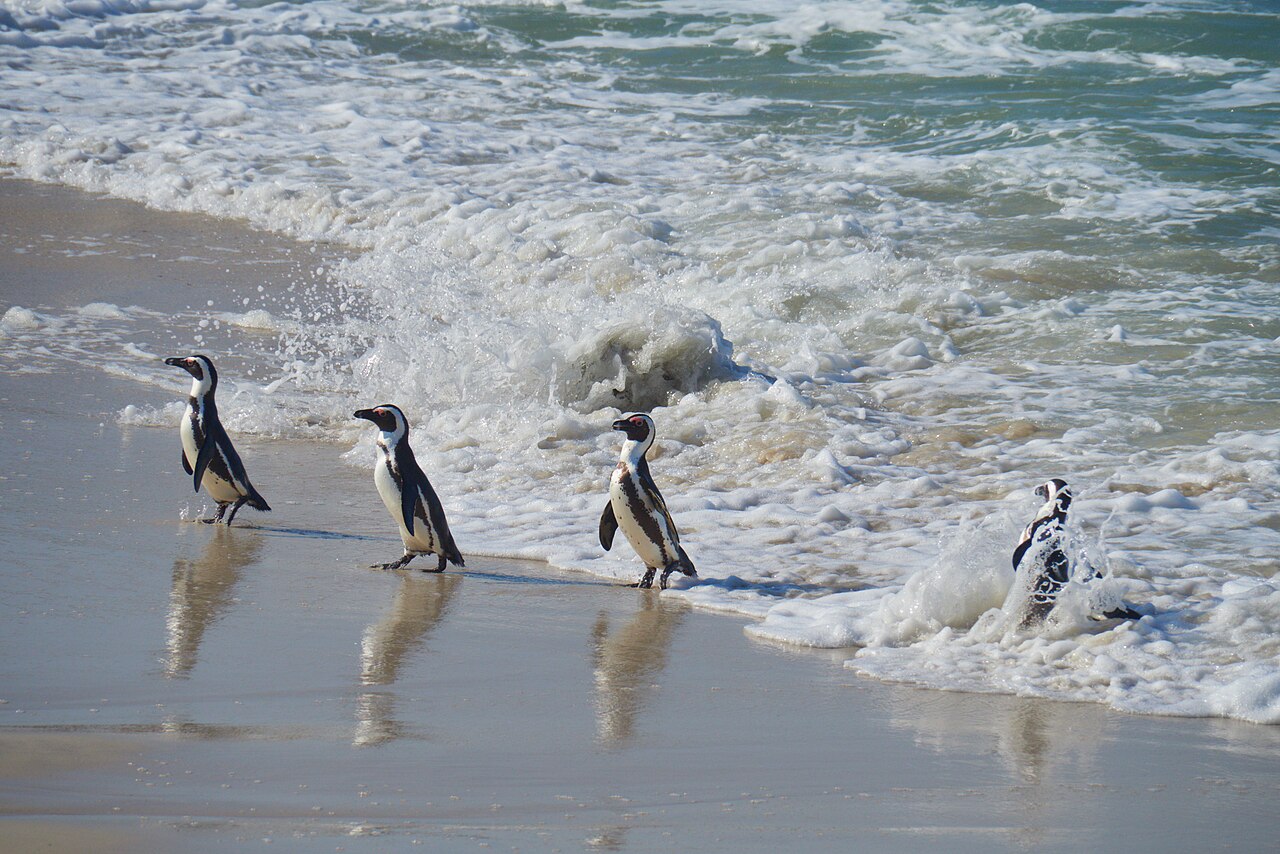
Breeds along Namibia and South Africa, mostly on islands plus two mainland colonies; forages in coastal waters rich in small pelagic fish. [1,2]
SANBI records a height of about 55–65 cm and mass of roughly 2.9–3.5 kg. [2]
Black above and white below with a horseshoe-shaped chest band; black breast and belly spots form individual patterns. Pink skin around the eyes assists heat loss. [1,2]
Wings form flippers, heavy bones aid diving, overlapping feathers retain insulating air and countershading reduces detection underwater. [1]
Behaviour and ecology
Colonial at breeding sites and pursues fish by swimming and diving; its donkey-like bray inspired the former name ‘jackass penguin’. [1]
Diet
Mainly eats small pelagic fish such as sardines, anchovies and horse mackerel, with squid and crustaceans varying by place and season. [1,2]
Reproduction and life cycle
Usually lays 1–2 eggs; both parents incubate for about 38–41 days. SANBI reports fledging at roughly 70–90 days. [1]
Ecosystem role
A mid-level fish predator and sensitive indicator of coastal prey resources; breeding trends reflect food, climate and fisheries pressures. [2,3]
Threats & conservation
Food shortage from shifting fish distribution and fisheries competition, oil spills, nesting-site degradation, disease and disturbance are major risks; the species is now CR. [2,3]
Reviewed 17 September 2026: BirdLife confirms the species was uplisted from EN to CR in the 2024 update. Appendix II was cross-checked in the CITES Appendices effective 5 March 2026; national rules and permits still require separate verification.5 sourced facts
Species in five facts
Belly-spot patterns differ among individuals. [1]
It is the penguin species breeding on mainland Africa and nearby islands. [1,2]
Its call can resemble a donkey’s bray. [1]
Both parents share incubation. [1]
Pink skin above the eyes contributes to heat regulation. [1]
Sources
[1] SANBI — African Penguin[2] SANBI Species Status — Spheniscus demersus[3] BirdLife DataZone — African Penguin[4] CITES Appendices — effective 5 March 2026[Ảnh] Wikimedia Commons — lumoplank, CC0