
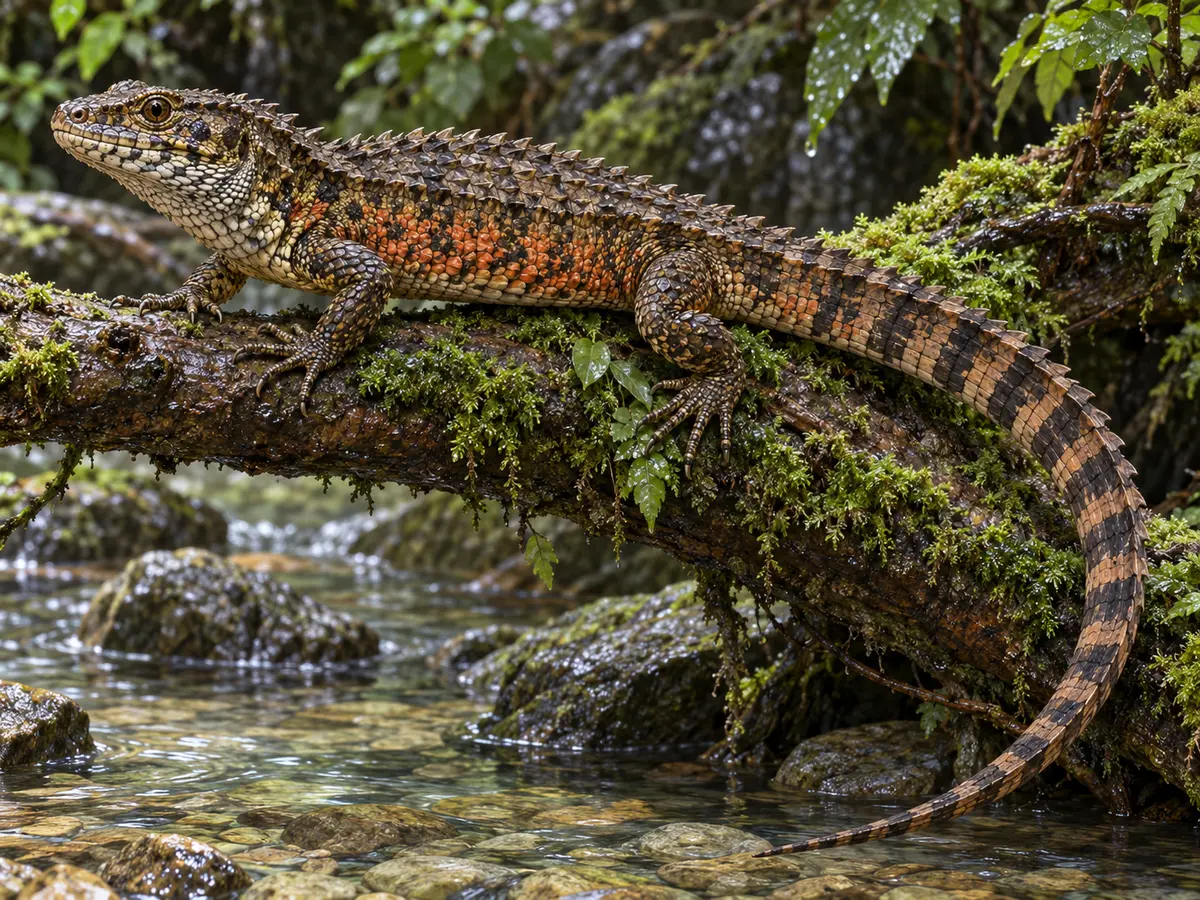
Remaining populations are fragmented in southern China and northeastern Vietnam, with large gaps between localities. Records span about 200–1,500 m in China and 400–800 m in Vietnam, around ponds and slow streams in subtropical forest. [1,2]
Total length can approach 40 cm, much of it a long laterally compressed tail. Males are generally larger, broader-headed and show stronger red-orange colour on the throat and flanks, especially in breeding season. [1,2]
The body is grey-brown with a yellow-tan underside and red-orange throat and flanks, grading into light and dark tail bands. Two rigid raised scale rows on the tail are diagnostic, but Chinese versus Vietnamese origin needs records and expertise, not photographs alone. [1,2]
A laterally compressed tail provides aquatic thrust, claws grip streamside branches and respiratory control supports underwater escape. Prolonged immobility conserves energy; brumation allows survival when water falls below about 15.5°C. [1]
Behaviour and ecology
Diurnal and territorial, often remaining motionless on low branches above water. When threatened it dives, swims with the powerful tail and can regulate breathing to stay submerged; in cold months it may brumate in rock crevices or tree holes. [1]
Diet
Feeds mainly on invertebrates and small waterside prey, including snails, worms, insects, larvae and tadpoles. Managed diets need diverse prey, controlled mineral provision and no unquarantined wild-caught feeders. [1]
Reproduction and life cycle
The species is viviparous: sexual maturity is reached around three years, breeding occurs mainly in July–August and females produce two to 12 young after about nine months. Newborns are precocial, feed soon after birth and receive no parental care. [1]
Ecosystem role
It preys on snails, insects, worms and tadpoles at the stream–forest boundary and is prey for snakes, birds and small mammals. Its presence reflects streams retaining shade, cool water and relatively intact bankside structure. [1,2]
Threats & conservation
Logging, mining, dams, roads, farming, stream pollution and collection for pets or traditional medicine drive decline. Appendix I demands strict control; DinoJura must exclude wild animals mislabelled captive-bred and audit breeders, pedigree, permits and cool-water microclimate. [1–5]
The 2014 IUCN assessment lists the species as Endangered (EN). CITES transferred Shinisaurus crocodilurus from Appendix II to Appendix I at CoP17, effective in 2017; some zoo pages still display the old Appendix-II status, so this profile uses the Appendices effective 5 March 2026 as the legal reference. [1–5]5 sourced facts
Species in five facts
The species survives in fragmented populations in China and Vietnam. [1,2]
Sexual maturity is reached at about three years. [1]
Females bear two to 12 young after about nine months. [1]
They may brumate when cold-season water falls below about 15.5°C. [1]
The species was transferred to CITES Appendix I, effective in 2017. [3–5]
Sources
[1] Smithsonian's National Zoo — Chinese crocodile lizard[2] EDGE of Existence — Shinisaurus crocodilurus[3] CITES CoP17 proposal — transfer to Appendix I[4] CITES Appendices effective 5 March 2026[5] Peer-reviewed review — colour variation and conservation