
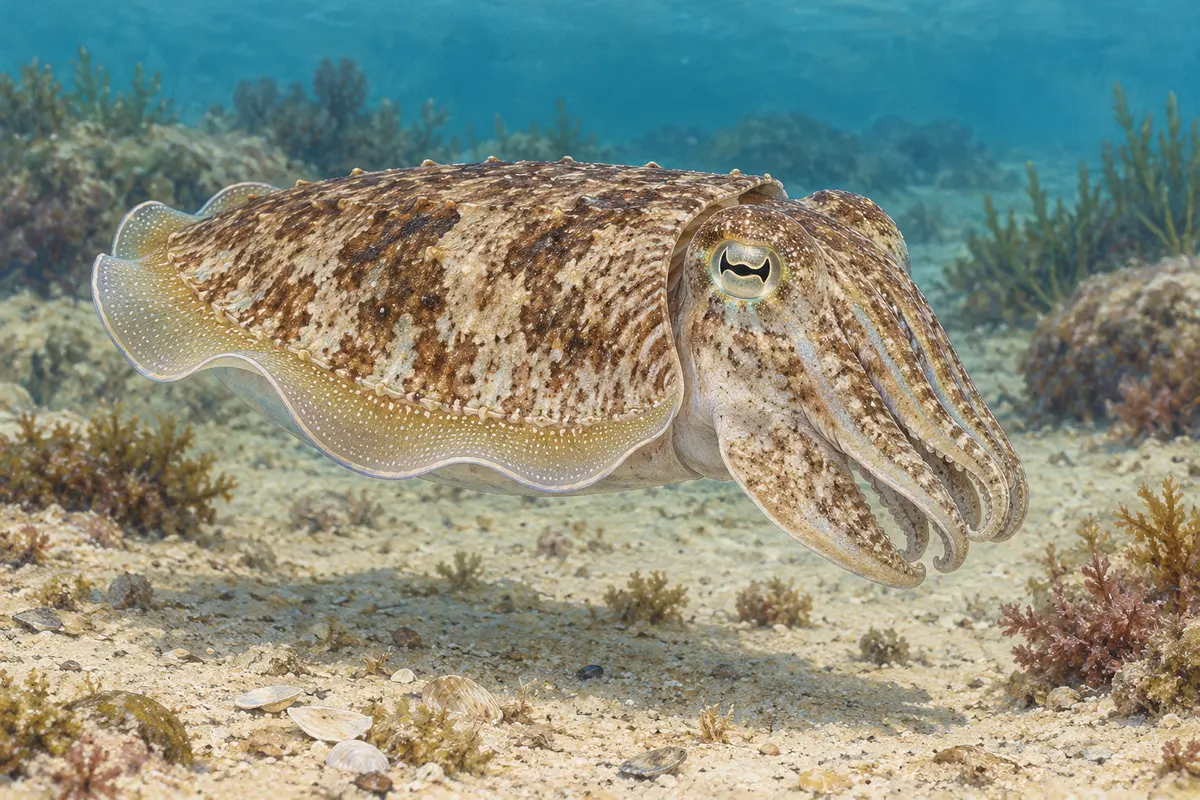
Occurs in the northeastern Atlantic and Mediterranean, commonly over coastal sand and mud. Seagrass provides juvenile shelter and egg-attachment structures. [2]
MarLIN reports a maximum mantle length around 45 cm. Mantle length excludes arms and tentacles; the maximum is not typical of every individual. [2]
A broad flattened mantle, thin lateral fins, eight arms and two retractile feeding tentacles. The internal cuttlebone is not a fish backbone. [1]
Pigment cells, reflective structures and papillae alter colour, pattern and texture. The porous cuttlebone regulates buoyancy, distinct from fin propulsion. [1]
Behaviour and ecology
May move inshore to breed and offshore to overwinter. Stalks prey before projecting its tentacles; migration timing varies among populations. [3]
Diet
Hunts crustaceans, small fish and other molluscs. Tentacles secure prey and bring it to the beak; this diet should not be assigned to every cuttlefish species. [3]
Reproduction and life cycle
Eggs attach to algae or submerged structures, commonly hatching after 30–90 days depending on conditions. Hatchlings resemble miniature cuttlefish; lifespan is usually around 1–2 years. [2,3]
Ecosystem role
Both a benthic predator and prey for large fishes and marine mammals, it links trophic levels. Management should consider breeding habitat as well as adult abundance. [3]
Threats & conservation
Fishing and seabed disturbance can injure animals, damage spawning habitat and remove eggs. Global LC does not replace local assessment; seagrass protection and harvest monitoring remain important. [2]
Reviewed 20 October 2026: Monterey Bay Aquarium reports IUCN Least Concern, but the latest direct assessment was not readable. An earlier Appendix check found no Sepia entry; current retrieval errors prevent independent CITES confirmation today. This is not a stock-safety finding or harvesting permission. [1,4,5]5 sourced facts
Species in five facts
Has eight arms and two feeding tentacles. [1]
The porous cuttlebone is internal. [1]
Skin changes both colour and texture. [1]
Hatchlings resemble miniature cuttlefish. [3]
Mantle length excludes tentacles. [2]
Sources
[1] Monterey Bay Aquarium — Common cuttlefish[2] Marine Biological Association, MarLIN — Sepia officinalis[3] Animal Diversity Web — biology; old conservation entry not used[4] IUCN — direct assessment access incomplete[5] CITES Appendix text — current retrieval incomplete