
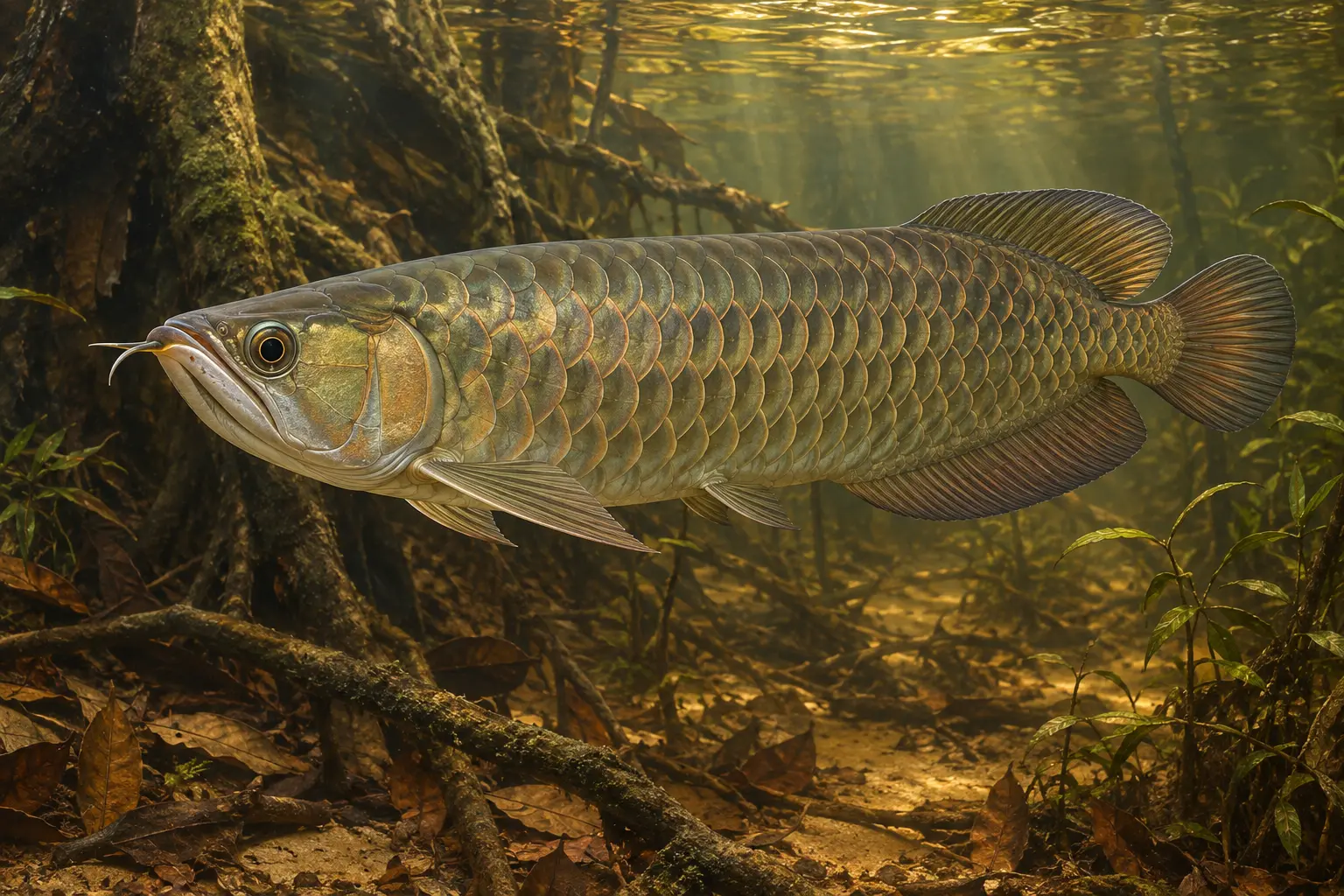
Native to South-East Asia, associated with tannin-stained blackwater rivers, slow channels and forest or peat-swamp streams. Species boundaries and colour forms have been taxonomically debated, so trade names do not replace scientific identification. [1,2]
FishBase reports a maximum total length of about 90 cm, while many individuals are smaller. The body is elongate and laterally compressed, with dorsal and anal fins set far back. [1]
A broad upturned mouth, projecting lower jaw with two tip barbels, very large round scales in rows and long pectoral fins are characteristic. Olive, silver, gold or red colour varies among populations and strains; colour cannot establish species or legal origin. [1,2]
The upturned mouth and sensory barbels support surface feeding; rear-set fins aid short acceleration and large scales protect the body. Powerful jumping is both a foraging adaptation and an escape risk in managed care. [1]
Behaviour and ecology
Usually patrols near the surface and ambushes prey above or at the waterline; it can leap from the water and is linked to riparian canopy in nature. Adults may defend space and should not be assumed compatible in groups. [1,2]
Diet
An opportunistic carnivore taking fish, insects, crustaceans, frogs and small animals falling to the surface; juveniles are more insect-oriented. Natural predation does not justify unquarantined live food in care. [1]
Reproduction and life cycle
Males mouthbrood, carrying large eggs and early fry in the buccal cavity. Late maturity and relatively few, large offspring per breeding event make wild populations sensitive to collection. [1,2]
Ecosystem role
As a surface predator, Asian arowana transfer energy from riparian insects and small fish into larger food-web pathways. Their presence reflects connectivity among riverside forest, hydrology and freshwater habitat quality. [1; ecological interpretation]
Threats & conservation
Collection for the aquarium market, loss of swamp and peat forest, pollution and river fragmentation threaten wild populations. Under Appendix I, each specimen requires checks of registered operation, source code, permits, identification marks and chain of custody. [1,3,4]
Reviewed 21 September 2026: IUCN/FishBase records EN; CITES lists Scleropages formosus in Appendix I. Some captive-bred transactions may use CITES provisions for registered operations, but this never means unrestricted trade and every file requires case-specific review.5 sourced facts
Species in five facts
Reported maximum total length is about 90 cm. [1]
Two barbels at the lower-jaw tip are a conspicuous identification feature. [1]
The male carries eggs and early fry in his mouth. [1,2]
The species commonly inhabits tannin-stained blackwater beneath forest cover. [1]
A commercial colour-strain name does not prove taxonomy or lawful origin. [2–4]
Sources
[1] FishBase — Scleropages formosus[2] Scientific Data — Asian arowana genome and taxonomy[3] CITES — Golden/Asian arowana species page[4] CITES Appendices effective 5 March 2026[5] IUCN Red List species search