
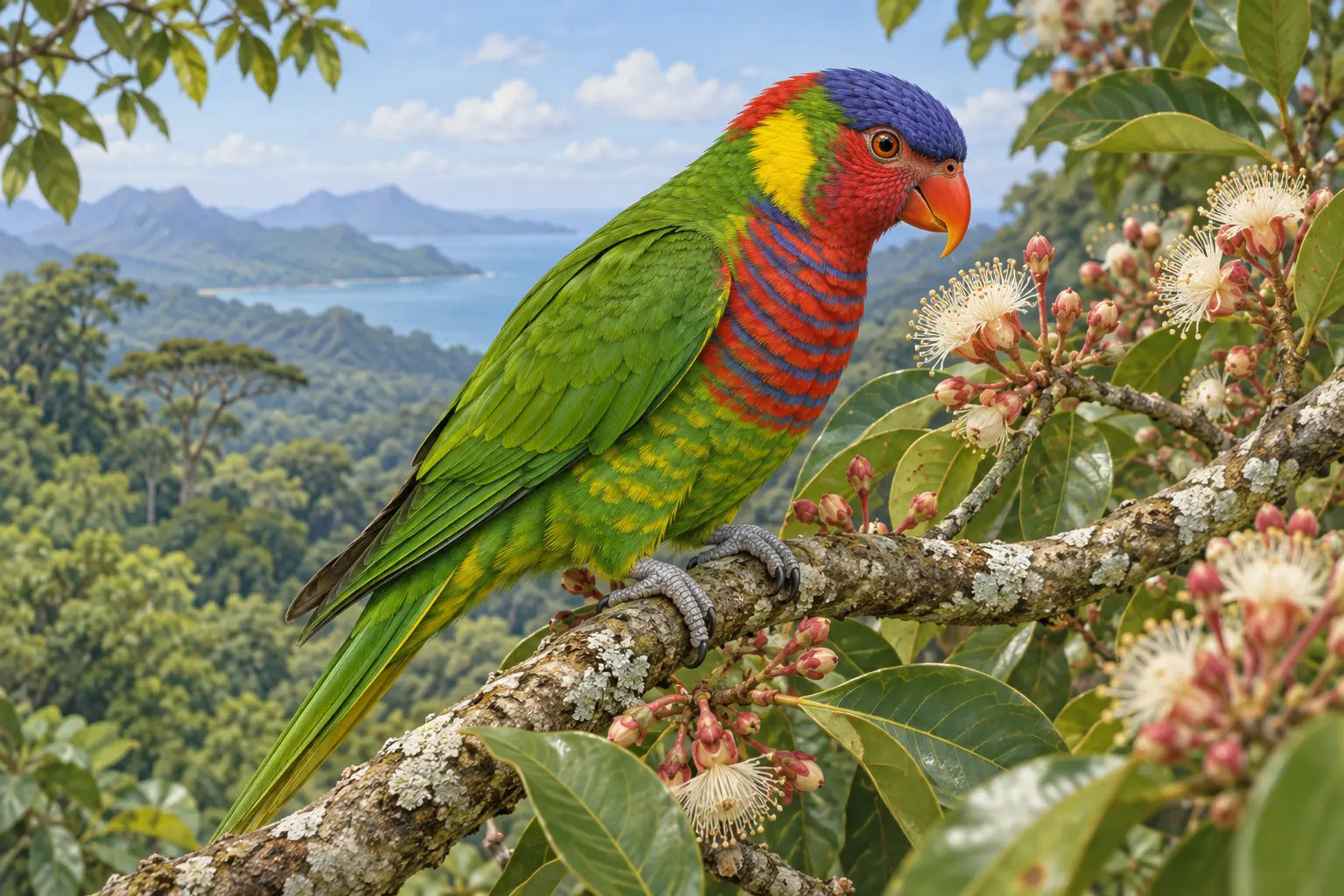
Endemic to Sulawesi and several offshore Indonesian islands. It uses forest, edge, secondary woodland, wooded swamp and cultivated areas retaining flowering or fruiting trees; presence in trade does not establish legal provenance. [1,2]
The World Parrot Trust reports a length of about 25 cm and mass around 110 g. These are species-level reference values, not body-condition thresholds for every sex, age or individual. [1]
The crown is violet-blue; face, throat and upper breast are red with blue barring; a yellow patch marks the nape, while the back and wings are green and the bill orange-red. The complete pattern matters because several regional lorikeets share green bodies and red bills. [1–3]
Brush-like papillae at the tongue tip collect nectar and pollen, and two-forward, two-back toes provide grip and manipulation. Bright plumage supports social recognition while breaking up the outline in dappled foliage. [1,2]
Behaviour and ecology
Usually encountered in pairs or small groups and moves in response to flowering and fruiting resources. A specialised tongue collects nectar and pollen, while the bill and zygodactyl feet support climbing and food handling. [1,2]
Diet
Consumes nectar, pollen, soft fruit, seeds and other plant material. In managed care, lorikeet food must be fresh, hygienic and nutritionally balanced; sugar-rich liquids ferment readily and are not a complete diet. [1]
Reproduction and life cycle
Nests in tree cavities. The World Parrot Trust reports a two-egg clutch and breeding around September–October, but timing may vary locally with food supply; one calendar should not be assumed for every population. [1]
Ecosystem role
Movement among flowers can transfer pollen, and fruit feeding contributes to seed-dispersal networks, although the effect varies with plant species and seed destruction. It also forms prey for canopy predators. [1,2]
Threats & conservation
The current global assessment does not place the species in a threatened category, but habitat loss and undocumented capture may cause local pressure. DinoJura should consider only correctly identified animals with lawful breeding evidence, chain of custody and the required CITES documents. [1,4]
Reviewed 4 October 2026: the World Parrot Trust account lists the species as Least Concern (LC) and CITES Appendix II. Some sources retain the older combination Trichoglossus ornatus; this profile follows the ITIS-accepted name Saudareos ornata. Appendix II still requires transaction-level provenance, permits and national-law checks. [1–4]5 sourced facts
Species in five facts
The species is endemic to Sulawesi and nearby Indonesian islands. [1,2]
Recorded length is about 25 cm. [1]
A brush-tipped tongue is adapted for gathering nectar and pollen. [1]
The accepted current combination is Saudareos ornata. [2,3]
International trade is controlled under CITES Appendix II. [1,4]
Sources
[1] World Parrot Trust — Ornate Lorikeet[2] ITIS — Saudareos ornata[3] Avibase — Ornate Lorikeet[4] CITES Appendices effective 5 March 2026