
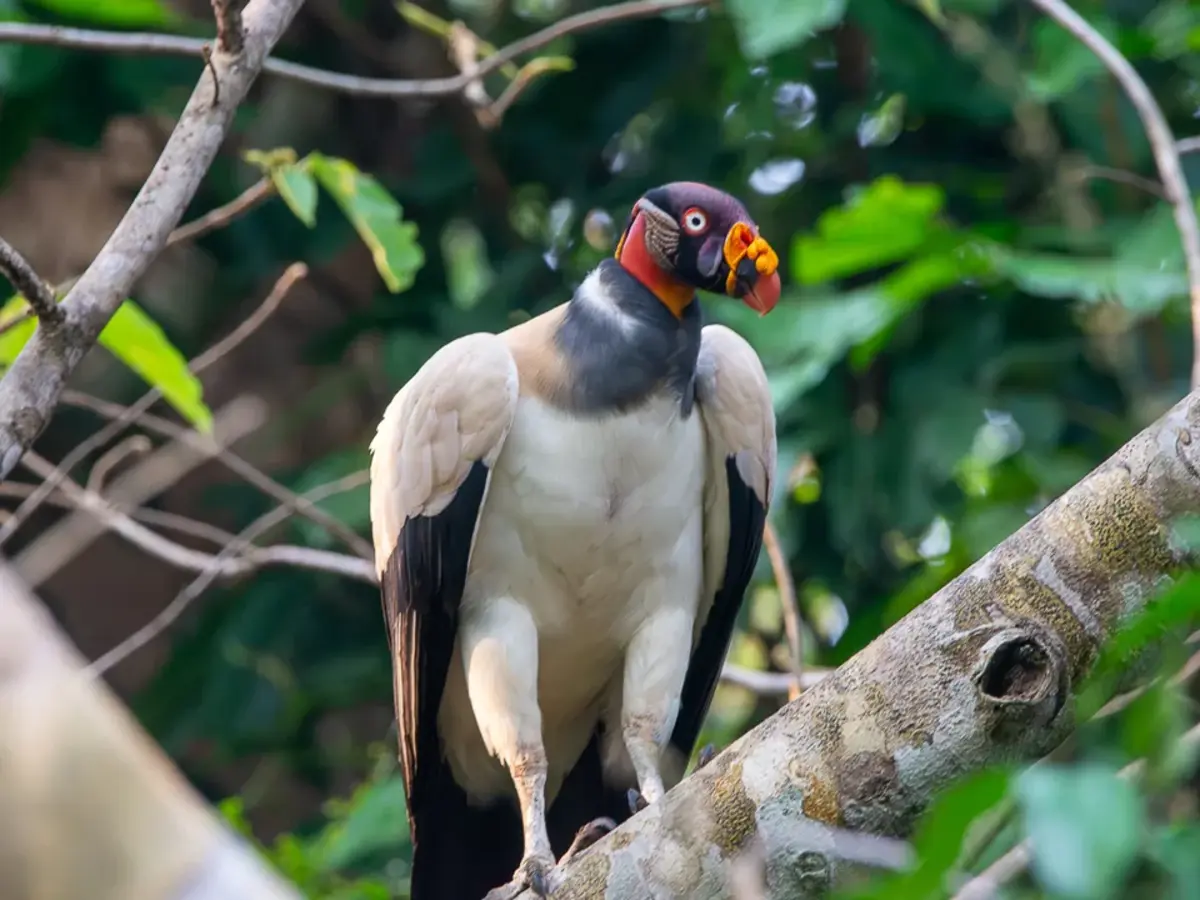
Ranges from southern Mexico through Central America and much of South America to northern Argentina. It mainly occupies relatively intact lowland tropical forest, also foraging in savanna and grassland near forest, with records to about 1,200 m. [1,2]
Length is about 71–81 cm, wingspan 180–198 cm and mass commonly 3–4.5 kg; Smithsonian describes it as about 0.8 m tall and up to 3.7 kg in its account. Differences reflect sources and individuals. [1,2]
Adults are mostly white with dark wing margins, flight feathers, tail and ruff; the bare head and neck carry red, orange, yellow, blue and purple skin, with an orange bill caruncle. Juveniles are dark and take several years to gain adult plumage. [1,2]
A bare head reduces fouling during carrion feeding, broad wings support energy-efficient soaring and the strong bill processes tough tissue. Scavenger digestion and immunity help tolerate microbe-rich food, but do not confer immunity to every pathogen. [1,2]
Behaviour and ecology
Usually solitary or in family units, soaring high on rising air and remaining broadly resident. Its size gives it priority over many vultures at carcasses; sources conflict on olfactory ability, so keen visual searching is the more securely supported claim. [1,2]
Diet
An obligate or near-obligate carrion feeder not known to kill healthy prey. The thick hooked bill and strong neck tear tissue and hide; food carried to chicks is stored in the crop and regurgitated. [1,2]
Reproduction and life cycle
Rather than building an elaborate nest, it lays in tree cavities, rotting stumps, hollow logs or natural crevices. A clutch normally contains one egg; both parents incubate, with compiled accounts giving about 53–58 days, then care for the dependent chick. [1,2]
Ecosystem role
Rapid carcass removal redistributes nutrients and may shorten pathogen persistence on exposed remains. By opening hides for smaller scavengers, king vultures can facilitate as well as compete within the carrion guild. [1,2]
Threats & conservation
Forest loss and fragmentation, secondary poisoning, persecution and depletion of wildlife carcasses are risks. Any transfer requires an Appendix-III check tied to country of origin, CITES documentation, lawful provenance, quarantine, flight space and a safe diet. [1–4]
BirdLife/IUCN lists the species as Least Concern (LC), while decline and forest loss still warrant attention. Sarcoramphus papa is in CITES Appendix III; permit or certificate requirements vary with country of origin and annotations, so each transaction needs a current record check. [1–4]5 sourced facts
Species in five facts
Recorded wingspan is about 180–198 cm. [1]
A clutch normally contains only one egg. [1,2]
Both parents participate in incubation. [1,2]
Compiled incubation time is about 53–58 days. [1]
The species is included in CITES Appendix III. [3,4]
Sources
[1] Animal Diversity Web — Sarcoramphus papa[2] Smithsonian's National Zoo — King vulture[3] BirdLife DataZone — Sarcoramphus papa[4] CITES Appendices effective 5 March 2026Photo record — iNaturalist observation 317498451