
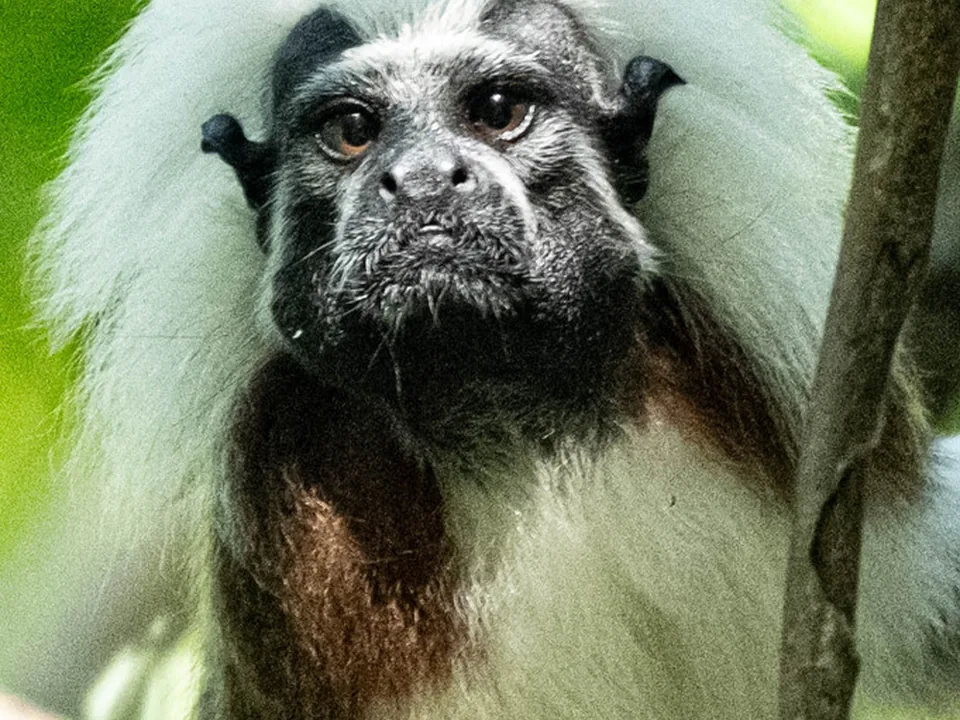
Now confined to tropical and semi-dry forest in north-western Colombia, spending most of its time in the canopy. [1]
Body length is about 18–23 cm, tail about 25 cm and mass roughly 0.5 kg; the tail is longer than the body but is not prehensile. [1]
A white crest runs from forehead to nape, with grey-brown upperparts, reddish thighs and white underparts. Claw-like nails aid grip and movement along branches. [1]
Claw-like nails, low body mass and a balancing tail support rapid branch travel; the crest can be raised when alert to make the animal appear larger. [1]
Behaviour and ecology
Diurnal and social, usually in groups of 2–10 centred on a dominant breeding pair. Smithsonian records at least 38 call types and changes of sleeping site between nights. [1]
Diet
Omnivorous: insects, fruit, nectar, plant sap, gum and nuts, with occasional small lizards, mice or birds. [1]
Reproduction and life cycle
Gestation lasts about five months and non-identical twins are usual. Infants cling to their mother for about three months, while group members share care and foraging instruction. [1]
Ecosystem role
By taking insects as well as fruit, nectar and sap, it participates in canopy nutrient flows and disperses at least some seeds. [1; ecological interpretation]
Threats & conservation
Deforestation, habitat degradation and capture for the illegal pet trade are principal threats. Smithsonian estimates fewer than 6,000 individuals remain in the wild. [1]
Reviewed 18 September 2026: CR was cross-checked through Smithsonian and IUCN records; Saguinus oedipus appears in Appendix I of the CITES Appendices effective 5 March 2026. These labels do not replace permit and national-law checks.5 sourced facts
Species in five facts
It lacks the opposable thumbs seen in many larger primates. [1]
At least 38 distinct call types have been recorded. [1]
It can leap to branches more than 4.5 m away. [1]
Non-identical twins are usual. [1]
Infants receive care from the wider group. [1]
Sources
[1] Smithsonian’s National Zoo — Cotton-top tamarin[2] IUCN Red List — Saguinus oedipus[3] CITES Appendices — effective 5 March 2026[Ảnh] iNaturalist observation 194111042 — Madeleine Claire, CC BY