
Occupies Amazonian forest in south-eastern Peru, north-western Bolivia and western Brazil, including lowland forest, edges, secondary growth and seasonally flooded areas. [1,2]
Head–body length is about 23–26 cm, tail roughly 36–42 cm and mass commonly 300–500 g; the long tail is not prehensile. [1]
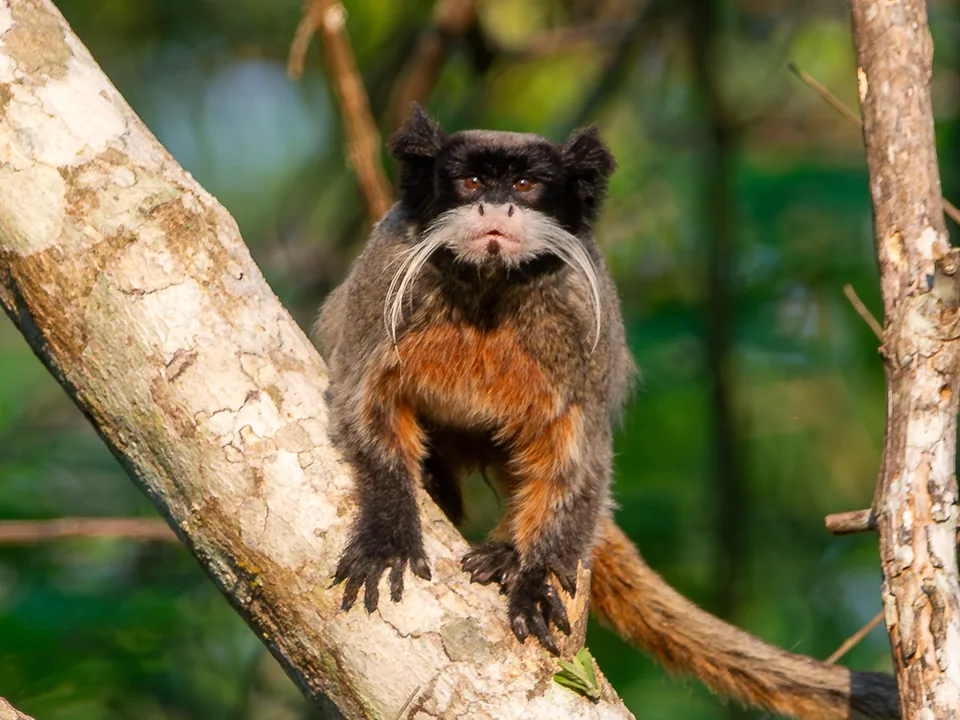
A white moustache extends past the shoulders, with a dark face, grey-yellow body and reddish-brown tail. Most digits carry claw-like nails for clinging; the great toe has a flat nail. [1]
Low body mass, clinging claws and leaping enable use of fine branches; vocal communication and group cooperation support foraging, predator detection and infant care. [1,2]
Behaviour and ecology
Diurnal and arboreal, usually living in groups of about 2–8, occasionally larger. It may form mixed-species foraging associations with other tamarins, exchanging calls and coordinating movement. [1]
Diet
Feeds on fruit, insects, spiders, flowers, nectar and tree exudates, sometimes taking lizards, tree frogs or bird eggs. Low body mass allows access to fine outer branches. [1]
Reproduction and life cycle
Gestation lasts about 140–145 days and twins are typical. Males and other group members carry infants and return them to the mother for nursing; weaning occurs at about 2–3 months. [1]
Ecosystem role
By hunting insects and eating fruit, it helps regulate invertebrates and disperse seeds in Amazonian forests. [1; ecological interpretation]
Threats & conservation
IUCN lists the species as LC, although forest loss and fragmentation remain local pressures. CITES Appendix II regulates trade; LC does not establish lawful or welfare-compatible supply. [1,3,4]
Reviewed 19 September 2026: IUCN displays LC; Saguinus imperator falls within the Primates spp. listing in CITES Appendix II. Population, origin and country-level law still require transaction-specific checks.5 sourced facts
Species in five facts
The common name refers to a moustache likened to that of Emperor Wilhelm II. [1]
A litter most often contains twins. [1]
Males and helpers perform much of the infant carrying. [1]
The long tail aids balance but cannot grasp branches. [1]
The species may coordinate foraging with saddle-back tamarins. [1]
Sources
[1] Animal Diversity Web — Saguinus imperator[2] GBIF — Saguinus imperator[3] IUCN Red List species search[4] CITES Appendices effective 5 March 2026[Ảnh] iNaturalist observation 317412935 — CC0