
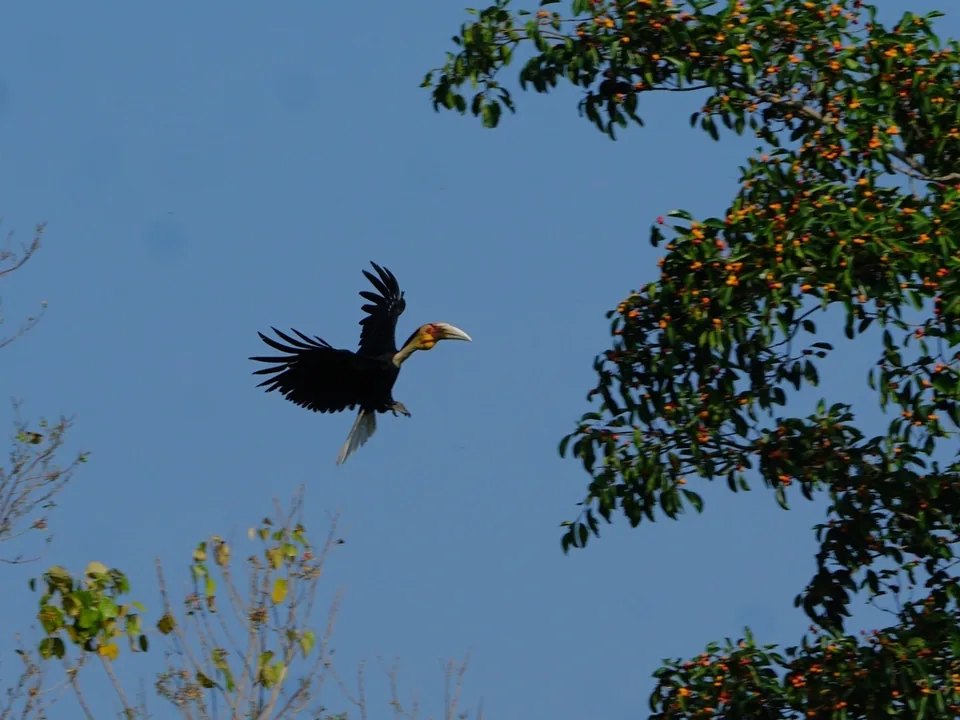
Its range extends from north-eastern India and Bhutan through mainland Southeast Asia to Sumatra, Borneo, Java and nearby islands. It uses lowland evergreen and montane forest but depends on large cavity-bearing trees for breeding. [1,2]
Body length is commonly about 75–85 cm; the bill and casque make the head appear heavier than it is. Males are generally larger than females, but measurements should be tied to sex, age and population. [1,2]
Both sexes have a pale bill and a casque marked by multiple wreath-like ridges. Males show a rufous head and neck with a yellow throat pouch; females are mainly black with a blue pouch. Ridge count is not an exact age measure. [2]
The long bill reaches fruit on fine branch tips without placing the whole body there; a strong neck and fused cervical vertebrae support the bill. The throat pouch can carry multiple fruits to the nest cavity. [2]
Behaviour and ecology
Canopy-dwelling, often seen in pairs or small groups and sometimes in large gatherings at abundant fruit crops. Flapping interspersed with gliding produces audible wingbeats, while calls maintain contact in dense forest. [1,2]
Diet
Ripe fruit dominates the diet, especially figs and many large-seeded fruits, with small animals taken opportunistically. Managed diets require balance; a monotonous supply of sweet fruit cannot reproduce the diversity of forest foods. [2]
Reproduction and life cycle
The female enters a tree cavity and seals most of the entrance, leaving a slit through which the male passes food. She incubates a small clutch and remains inside through much of early chick rearing, making old cavity trees indispensable. [2]
Ecosystem role
After swallowing fruit, birds move seeds over long distances and deposit them away from the parent tree. This maintains forest connectivity and helps regenerate large-seeded trees that smaller dispersers cannot readily handle. [1,2]
Threats & conservation
Forest loss and fragmentation, removal of nest trees and hunting are primary pressures. Managed care needs flight space, canopy structure, foraging opportunities, compatible social partners and continuous origin and permit records; captive birds do not reduce the priority of forest protection. [1–3]
Reviewed 24 September 2026: BirdLife/IUCN records VU with a declining trend; Rhyticeros undulatus is in CITES Appendix II. Appendix II regulates international trade but does not establish the legal origin of a particular specimen.5 sourced facts
Species in five facts
Its English name refers to the transverse ridges on the casque. [2]
The female seals herself into the nest cavity and receives food through a narrow slit. [2]
Males have a yellow throat pouch, whereas females have a blue one. [2]
The species can carry seeds between widely separated forest patches. [1,2]
Old cavity-bearing trees are a breeding resource that cannot be replaced quickly. [2]
Sources
[1] BirdLife DataZone — Wreathed Hornbill[2] IUCN SSC Hornbill Specialist Group — Wreathed Hornbill[3] CITES Appendices effective 5 March 2026[Ảnh] iNaturalist observation 203555050 — Focus Saranpat Ouilapan, CC BY