
Occurs globally in tropical and warm oceans, from coasts, reefs and lagoons to the open sea. Seasonal aggregations often track plankton blooms, fish eggs or the spawning of other marine life. [1–4]
NOAA records length to about 12.2 m, while many observed animals are considerably smaller. Maximum mass estimates vary among sources, so this profile does not present one record weight as typical. [1]
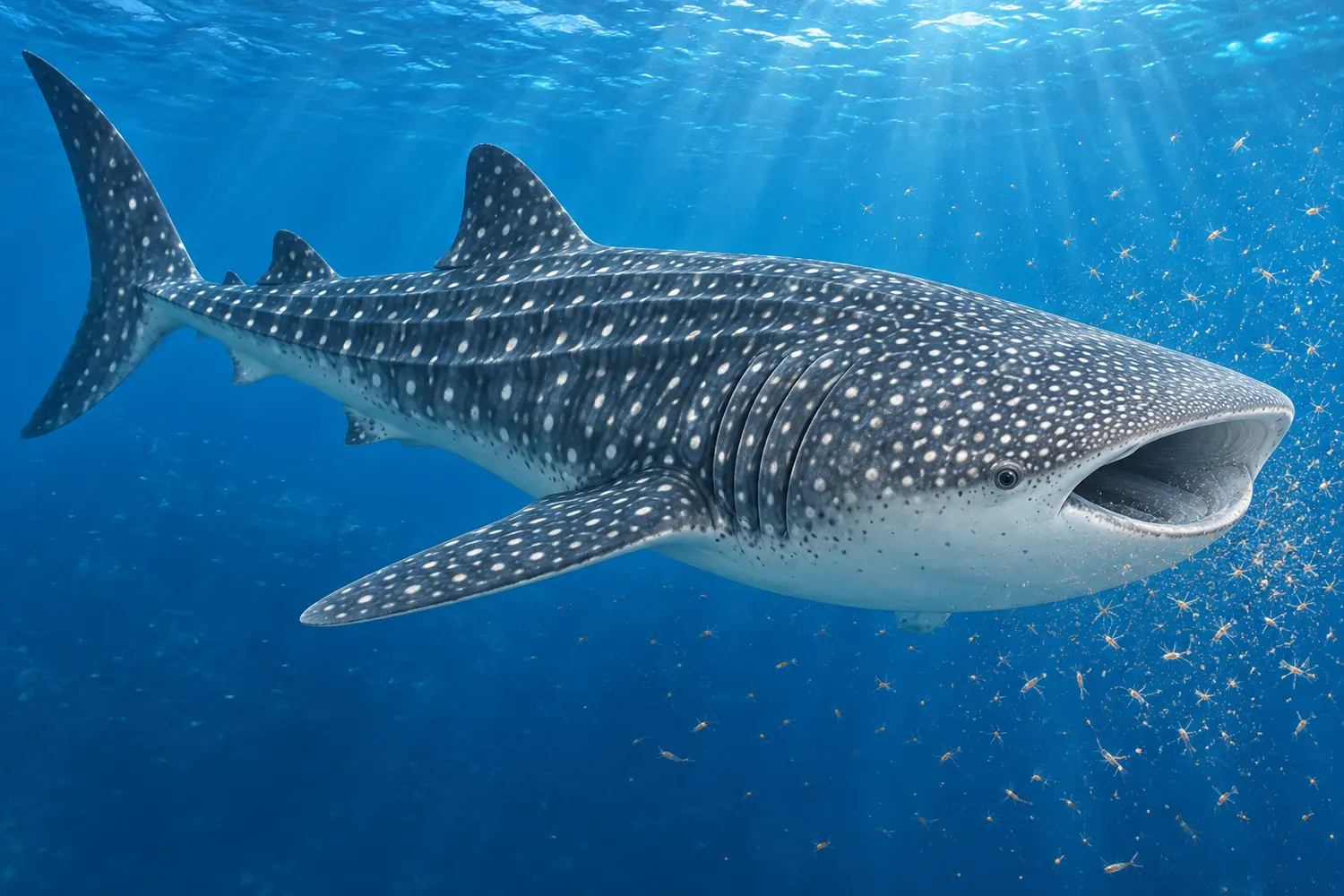
A broad flat head, terminal mouth, five large gill slits, three longitudinal ridges on each side and pale spots with transverse bars on a dark body identify the species. No two individuals have exactly the same pattern. [1,2]
A wide mouth, gill filter pads and suction mechanisms collect large quantities of tiny prey. Individually unique patterns support photographic identification without invasive tagging. [1–3]
Behaviour and ecology
Often swims slowly near the surface while feeding but can dive deeply and travel long distances. It may ram-filter while moving or suction-feed at dense prey patches; aggregations do not imply stable year-round social groups. [2–4]
Diet
Filters zooplankton, fish eggs, small fishes and small squid through specialised gill structures. Enormous size does not mean hunting large prey; rows of tiny teeth are not the primary feeding tool. [1–3]
Reproduction and life cycle
Ovoviviparous, with embryos hatching inside the mother and live young being born. One female carried hundreds of embryos at different stages, but wild birthing grounds, cycles and reproductive frequency remain poorly understood. [2–4]
Ecosystem role
By tracking productive waters and linking habitats during migration, whale sharks indicate plankton and fish-spawn hotspots. Conservation must cover both aggregation sites and oceanic corridors. [2–4]
Threats & conservation
Historic targeted fisheries, bycatch, vessel strikes, pollution and poorly managed tourism create risks, while late maturity slows recovery. Vessel speed and approach distance require control, and touching, riding or provisioning must be prohibited. [3–5]
Reviewed 29 September 2026: IUCN lists the species as Endangered (EN) in its 2016 assessment; CITES has included it in Appendix II since 2003. Conservation and CITES status do not replace fisheries rules, marine protected areas, specimen transport requirements or national law.5 sourced facts
Species in five facts
The whale shark is the largest living fish. [1,2]
NOAA records length to about 12.2 m. [1]
Spot-stripe patterns can identify individual animals. [2,3]
It is a filter-feeding shark, not a whale. [1,2]
CITES has regulated the species under Appendix II since 2003. [5]
Sources
[1] NOAA Fisheries — Shark identification: Rhincodon typus[2] Australian Museum — Whale shark[3] IUCN Red List species search[4] CMS Sharks MOU — Whale shark[5] CITES Appendices effective 5 March 2026