
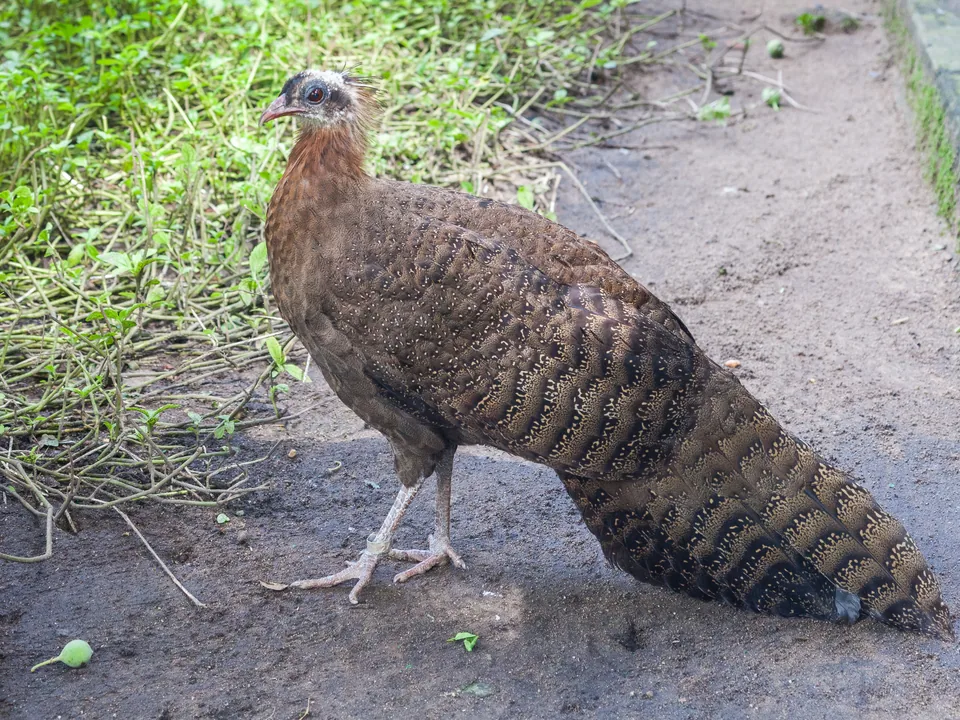
Recorded in primary evergreen and humid montane forests of Vietnam and Laos, chiefly along the Annamite range. The surviving range is fragmented; sensitive locality detail should not be published when it could facilitate collection. [1,2]
Females are roughly three-quarters of a metre long; males can approach 1.9 m including the train, whose central feathers have been reported at about 1.73 m. Mass is only around 1.5 kg, showing that most of the extraordinary length is ornamental feathering. [1]
Dark brown and buff plumage carries many small ocelli, with a heavy pink bill, blue orbital skin and two crests. Adult males have a very long, laterally compressed train; females have much shorter tails and more conspicuous dorsal patterning. [1]
Ocellated brown plumage breaks up the body outline in leaf litter, while strong legs support scratching for food. The male train is a costly display signal, and broad wings allow escape into trees when threatened. [1]
Behaviour and ecology
Secretive on the forest floor and more often detected by voice than sight. Males use display courts, erecting the crest, vibrating feathers and spreading the train; birds roost in trees and are stronger fliers than their terrestrial appearance suggests. [1]
Diet
An omnivorous forest-floor feeder taking fruit, seeds, shoots, young leaves, fungi, invertebrates and occasionally small vertebrates. Field evidence remains limited, so observed food lists should not be converted into fixed dietary proportions. [1]
Reproduction and life cycle
Wild data are sparse. Compiled accounts describe a ground nest and a clutch of only 1–2 large eggs, producing relatively developed chicks. Care roles and incubation length should be tied to a cited population rather than inferred from other pheasants. [1]
Ecosystem role
Eating fruit, fungi, seeds and small animals links the forest floor with seed movement and invertebrate regulation. Protecting the species also retains humid montane forest for many other Annamite endemics. [1,2]
Threats & conservation
Widespread wire snaring, hunting and forest loss or fragmentation are major pressures. CR and Appendix-I status demand an in-situ priority; any managed individual requires documented origin, correct species identification and a permit pathway confirmed by authorities. [1–3]
Reviewed 23 September 2026: BirdLife/IUCN records CR; Rheinardia ocellata is in CITES Appendix I. Older literature often combined the Malayan crested argus with this species; modern records should separate R. nigrescens and not transfer data between them without verification.5 sourced facts
Species in five facts
The male's central train feathers rank among the longest feathers of any wild bird. [1]
It is now separated from the Malayan crested argus, Rheinardia nigrescens. [1,2]
The bird has two crests and can erect the rear crest during alarm or display. [1]
A clutch of only about one or two eggs limits natural recovery speed. [1]
Most modern records come from Vietnam and Laos along the Annamite range. [1,2]
Sources
[1] BirdLife DataZone — Vietnamese Crested Argus[2] IUCN Red List species search[3] CITES Appendices effective 5 March 2026[Ảnh] Diego Delso / Wikimedia Commons — CC BY-SA 3.0