
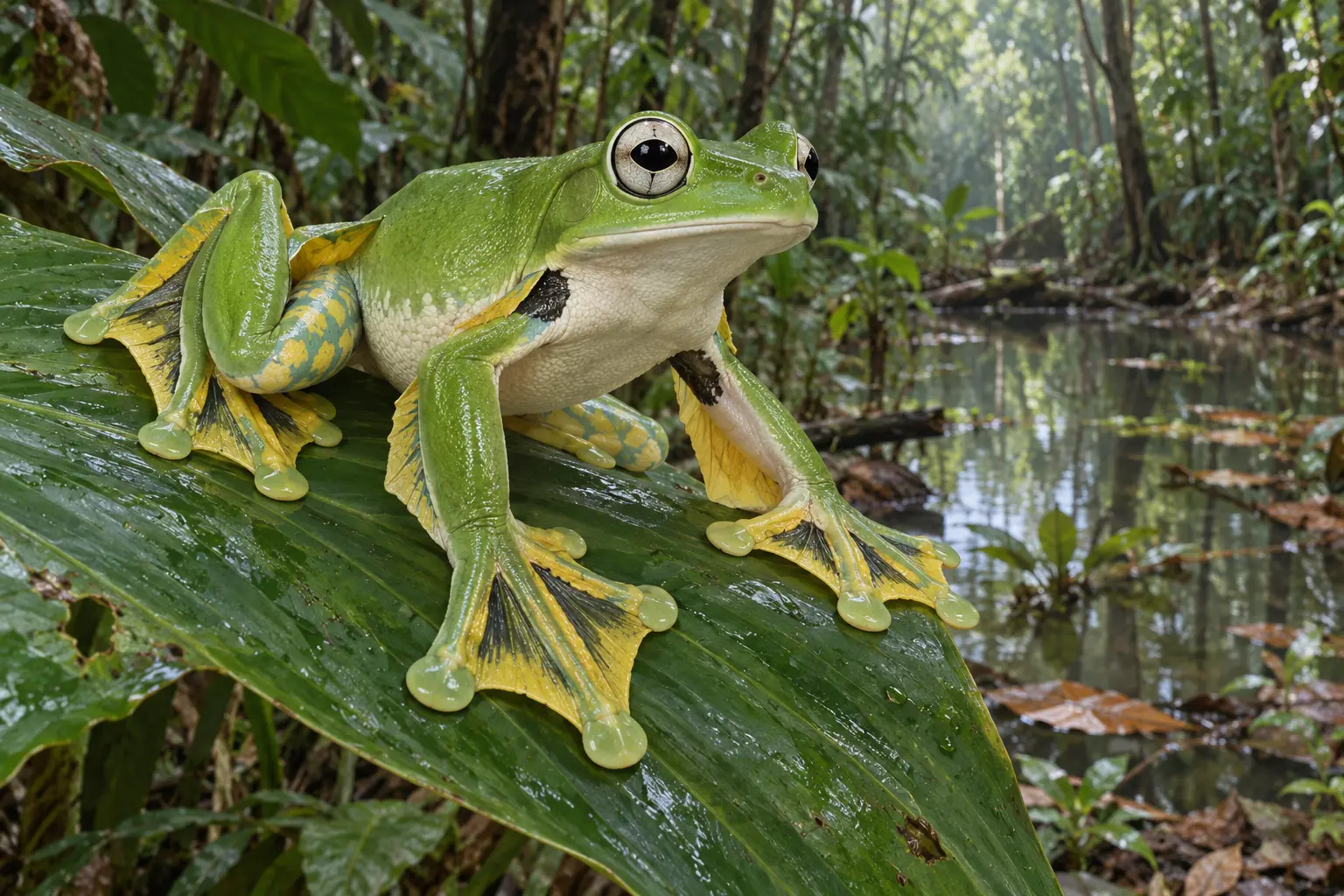
Described from Nui Ong Nature Reserve, Binh Thuan, and fragmented lowland forest at Tan Phu, Dong Nai; later surveys added populations in Dong Nai and Ba Ria–Vung Tau. Known sites are lowland monsoon forests in southern Vietnam, with a narrow, fragmented range. [1–3]
The original description reports male snout–vent length of 72.3–85.5 mm and females 89.4–90.7 mm. This is body length excluding extended limbs; the small sample from a rare species means observed limits may shift with more data. [1]
Green dorsum and head, white belly, extensive hand and foot webbing, and large toe discs combine with pale bluish-green thighs marbled yellow, a dark axillary patch and conspicuous white sclera. Identification should combine colour, webbing, skin fringes and calls because several green Rhacophorus look similar. [1–3]
Extensive webbing, skin fringes along the limbs and a flattened spread posture increase surface area, slowing descent and aiding direction changes between branches. Toe discs grip wet surfaces, while foam nests keep eggs moist above ground yet connect larvae to the pond below. [1,3]
Behaviour and ecology
Largely arboreal and nocturnal, gripping leaves and branches with expanded toe discs. On long leaps it spreads limbs and webbing for controlled gliding rather than powered flight. Research recorded five call types with complex tonal and pulsed structure, supporting nocturnal species identification. [2,3]
Diet
Species-specific diet data remain limited; adults are regarded as arboreal predators of invertebrates such as insects and spiders, while tadpoles are pond-dwelling. Prey lists or husbandry diets from another Rhacophorus should not be assigned to R. helenae without evidence. [2,3]
Reproduction and life cycle
Spawning was observed in May. Small unpigmented eggs are embedded in foam nests suspended high above temporary ponds; developing larvae drop into the water and continue as tadpoles. The study describes pond-dwelling larvae and newly metamorphosed juveniles with different colour and less-developed webbing than adults. [3]
Ecosystem role
Adults consume invertebrates in lower canopy layers, while eggs and tadpoles feed aquatic and forest predators. Because the life cycle spans trees and temporary ponds, the species can indicate continuity among canopy, seasonal hydrology and buffer-zone quality. [2,3]
Threats & conservation
Loss and fragmentation of lowland forest, agriculture, infrastructure, pollution and altered temporary ponds can remove different parts of the life cycle. A narrow range makes each local project proportionally important. Do not collect, move or publish sensitive locality data; surveys should disinfect equipment to reduce amphibian pathogen transfer. [2–4]
Reviewed 1 October 2026: IUCN lists the species as Endangered (EN) in its 2014 assessment. Rhacophorus helenae was not located in the CITES Appendices effective 5 March 2026; absence is not collection or trade permission, and Vietnamese species, forest, quarantine and other national rules still apply. [2–5]5 sourced facts
Species in five facts
The species was scientifically described in 2012 from southern Vietnam. [1,2]
Females in the original description were larger than males in body length. [1]
Foam nests hang in trees above temporary ponds, linking two habitat layers. [3]
Researchers recorded five call types rather than one simple advertisement call. [3]
It was not located in the 5 March 2026 CITES Appendices, while IUCN lists it as Endangered. [4,5]
Sources
[1] Journal of Herpetology — Original description of Rhacophorus helenae[2] AMNH Amphibian Species of the World — Rhacophorus helenae[3] Zootaxa — Larval morphology, reproduction and vocal repertoire[4] IUCN Red List 2014 assessment — Rhacophorus helenae[5] CITES Appendices effective 5 March 2026