
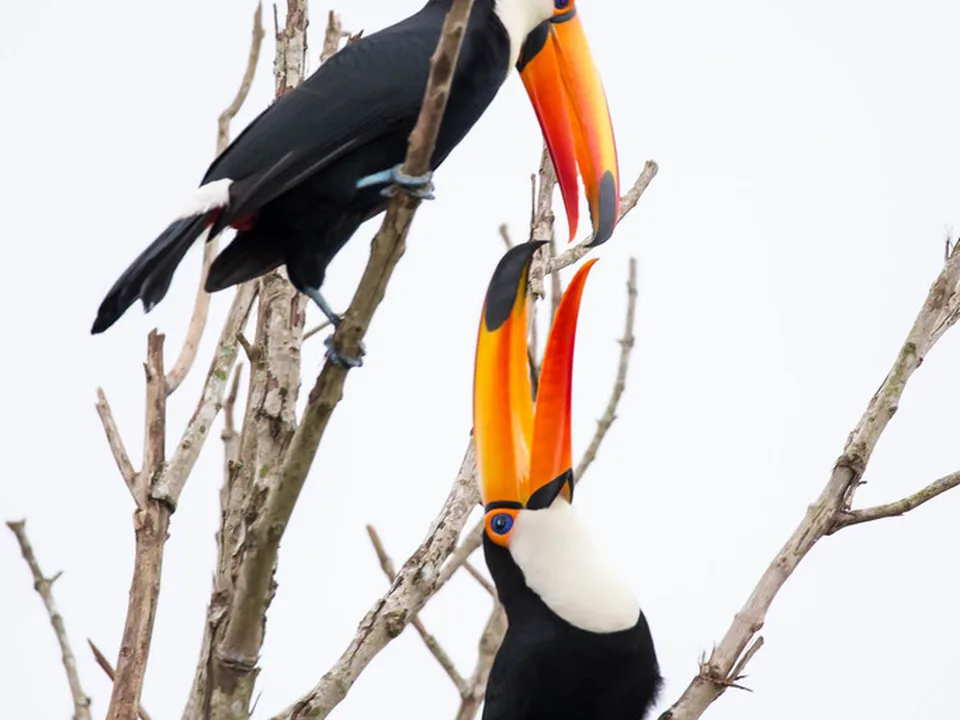
Widely distributed across central and eastern South America, including much of Brazil, Bolivia, Paraguay, northern Argentina and adjacent regions; uses savanna, woodland, gallery forest, edges and farmed landscapes retaining trees. [1,2]
About 55–65 cm long and commonly 500–860 g; the bill is roughly 15–20 cm yet its lightweight internal structure limits the load. [1,2]
Black body, white throat and chest, red undertail, blue orbital skin and an orange-yellow bill with black tip. Its conspicuous bill is not a solid mass. [1,2]
The bill combines an outer keratin shell with an internal bony trabecular network, producing a light yet resilient structure; changing blood flow through it dissipates body heat. [3]
Behaviour and ecology
Diurnal, often in pairs or small groups, moving between trees with alternating flaps and glides. It reaches fruit, tosses food and adjusts foraging position with the bill. [1,2]
Diet
Predominantly frugivorous, but also takes insects, small animals, eggs and nestlings opportunistically. It therefore functions as both seed disperser and nest predator. [1,2]
Reproduction and life cycle
Nests in natural tree cavities or holes made by other species, commonly laying 2–4 eggs. Both parents incubate and tend naked, blind and fully dependent chicks. [1,2]
Ecosystem role
By swallowing and transporting seeds it supports plant regeneration, while predation on eggs, nestlings and small animals also shapes edge-habitat food webs. [1,2]
Threats & conservation
IUCN lists the species as LC and it tolerates some modified habitats, but hunting, trade and loss of cavity trees may cause local declines. CITES Appendix II regulates international trade. [1,4]
Reviewed 19 September 2026: BirdLife/IUCN records LC; the official CITES species page records Ramphastos toco in Appendix II since 11 June 1992. Current transaction-specific import and export rules still require verification.5 sourced facts
Species in five facts
It is the largest member of the toucan family. [1,2]
The oversized bill functions as an adjustable heat exchanger. [3]
The bill remains light through a hollow, trabecular internal structure. [3]
Toucans are not purely frugivorous; they also take eggs and small animals. [1,2]
Chicks have specialised heel pads while resting on the cavity floor. [2]
Sources
[1] BirdLife DataZone — Toco Toucan[2] San Diego Zoo Wildlife Alliance — Toucans[3] Science — Heat exchange from the toucan bill[4] CITES species gallery — Toco toucan[Ảnh] iNaturalist observation 59738495 — Diogo Luiz, CC BY