
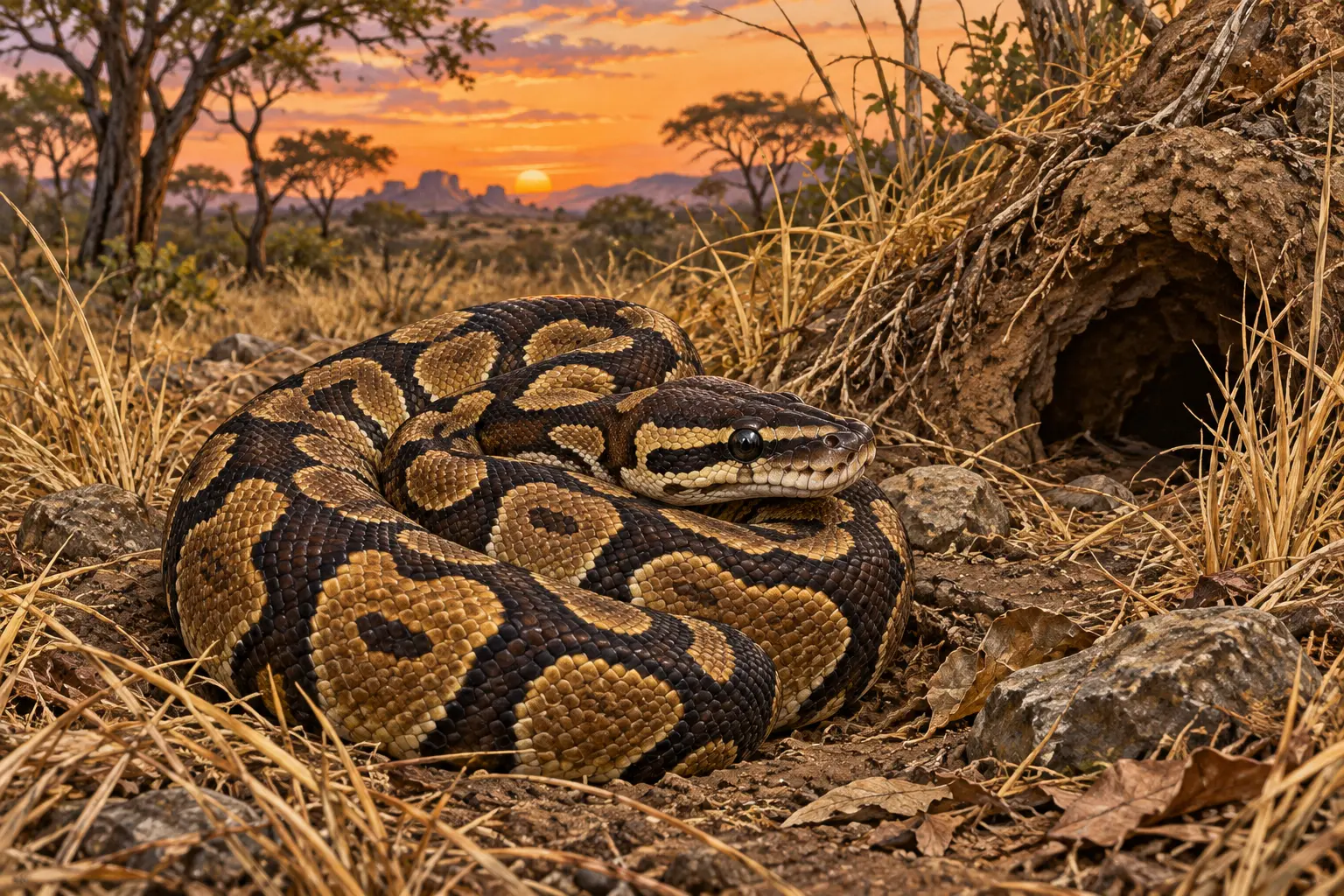
Distributed from West through Central Africa, with records extending to South Sudan and Uganda in the IUCN assessment. Habitats include grassland, savanna, scrub, woodland, forest edge and farmland with refuges; it is not exclusively a high-canopy rainforest snake. [1,2]
Adults are commonly about 1–1.5 m long; females are generally larger than males and exceptional animals may be longer. The body is robust and the head relatively small; length alone cannot determine sex or age. [2]
Wild-type animals are dark brown-black with irregular golden-brown blotches, a pale eye stripe and heat-sensitive pits along the lips. Captive morphs may alter colour and pattern dramatically but remain Python regius when identification and pedigree are sound. [2,3]
Heat-sensitive pits help detect warm prey in low light, while flexible jaw bones and ligaments allow prey to be swallowed whole. Balling protects the head and the pattern breaks up the body's outline among soil, grass and litter. [2]
Behaviour and ecology
Mainly crepuscular-nocturnal, it ambushes prey from burrows, litter or travel routes. When threatened it often coils tightly around the head rather than striking; this ball posture is defensive, not evidence that the animal is relaxed. [2]
Diet
Takes small vertebrates, especially rodents and birds depending on age, sex and locality. Curved teeth secure prey before constriction causes circulatory arrest; managed feeding should follow body condition rather than a rigid calendar. [1,2]
Reproduction and life cycle
Oviparous; the female coils around the clutch and may guard and regulate its microclimate. Animal Diversity Web summarises 1–11 eggs, averaging about seven, with hatching near two months; biological variation matters more than maximising output. [1,2]
Ecosystem role
It preys on rodents and small birds and is itself taken by raptors, mammals and larger snakes. Use of burrows dug by other animals links the python to refuge networks and rodent populations across savanna-farmland mosaics. [1,2]
Threats & conservation
Collection for pets, skins and local consumption, together with habitat change, creates pressure; IUCN notes that harvest may be unsustainable in some places. Captive-bred stock requires pedigree, legal records and morph-welfare review; a 'captive-bred' label does not prove legality by itself. [1,4]
Reviewed 27 September 2026: IUCN's 2022 amended assessment records NT, based on an assessment completed in 2020; older material may still show LC from 2010. CITES Appendix II regulates international trade. A 'morph' is a captive colour-pattern form, not a separate taxon or conservation status. [1–4]5 sourced facts
Species in five facts
The name 'ball python' comes from its tight head-protecting defensive coil. [2]
Females are generally larger than males. [2]
Pits along the lips detect thermal radiation from prey. [2]
Females coil around their eggs during incubation. [1,2]
A morph is a colour-pattern form, not a separate species. [3]
Sources
[1] IUCN Red List — Python regius (2022 amended assessment)[2] Animal Diversity Web — Python regius[3] The Reptile Database — Python regius[4] CITES Appendices effective 5 March 2026