
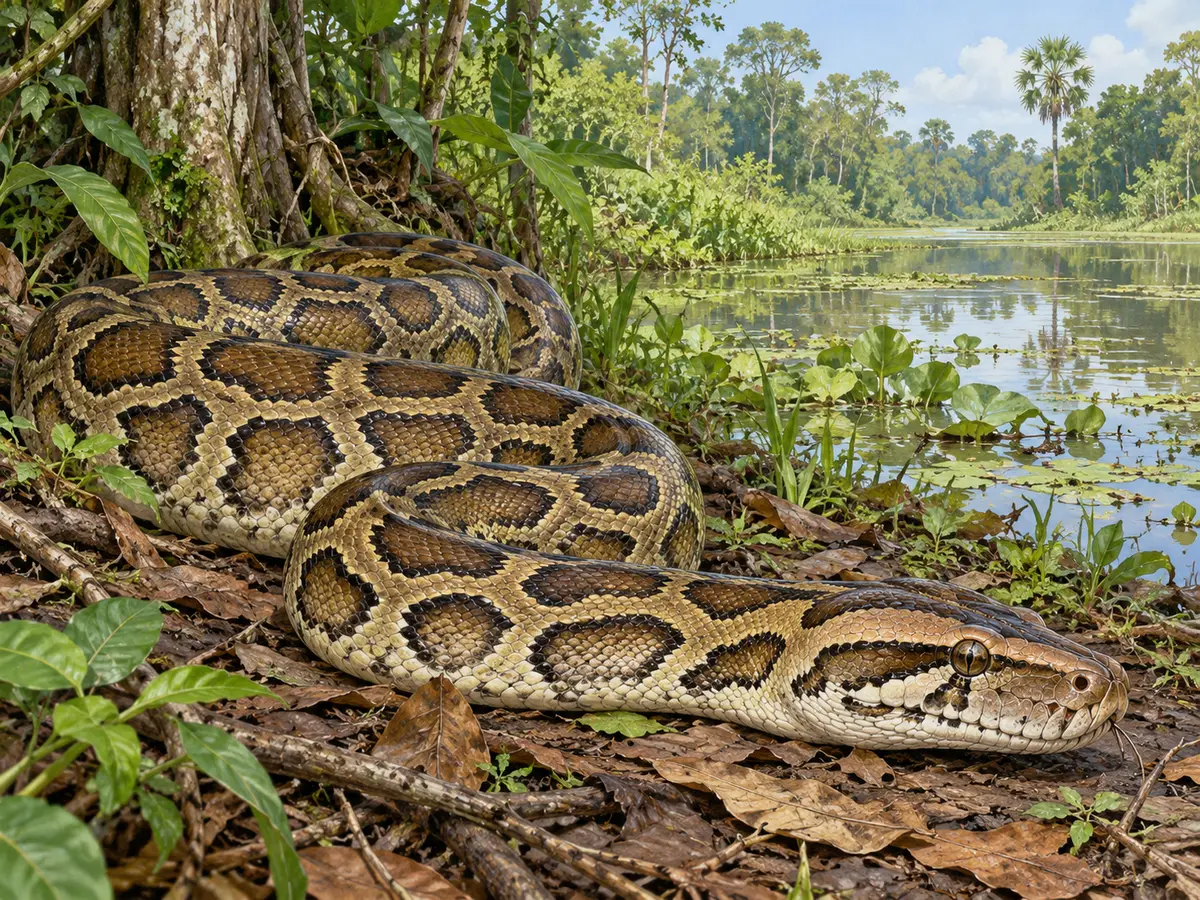
Native from north-eastern India and southern China through Myanmar, Thailand, Laos, Cambodia, Vietnam and the Malay Peninsula to parts of Indonesia. It uses forest, grassland, marsh and river margins and is often water-associated; Florida is a human-mediated invasive range. [1,3]
Smithsonian reports adults commonly around 3–4.9 m, with females larger than males; exceptional individuals may exceed this range. Record length should not be used as an enclosure minimum or body-condition target. [1]
Heavy-bodied, tan-yellow with dark-brown rectangular saddle blotches edged in black; the head bears a dark spear shape and eye stripe. Captive albino colour does not represent the wild type and cannot alone confirm identity. [1,2]
Labial pits detect thermal radiation, the forked tongue delivers scent particles to the vomeronasal organ, and an elongated right lung performs most gas exchange. Powerful trunk muscles support constriction and swimming. [1,2]
Behaviour and ecology
An ambush predator on the ground or near water, a strong swimmer, with juveniles climbing more readily than large adults. Backward-curved teeth hold prey before constriction; the snake does not crush bones but disrupts circulation and breathing. [1,2]
Diet
Eats birds, mammals and sometimes reptiles, with prey size increasing with body size. Mobile jaw joints and extensible skin allow large meals; the jaws do not actually dislocate. [1,2]
Reproduction and life cycle
Oviparous; the female coils around the clutch and shivers to generate heat when cool. Smithsonian reports usually 30–60 eggs, occasionally around 100, roughly two months of incubation and maturity at about 4–5 years. [1]
Ecosystem role
In its native range it is a large predator of varied birds and mammals and may itself be prey when young. In Florida, high densities cause unusual impacts on native mammal communities; those effects should not be projected back onto its natural Asian role. [1,3]
Threats & conservation
Habitat loss, harvest for skins or food and the pet trade contribute to native decline. Captive animals must never be released; facilities need escape-proof housing, two-person procedures for large individuals, Appendix-II traceability and incident plans. [3–5]
IUCN lists the Burmese python as Vulnerable (VU) and decreasing in its native range; invasive Florida populations are a separate issue and do not represent native conservation status. The species is in CITES Appendix II; managed origin, trade and transport still require traceability, permits, quarantine and invasive-species law checks. [1,3–5]5 sourced facts
Species in five facts
It is a nonvenomous constrictor, not a venomous snake. [1,2]
Females can shiver to warm their egg clutch. [1]
Pits along the mouth detect thermal radiation from prey. [1]
The species has two lungs, but the left is very small. [1]
It is native to Asia but invasive in southern Florida. [3]
Sources
[1] Smithsonian's National Zoo — Burmese Python[2] Florida Museum — Burmese Python[3] U.S. Fish & Wildlife Service — Managing Burmese Pythons[4] IUCN Red List search — Python bivittatus[5] CITES Appendices effective 5 March 2026