
Native from the Indian subcontinent through southern China and Southeast Asia, including Vietnam. It occupies forest edges, scrub, gardens, parks, farmland and cities; introduced populations are established on many islands and in other tropical regions. [1–3]
About 20 cm long, slim-bodied, with a fairly long white-tipped tail. The erect crest makes the bird appear taller but does not indicate body mass or condition. [2,3]
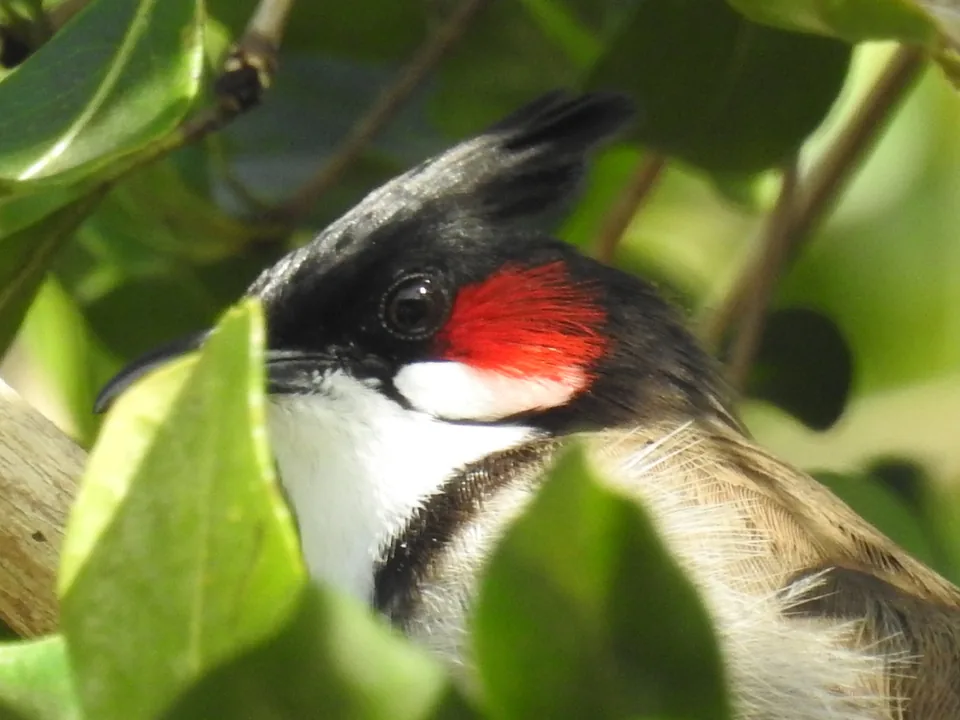
The crest and nape are black, cheek and throat white, ear patch red, back brown, belly white and vent red. The sexes are similar; colour or apparent size in a photograph should not be used alone for sexing. [2,3]
A slender but robust bill handles both soft fruit and insects, while perching feet grip fine branches. Broad diet and tolerance of modified habitat help it live near people and establish in new regions. [2,3]
Behaviour and ecology
Often in pairs or small groups, perching conspicuously and giving clear calls. It moves flexibly between low canopy and ground, defends nesting areas, yet may gather at heavily fruiting trees. [2,3]
Diet
Takes fruit, berries, nectar and many small invertebrates. Fruit use makes it a seed disperser, but in introduced ranges it can also spread alien plants or affect crops. [2,3]
Reproduction and life cycle
Builds a cup nest from twigs, roots and plant fibres in shrubs or low trees and commonly lays 2–3 eggs. A Xishuangbanna study recorded breeding from February to early August, but that local calendar should not be applied across the species. [2,5]
Ecosystem role
In its native range the bulbul disperses seeds and consumes insects, while eggs, young and adults feed predators. In introduced ranges these same interactions can alter ecological communities. [1–3]
Threats & conservation
The species is adaptable and currently LC, but songbird trapping, loss of wooded patches and undocumented trade remain local risks. Movement outside its native range also requires invasive-risk and quarantine assessment. [1,4]
BirdLife/IUCN lists the species as Least Concern (LC). Pycnonotus jocosus was not located in the CITES Appendices effective 5 March 2026; this is not permission to trap or trade and does not replace wild-bird, quarantine or invasive-species law. [1,4]5 sourced facts
Species in five facts
The red patch behind the eye gives the English name “red-whiskered”. [2,3]
The sexes have very similar plumage. [2]
It eats both fruit and insects. [2,3]
Introduced populations are established beyond native Asia. [1,3]
The nest is an open cup rather than a tree cavity. [2,5]
Sources
[1] BirdLife DataZone — Red-whiskered Bulbul[2] Cornell Birds of the World — Red-whiskered Bulbul[3] eBird — Red-whiskered Bulbul[4] CITES Appendices effective 5 March 2026[5] Li et al. 2015 — breeding biologyPhoto record — Sam Kieschnick, iNaturalist 20046942, CC BY