
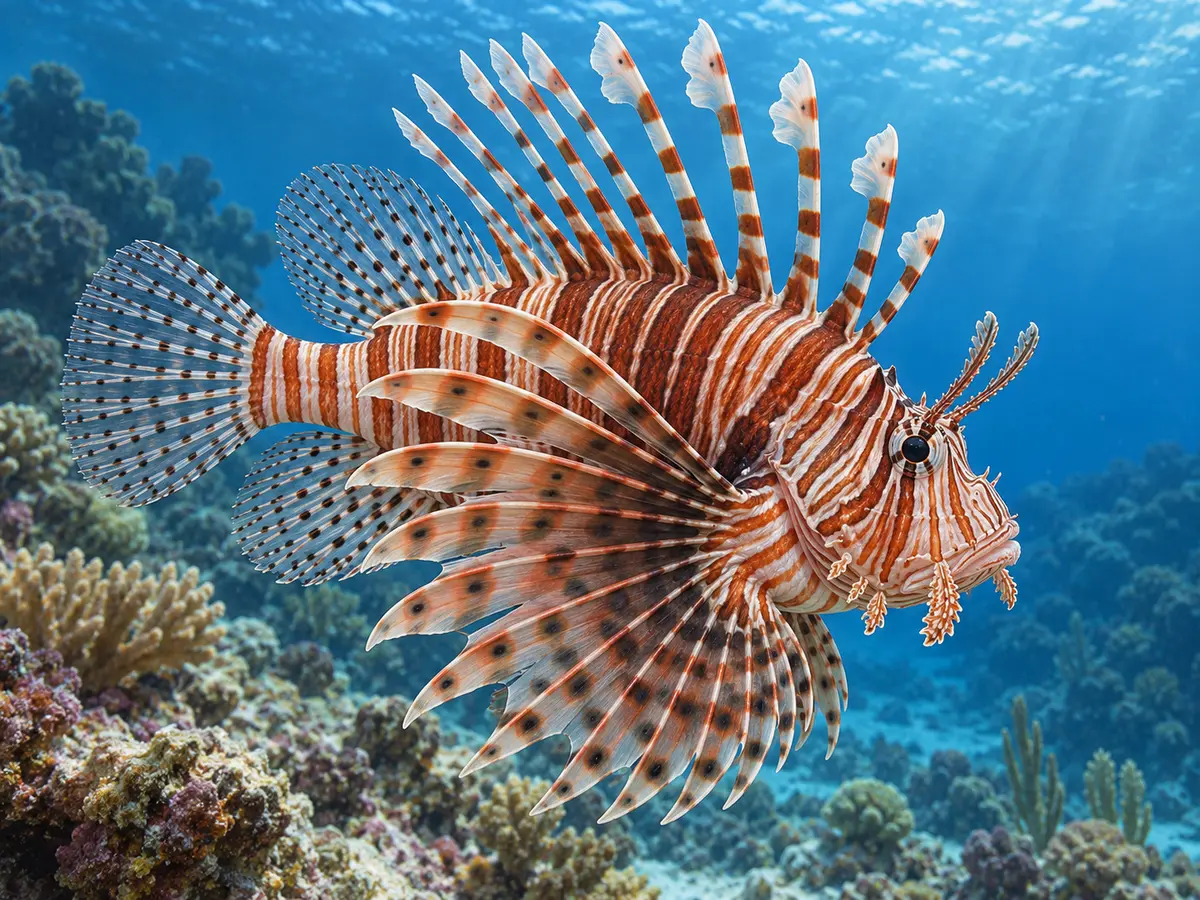
Native across the Indo-Pacific from western Australia and Malaysia through Micronesia to Polynesia, north to Japan–Korea and south toward New Zealand. It is established as a non-native species in the western Atlantic, Caribbean and Gulf of Mexico, using coral and rocky reefs, wrecks and even estuaries. [1–3]
NOAA notes adults may reach about 46 cm; Florida Museum gives a conservative maximum of roughly 30–38 cm, while a NOAA Gulf of Mexico study measured fish to 44.4 cm and 1.153 kg. Size varies by region and sampling method. [1,2,4]
The head and body carry red-brown and white bands, with fleshy tentacles above the eyes and below the mouth and very broad separated pectoral rays. NOAA records 13 dorsal spines, 10–11 dorsal soft rays, three anal spines and 6–7 anal soft rays; separating it from Pterois miles requires fin-ray characters and expertise. [1]
Large pectoral fins corral prey and enlarge the visual profile; bands and tentacles disrupt the outline against reef structure. Venom is delivered through dorsal, anal and pelvic spines, causing severe pain and systemic effects; it is defensive, not injected by teeth. [1,2]
Behaviour and ecology
Often shelters beneath ledges or in caves and crevices by day and hunts more actively at dusk or night, although daytime feeding occurs. It spreads the pectoral fins to corral prey, then engulfs it with a rapid strike; it is usually solitary but may aggregate where prey is abundant. [2]
Diet
A generalist predator of small fishes, shrimp, crabs and other crustaceans, swallowing prey whole. In invaded waters it consumes juveniles of ecologically and commercially important fishes, including snappers and groupers. [2,3]
Reproduction and life cycle
Fertilisation is external; females release floating gelatinous egg masses and larvae live planktonically before settlement. NOAA data from invaded waters show females may spawn every three to four days and release more than two million eggs per year, contributing to rapid spread. [2,5]
Ecosystem role
In its native range lionfish is part of reef food webs. At high densities in invaded waters it can reduce juvenile reef fishes, compete with native predators and indirectly alter algae–coral balance by consuming herbivorous fishes. [2,3]
Threats & conservation
The species is not globally threatened, but invasive potential is a major operational hazard. DinoJura must never release fish or aquarium water, and needs closed systems, escape prevention, venom-response protocols, trained handling and location-specific import and invasive-species checks. [1–5]
FishBase, using IUCN version 2025-2, reports the 2015 global assessment as Least Concern (LC). Pterois volitans was not located in the CITES Appendices of 5 March 2026; that does not waive invasive-species, aquatic import, veterinary, venom-safety or national rules. [1–5]5 sourced facts
Species in five facts
NOAA reports adults may reach about 46 cm. [1]
NOAA records 13 venom-bearing dorsal spines. [1]
Invasive females may spawn every three to four days. [5]
A mature female may release more than two million eggs per year. [5]
Lionfish were recorded to 234 m during a NOAA survey. [1]
Sources
[1] NOAA National Ocean Service — What is a lionfish?[2] Florida Museum of Natural History — Red lionfish[3] U.S. Geological Survey — Lionfish biology and spread[4] NOAA repository — Flower Garden Banks life history study[5] NOAA — Invasive lionfish reproductive biologyIUCN status via FishBase v2025-2CITES Appendices effective 5 March 2026