
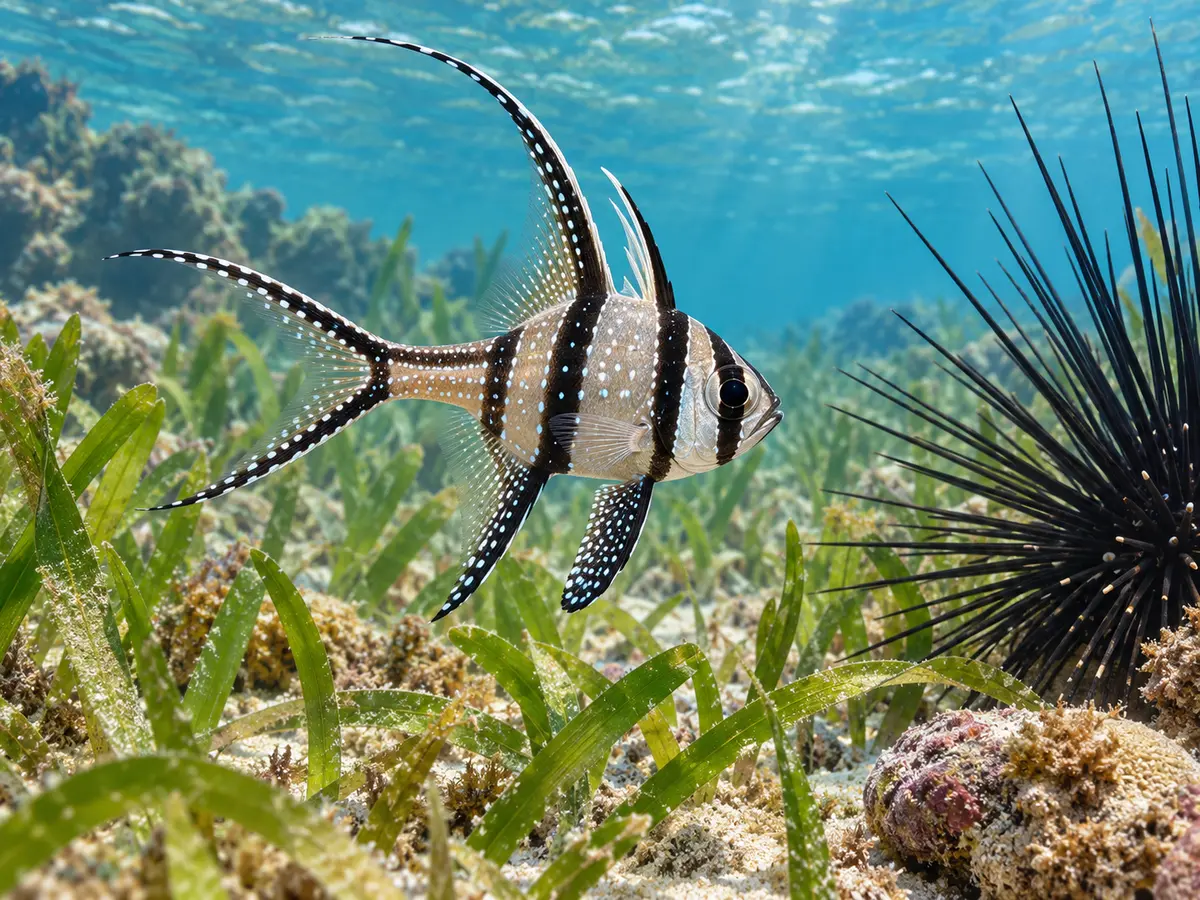
The native distribution is restricted to the Banggai Archipelago, with some introduced populations linked to the ornamental trade. It occupies shallow calm water in coral reefs, seagrass beds, submerged roots and around shelter such as long-spined sea urchins. [1,3,4]
NOAA gives a maximum total length near 3.4 inches (8.6 cm) and mass up to about 11 g. Lifespan is usually 2.5–3 years and may reach 5 years; these species-level figures are not aquarium stocking or growth targets. [1]
A silver body carries three vertical black bars and white spots across body and fins; the first dorsal is tall and tasseled, second dorsal and anal rays are elongated, and the tail deeply forked. Dot patterns differ among individuals and can support monitoring. [1]
Contrasting bars disrupt the outline among urchin spines and reef structure, while long fins aid hovering in calm water. Mouth-brooding protects embryos, and direct development bypasses a widely dispersing pelagic larval phase. [1,3]
Behaviour and ecology
Unlike many nocturnal cardinalfishes, it often hovers in small daytime groups close to shelter and moves little. Juveniles depend strongly on refuge structure; site fidelity means local harvest can deplete a site without rapid replenishment. [1,3,4]
Diet
Feeds primarily on copepods and other planktonic organisms when abundant; juveniles also take small microcrustaceans. In care, prey size, feeding frequency, water quality and competition must be monitored rather than assuming any food substitutes for natural plankton. [1,2]
Reproduction and life cycle
After mating, the male holds and hatches eggs in his mouth, releasing fully formed juveniles, making paternal care conspicuous. Broods are small relative to many broadcast-spawning marine fishes, contributing to slow recovery after heavy harvest. [1,3,4]
Ecosystem role
It consumes microcrustaceans and plankton and is prey for larger fishes; refuge with sea urchins and corals ties its fate to healthy benthic structure. Loss of shelter can raise juvenile mortality even before broad water quality visibly changes. [1,3]
Threats & conservation
Ornamental harvest and reef destruction are the two main threats, while blast and cyanide fishing further damage habitat. DinoJura should prioritise documented captive lines, exclude unrecorded wild fish, screen disease and never release animals outside the native range. [1–5]
FishBase's IUCN 2025-2 cross-reference lists the species as Endangered (EN), assessed 1 March 2007; the age of that assessment matters. The species was proposed for CITES Appendix II but is absent from the Appendices effective 5 March 2026. Non-listing does not make harvest or trade lawful; NOAA has listed it as Threatened under the U.S. ESA since 2016. Reviewed 6 October 2026. [1–5]5 sourced facts
Species in five facts
The species is naturally endemic to Indonesia's Banggai Archipelago. [1]
NOAA reports a maximum total length near 8.6 cm. [1]
Spot patterns can differ among individual fish. [1]
Males mouth-brood eggs and release formed juveniles. [1]
IUCN lists Endangered from an assessment dated 1 March 2007. [2]
Sources
[1] NOAA Fisheries — Banggai Cardinalfish[2] FishBase — Pterapogon kauderni[3] NOAA Fisheries — ESA status review[4] CITES Animals Committee — trade and conservation review[5] CITES Appendices effective 5 March 2026