
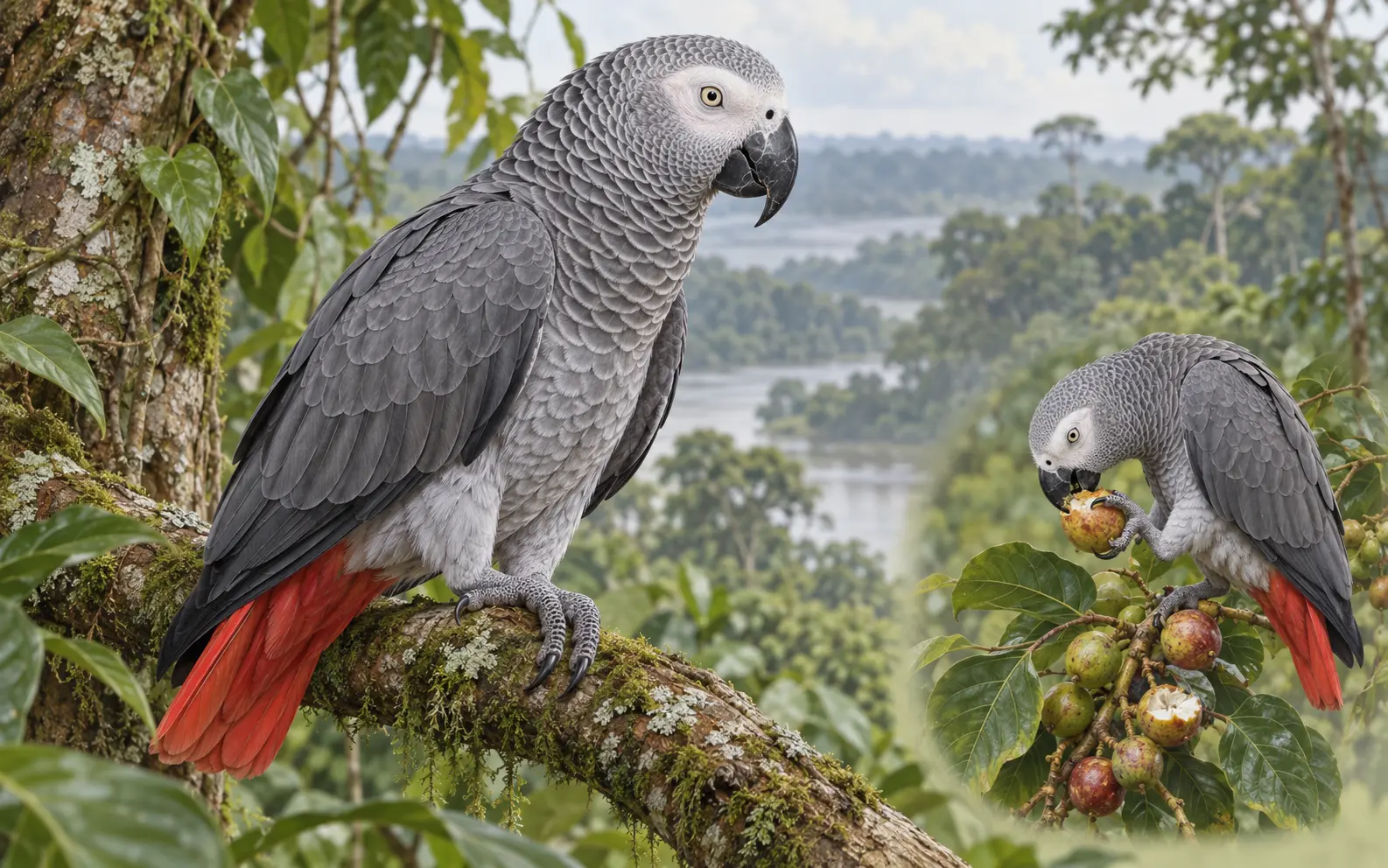
Patchily distributed through humid forests of West and Central Africa, using primary and secondary forest, edges and some farmed landscapes retaining large trees.
About 30–35 cm long, robust-bodied with broad wings; mass is typically several hundred grams and varies among individuals.
Grey body feathers with pale edging create a scalloped appearance, paired with a pale face, black bill and bright red tail. Do not confuse it with the separately recognised Timneh parrot, Psittacus timneh.
A powerful bill processes food and assists climbing; two-forward, two-back toes enable manipulation. A developed brain and social learning support flexible problem-solving.
Behaviour and ecology
Highly social, using varied calls and often foraging, travelling or roosting in groups. Human-speech mimicry reflects vocal learning, not proof that every repeated word is understood.
Diet
Feeds on seeds, fruit, nuts and plant material; wild birds may forage in canopies and visit mineral-rich ground. Captive diets require variety and should not rely on fatty seed mixes.
Reproduction and life cycle
Nests in cavities of large trees, lays a small clutch and provides prolonged parental care. Dependence on old trees means logging removes nesting opportunities.
Ecosystem role
By consuming fruit and seeds it may both destroy and disperse seeds, making it an important component of African forest ecological networks.
Threats & conservation
Declines are driven by forest loss and large-scale trapping for trade. IUCN lists the species as EN; its transfer to CITES Appendix I places strict limits on international commercial trade in wild specimens.
IUCN/CITES status was checked on the profile date; re-verify before any legal or transaction decision.5 sourced facts
Species in five facts
The Timneh parrot is now treated as a separate species, not a grey-parrot subspecies.
The contrasting red tail is a key adult field mark.
Communal roosting creates visible concentrations that are also vulnerable to trapping.
Mimicry arises from a sophisticated vocal-learning system.
Large cavity trees lost to logging cannot be quickly replaced.
Sources
BirdLife DataZone — Grey ParrotCITES — African grey parrotIUCN Red List search