
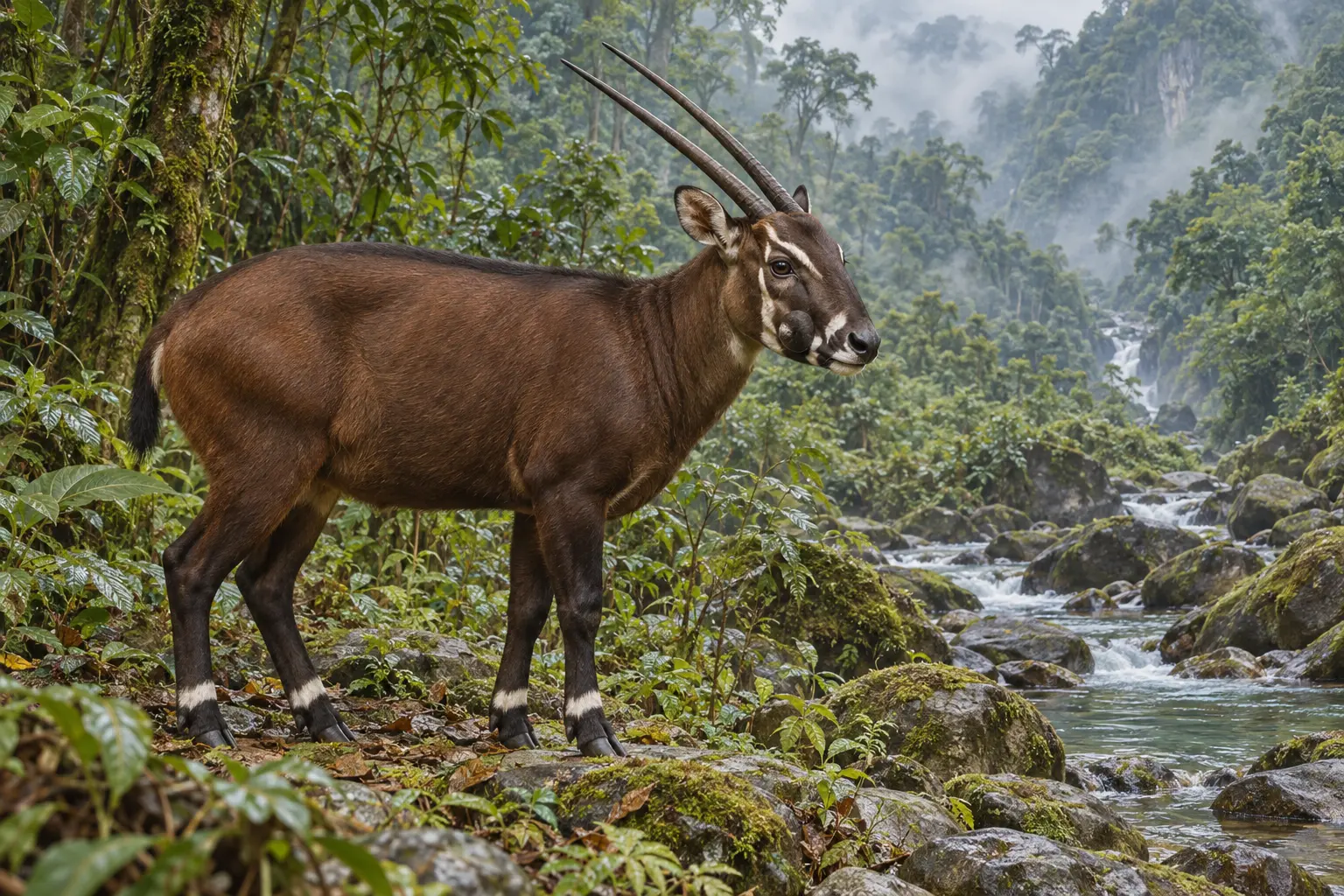
Known only from moist evergreen forest in the Annamite Range along the Viet Nam–Laos border. It is associated with steep forest, streams and dense understory; exact sensitive occurrence localities should not be publicised because of snaring risk. [1,2]
WWF reports roughly 80–100 kg in mass, about 85 cm at the shoulder and horns up to around 50 cm. Data come from very few specimens and observations and should not be treated as body-condition standards for living animals. [1]
Dark brown coat, striking white facial and eyebrow markings, a large dark muzzle with developed preorbital glands, white leg patches, and straight slender nearly parallel horns in both sexes. Presence must not be inferred from AI imagery or non-diagnostic tracks. [1,2]
Long straight horns and a compact body suit movement through forest understory, while large scent glands may support chemical communication. The precise adaptive meaning of many traits remains untested because observations are so scarce. [1,2]
Behaviour and ecology
Wild behaviour remains very poorly known. Records and descriptions suggest a secretive animal using dense forest near water, perhaps alone or in small groups; claims about territoriality or daily rhythm remain data-limited. [1,2]
Diet
Considered a browser taking leaves and shoots from shrubs and moist-forest vegetation. Detailed nutrition remains poorly studied, and cattle, goat or other antelope diets must not be transferred to saola. [1,2]
Reproduction and life cycle
Reproduction is almost unknown from the wild population; mating season, gestation and litter size cannot be presented as secure species facts. This absence of data is a scientific limitation, not permission to infer from relatives. [1,2]
Ecosystem role
As a large Annamite forest browser it likely influences plant regeneration and nutrient cycling and participates in prey networks. Its quantitative role is insufficiently studied and should be framed as a reasonable ecological inference, not a directly measured fact. [1,2]
Threats & conservation
Wire snares set for other wildlife are the gravest threat, compounded by habitat loss and fragmentation. Saola is not a sourcing target: any animal, part, sale offer or location information should be referred to authorities and conservation programmes, never entered into a transaction. [1–4]
Reviewed 4 October 2026: the Mammal Diversity Database links the current IUCN assessment as Critically Endangered (CR), and CITES lists the species in Appendix I. Population size is unknown; WWF states that at most a few hundred and possibly only a few dozen remain—an uncertain estimate, not a census. [1–4]5 sourced facts
Species in five facts
Saola became known to science only in 1992–1993. [1,2]
Both males and females carry nearly parallel horns. [1]
Its known natural range is confined to the Annamites of Viet Nam and Laos. [1–3]
Population size is unknown; circulated numbers are estimates rather than a census. [1]
IUCN lists CR and CITES places the species in Appendix I. [2–4]
Sources
[1] WWF — Saola[2] Mammal Diversity Database — Pseudoryx nghetinhensis[3] IUCN Red List — Pseudoryx nghetinhensis[4] CITES Appendices effective 5 March 2026