
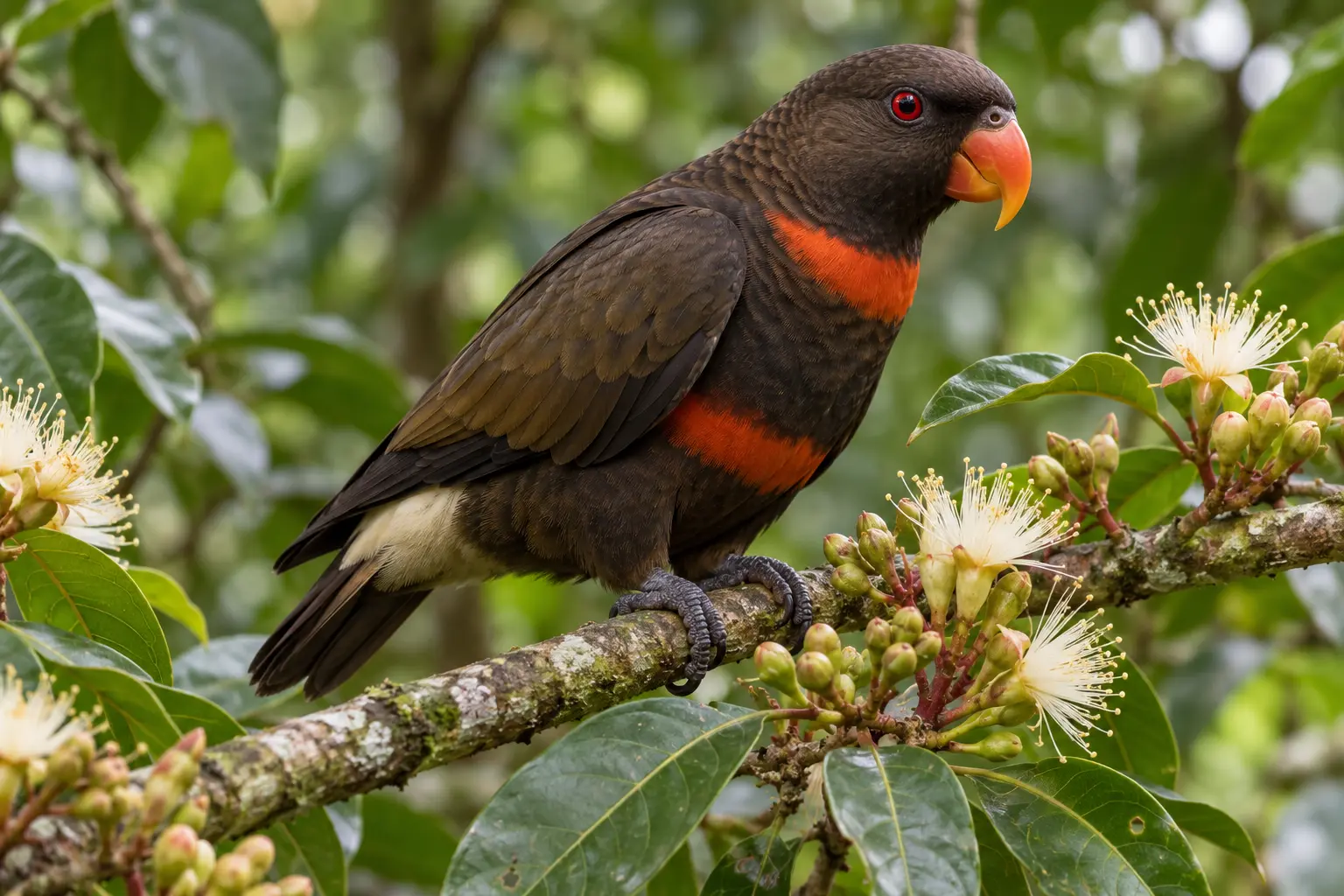
Occurs across most of New Guinea except the highest areas, and on Yapen and Salawati. Recorded from lowlands to about 2,400 m in humid forest edge, secondary growth, savanna, plantations and inhabited landscapes retaining flowering or fruiting trees. [1]
The World Parrot Trust reports a length of about 25 cm and mass of 140–190 g. These are species-level reference values, not body-condition standards for every sex, age or individual. [1]
Plumage is broadly dusty olive-brown, with a dull yellow crown, a yellow or orange-red fore-neck band and sometimes a second chest band; the belly follows the same colour phase, the rump is buff-white, the bill deep orange and the eye red. Both yellow and orange-red phases occur naturally. [1]
Brush-like papillae on the tongue gather nectar and pollen; two-forward, two-back toes grip branches and food. The strong bill assists climbing, opening fruit and manipulating plant material. [1]
Behaviour and ecology
Highly social, forming large noisy flocks and communal roosts that may number in the thousands. Shifting flowering resources make flocks locally nomadic rather than tied to one year-round feeding site. [1]
Diet
In the wild it takes nectar, fruit, probably pollen, and insects or pupae; coconut blossom and cultivated fruit are also recorded. Managed care requires a balanced lory diet, fresh food and strict hygiene because sugar-rich mixtures spoil rapidly. [1]
Reproduction and life cycle
Nests in cavities of tall trees; a typical clutch is two rounded eggs and managed-care records place fledging around ten weeks. Breeding is reported from November to August, although local timing varies with place and food supply. [1]
Ecosystem role
Movement among flowers can transfer pollen, while fruit feeding may disperse or destroy seeds depending on the plant. Lories also serve as prey within New Guinea canopy food webs. [1,2]
Threats & conservation
The species is not globally threatened and is reported as common, but habitat loss and undocumented capture can create local pressure. DinoJura should consider only correctly identified animals with lawful breeding evidence, chain of custody and required CITES documents. [1,2,4]
Reviewed 5 October 2026: the World Parrot Trust and BirdLife list the species as Least Concern (LC), while CITES places it in Appendix II. Some references retain Chalcopsitta fuscata; this profile follows Pseudeos fuscata in ITIS. Appendix II still requires transaction-level provenance, permits and national-law checks. [1–4]5 sourced facts
Species in five facts
The species has two natural colour phases: yellow and orange-red. [1]
Recorded length is about 25 cm. [1]
Communal roosts may contain thousands of birds. [1]
A typical clutch contains two eggs. [1]
International trade is controlled under CITES Appendix II. [1,4]
Sources
[1] World Parrot Trust — Dusky Lory[2] BirdLife DataZone — Pseudeos fuscata[3] ITIS — Pseudeos fuscata[4] CITES Appendices effective 5 March 2026