
Occurs in New Guinea, the Aru Islands, Cape York Peninsula and nearby islands; uses rainforest, monsoon forest, wooded savanna and areas retaining large hollow trees. [1,2]
About 49–68 cm long and roughly 0.5–1.1 kg in ADW’s synthesis; size varies by sex and population. [1]
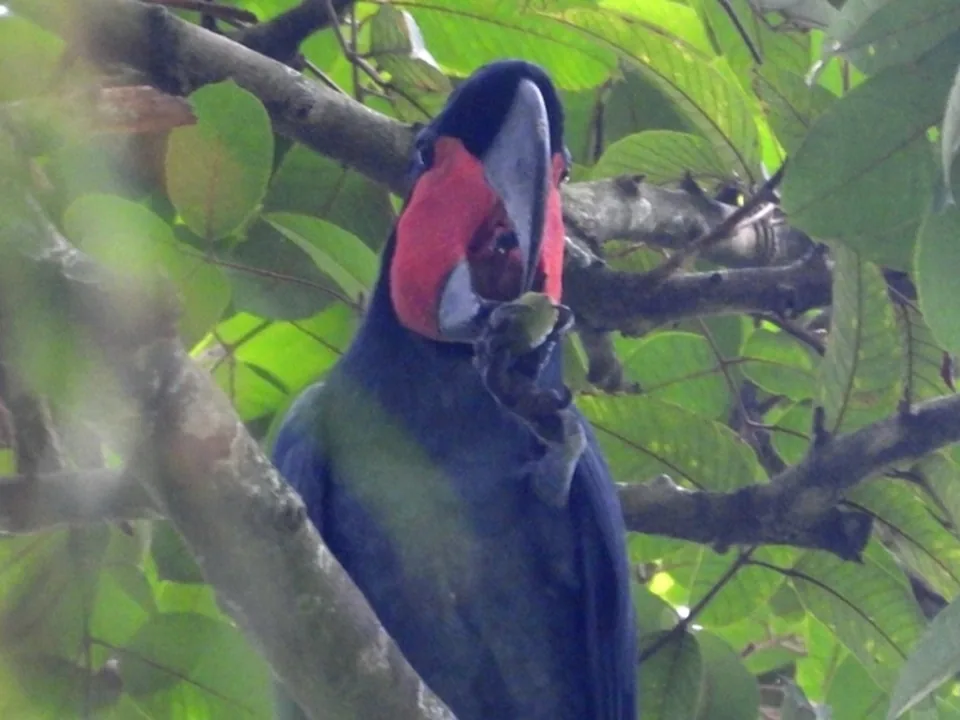
Grey-black plumage, an erectile crest, a very large upper bill and bare red cheek skin; the cheek patch can change with arousal and signalling. [1]
The large bill opens hard foods; zygodactyl feet hold food and climb; crest, cheek patch and drumming form a visual-acoustic signalling system. [1,2]
Behaviour and ecology
Usually alone, in pairs or small parties. Males may fashion a ‘drumstick’ from a branch and strike a hollow tree—a rare example of tool manufacture and use in birds. [1,2]
Diet
Feeds on seeds, nuts, fruit and leaf buds, with insects and larvae also recorded. The powerful bill processes hard foods. [1]
Reproduction and life cycle
Forms long-term pairs, nests in existing tree hollows and commonly lays a single egg. Incubation is summarised at about 30–33 days; fledging follows at roughly 100–110 days. [1]
Ecosystem role
Interacts with forest plants through fruit and seed feeding and may move some seeds, while depending on old hollow-bearing trees for breeding. [1; ecological interpretation]
Threats & conservation
Loss of large hollow-bearing trees and exploitation require locality-specific management. The species is in CITES Appendix I; lawful origin and permits must be verified directly. [2,3]
Reviewed 17 September 2026: indexed pages presented inconsistent global-conservation labels, so DinoJura does not assign an IUCN category here. Appendix I was cross-checked in the CITES Appendices effective 5 March 2026; competent authorities must confirm any transaction, and this page grants no trade entitlement.5 sourced facts
Species in five facts
Males may manufacture sticks and drum on tree trunks. [2]
A clutch commonly contains only one egg. [1]
ADW reports a nestling period of roughly 100–110 days. [1]
The red cheek patch is bare skin used in signalling. [1]
Breeding depends on hollows in large trees. [1,2]
Sources
[1] Animal Diversity Web — Probosciger aterrimus[2] BirdLife DataZone — Palm Cockatoo[3] CITES Appendices — effective 5 March 2026[Ảnh] iNaturalist observation 267307307 — Octavianti Shanna, CC BY