
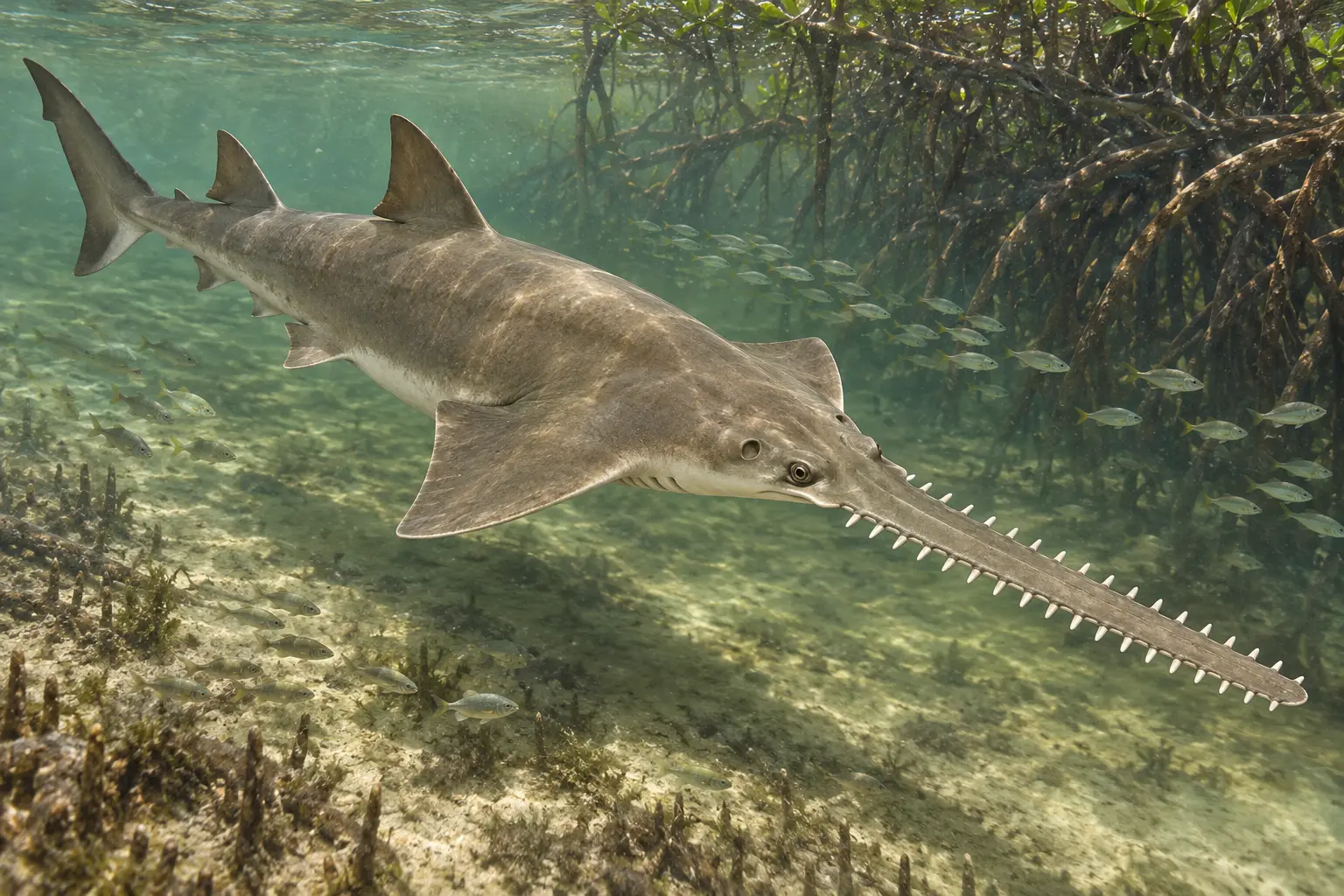
Historically circumtropical across the Atlantic, eastern Pacific and Indo-West Pacific. It is now extremely rare or absent through much of that range, with important remnants in Australia, Amazonia and parts of the Indo-Pacific. Young use shallow freshwater and estuaries; larger animals expand into coastal waters. [1,2]
NOAA records a maximum just over 7 m (705 cm), with newborns about 76–90 cm long. It is among the largest sawfishes, although modern observations are often smaller and historical size estimates may include measurement uncertainty. [1]
Brown above and white below, with a broad robust tapering rostrum bearing 14–24 evenly spaced teeth per side. The first dorsal fin begins well ahead of the pelvic origins and the tail has a distinct lower lobe. It is a ray: gill slits are ventral, unlike sawsharks with lateral gills and rostral barbels. [1]
Osmoregulation enables movement between fresh and salt water; the rostrum integrates mechanical and electrical sensing to find prey in turbid water. A flattened body and broad pectoral fins generate lift near the bottom, yet the saw becomes a liability in fishing gear. [1,2]
Behaviour and ecology
It sweeps the rostrum through fish schools to stun or impale prey and senses weak electric fields with electroreceptors. Individuals shift with age among shallow freshwater, estuaries and coastal sea; dams or estuary loss therefore sever a life-history pathway rather than merely shrinking one site. [1]
Diet
Feeds mainly on diverse fishes, with molluscs and crustaceans such as crabs and shrimp also recorded. Rostral teeth are not jaw teeth: prey is detected and struck with the ‘saw’ before being taken by the ventral mouth. There is no evidence that the species actively hunts people. [1]
Reproduction and life cycle
Fertilisation is internal and young are born live, nourished by yolk inside the mother. NOAA reports gestation believed to be about five months, females potentially breeding every other year, 1–13 pups per litter and maturity around 8–10 years near 3 m length. A pup's toothed rostrum is flexible and sheathed in gelatin at birth. [1]
Ecosystem role
A large predator linking rivers, estuaries, mangroves and coasts. Protecting shallow nursery areas, river flows and estuarine structure for sawfish also maintains nursery habitat for many other fishes and crustaceans. [1,2]
Threats & conservation
Entanglement in gillnets, trawls and hook gear is a leading threat; the rostrum tangles easily and animals are often retained or killed. Fin and rostrum use, dams, altered flows, pollution and mangrove loss compound slow reproduction. Appendix I and CR status rule out commercial sourcing; rescue requires authorities and elasmobranch specialists. [1–3]
Reviewed 1 October 2026: IUCN 2022 lists the species as Critically Endangered (CR), inferring a decline greater than 80% over three generations from exploitation, habitat degradation and range contraction; NOAA confirms CITES Appendix I. IUCN treats it as possibly extinct in Viet Nam, which is not a final national-survey declaration. [1–3]5 sourced facts
Species in five facts
Despite its shark-like body, a sawfish is a ray. [1]
Each side of the rostrum carries about 14–24 evenly spaced teeth. [1]
Pups are born with a complete saw that is temporarily soft-sheathed to protect the mother. [1]
The species can travel far upriver while larger individuals also use coastal marine water. [1,2]
IUCN 2022 lists it as Critically Endangered and CITES places it in Appendix I. [1–3]
Sources
[1] NOAA Fisheries — Largetooth sawfish[2] IUCN Red List 2022 assessment — Pristis pristis[3] CITES Appendices effective 5 March 2026