
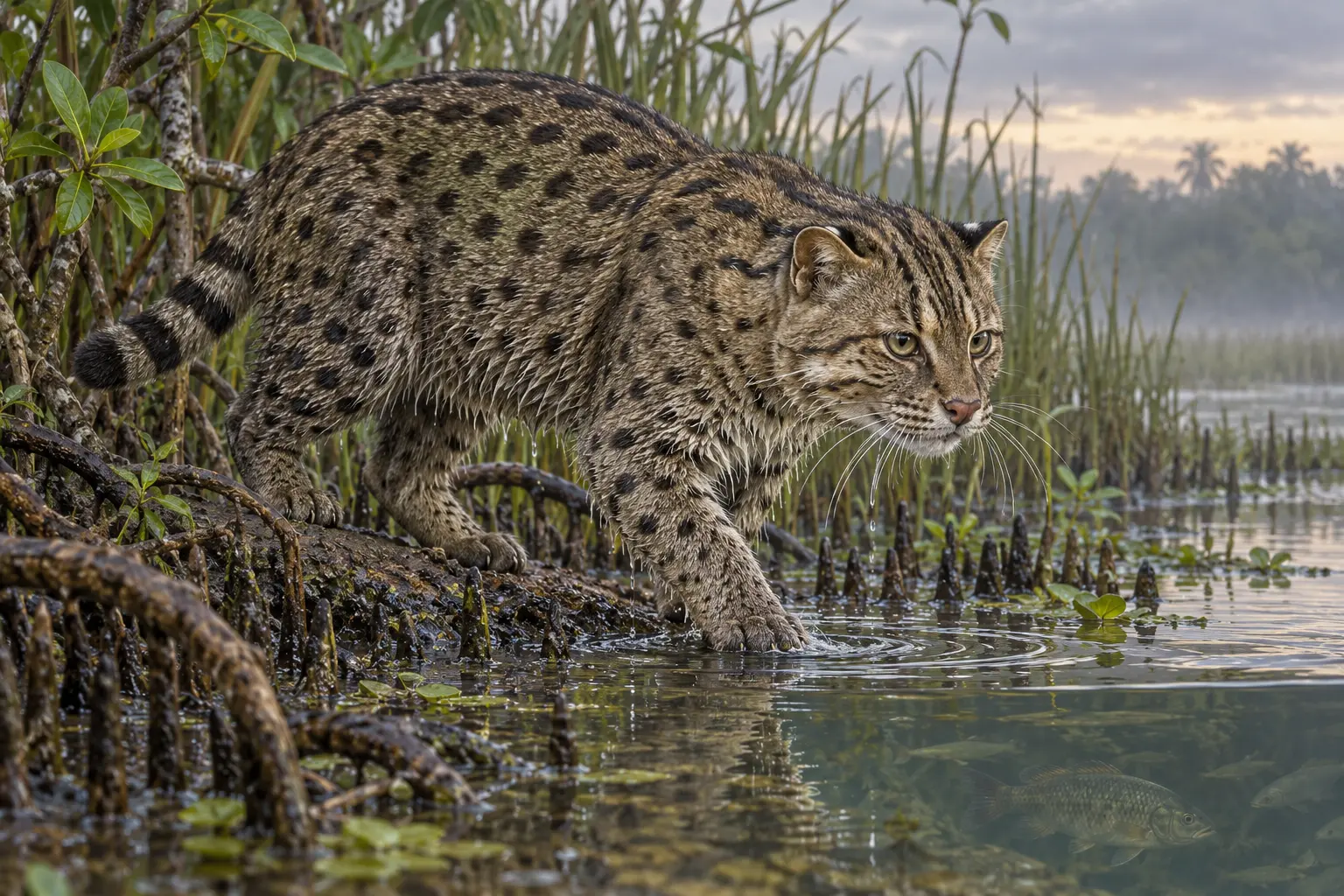
Patchily distributed from the Indian subcontinent through parts of Sri Lanka, Nepal and Bangladesh to mainland Southeast Asia, with many current boundaries uncertain. Core habitats include marshes, reed beds, mangroves, rivers and ponds with dense cover. [1,3,4]
Smithsonian reports body length around 85–115 cm and shoulder height near 40 cm; males commonly weigh about 8–14 kg and females 5–9 kg. These species ranges are guidance, not individual body-condition standards. [1]
A stocky body, broad head, small rounded ears with white rear spots, paired dark lines from forehead to neck and spots merging into dorsal stripes are characteristic. The relatively short tail is banded; tracks or poor images alone cannot exclude other small cats. [1,2]
Dense underfur insulates when wet, while some interdigital webbing and partly protruding claws assist movement and prey handling. This is a wetland adaptation suite, not evidence of a fully aquatic lifestyle. [1,2]
Behaviour and ecology
Largely solitary, scent-marking and often crepuscular or nocturnal, although activity varies by site and disturbance. It can wade, swim, stalk at the water's edge and use the forepaws at the surface when capturing prey. [1,2]
Diet
Takes fish, crustaceans, molluscs, frogs, reptiles, birds and small mammals, with composition varying by local prey. ‘Fishing cat’ does not mean every animal eats fish alone, and managed diets should not be copied from domestic cats. [1,2]
Reproduction and life cycle
Gestation is about 65 days and litters commonly contain 1–4 kittens; young depend on the mother for months before independence. Wild reproductive data remain limited, so managed-population figures should not define every population's seasonality. [1]
Ecosystem role
As a mid-to-upper wetland predator, the fishing cat links aquatic communities with the shore and can reflect habitat quality. Conserving it also protects mangroves, marshes and water resources used by people. [1,3]
Threats & conservation
Wetland drainage and conversion, pollution, prey loss, roads, trapping and retaliation in conflict are major pressures. Priorities are connected wetland habitat, safer fishing practices and lawful provenance; direct-contact promotion with wild cats is inappropriate. [1,3,4]
Reviewed 30 September 2026: the 2024 IUCN assessment lists the species as Vulnerable (VU); Felidae, including Prionailurus viverrinus, is in CITES Appendix II except for taxa listed in Appendix I. Population estimates remain uncertain and do not replace site-level surveys. [3–5]5 sourced facts
Species in five facts
Dense underfur helps insulate the skin when the cat enters water. [1]
Its diet spans many prey groups, not fish alone. [1,2]
Its tail is proportionally shorter than that of many other small cats. [1]
The 2024 IUCN assessment retains the species as Vulnerable. [3,4]
CITES regulates the species under Appendix II. [5]
Sources
[1] Smithsonian's National Zoo — Fishing cat[2] Smithsonian's National Zoo — Fishing cat facts[3] IUCN Red List — Prionailurus viverrinus[4] IUCN SSC Cat Specialist Group — Fishing cat[5] CITES Appendices effective 5 March 2026